
辅助绿色合成银纳米颗粒的潜在生物活性。
The potential biological activities of -aided green synthesis of silver nanoparticles.
作者信息
Abd Elghaffar Rasha Y, Emam Amany M, Taher Ehab S, Baz Mohamed M, Nayel Hamada, Abdeen Ahmed, El-Nablaway Mohammad, Alwutayd Khairiah M, Mihaela Ostan, Ioan Banatean-Dunea, Khattab Abeer A, Al-Serwi Rasha H, Sehim Amira E
机构信息
Department of Botany and Microbiology, Faculty of Science, Benha University, Benha, Egypt.
Department of Basic Medical and Dental Sciences, Faculty of Dentistry, Zarqa University, Zarqa, Jordan.
出版信息
Front Microbiol. 2024 May 20;15:1381302. doi: 10.3389/fmicb.2024.1381302. eCollection 2024.
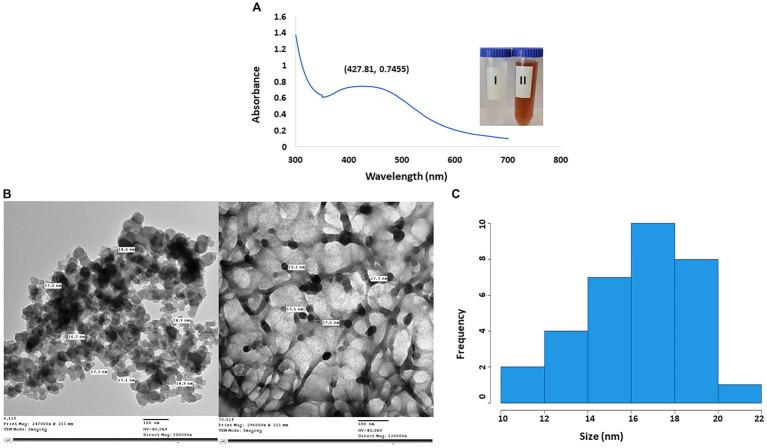
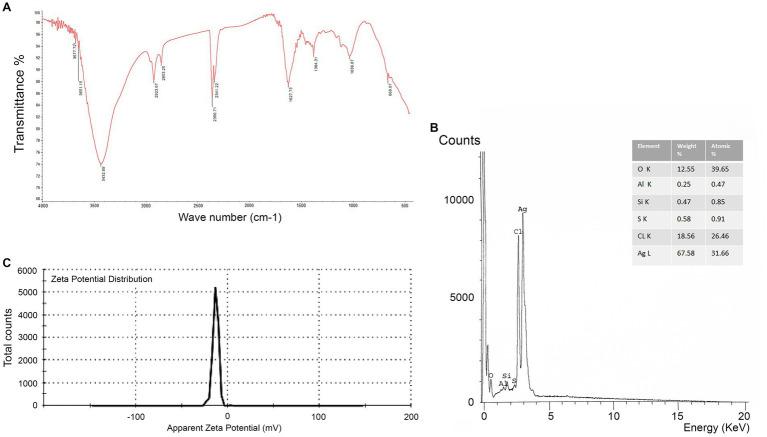
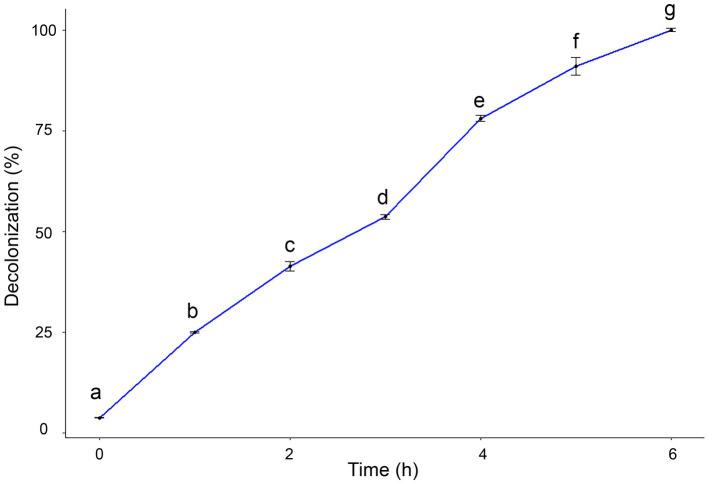
Biosynthetic metals have attracted global attention because of their safety, affordability, and environmental friendliness. As a consequence, the cell-free filtrate (CFF) of Dill leaf-derived endophytic fungus was employed for the extracellularly synthesis silver nanoparticles (AgNPs). A reddish-brown color shift confirmed that AgNPs were successfully produced. The obtained AgNPs were characterized by UV-Vis (ultraviolet-visible spectroscopy), Transmission electron microscopy (TEM), FTIR, EDX, and zeta potential. Results demonstrated the creation of crystalline AgNPs with a spherical shape at 427.81 nm in the UV-Vis spectrum, and size ranged from 16 to 18 nm as observed by TEM. Additionally, the biogenic AgNPs had a promising antibacterial activity versus multidrug-resistant bacteria, notably, , , and . The highest growth reduction was recorded in the case of . Furthermore, the biosynthesized AgNPs demonstrated potent antifungal potential versus a variety of harmful fungi. The maximum growth inhibition was evaluated from , followed by as compared to cell-free extract and AgNO. In addition, data revealed that AgNPs possess powerful antioxidant activity, and their ability to scavenge radicals increased from 33.0 to 85.1% with an increment in their concentration from 3.9 to 1,000 μg/mL. Furthermore, data showed that AgNPs displayed high catalytic activity of safranin under light irradiation. The maximum decolorization percentage (100%) was observed after 6 h. Besides, the biosynthesized AgNPs showed high insecticidal potential against 3 larval instar of . Taken together, data suggested that endophytic fungus, is an attractive candidate as an environmentally sustainable and friendly fungal nanofactory.
生物合成金属因其安全性、经济性和环境友好性而受到全球关注。因此,莳萝叶内生真菌的无细胞滤液被用于细胞外合成银纳米颗粒(AgNPs)。红棕色的颜色变化证实了AgNPs的成功制备。通过紫外可见光谱(UV-Vis)、透射电子显微镜(TEM)、傅里叶变换红外光谱(FTIR)、能量散射X射线光谱(EDX)和zeta电位对所得的AgNPs进行了表征。结果表明,在UV-Vis光谱中,427.81nm处形成了球形的结晶AgNPs,TEM观察其尺寸范围为16至18nm。此外,生物合成的AgNPs对多重耐药菌具有良好的抗菌活性,特别是 、 、 和 。在 的情况下记录到最高的生长抑制率。此外,生物合成的AgNPs对多种有害真菌显示出强大的抗真菌潜力。与无细胞提取物和硝酸银相比,从 评估出最大生长抑制率,其次是 。此外,数据显示AgNPs具有强大的抗氧化活性,随着其浓度从3.9增加到1000μg/mL,其清除自由基的能力从33.0%增加到85.1%。此外,数据表明AgNPs在光照下对番红具有高催化活性。6小时后观察到最大脱色率(100%)。此外,生物合成的AgNPs对 的3龄幼虫显示出高杀虫潜力。综上所述,数据表明内生真菌 作为一种环境可持续且友好的真菌纳米工厂是一个有吸引力的候选者。




 Zotero 插件