
一项针对 12-18 个月大孟加拉国儿童的基于肠道菌群的辅食干预措施可改善其线性生长。
A microbiota-directed complementary food intervention in 12-18-month-old Bangladeshi children improves linear growth.
机构信息
International Centre for Diarrhoeal Disease Research, Bangladesh (icddr,b), Dhaka, 1212, Bangladesh; Center for Child, Adolescent, and Maternal Health Research, Faculty of Medicine and Health Technology, Tampere University and Tampere University Hospital, Tampere, Finland.
Edison Family Center for Genome Sciences and Systems Biology, Washington University School of Medicine, St. Louis, MO, 63110, USA; The Newman Center for Gut Microbiome and Nutrition Research, Washington University School of Medicine, St. Louis, MO, 63110, USA; Department of Pathology and Immunology, Washington University School of Medicine, St. Louis, MO, 63110, USA.
出版信息
EBioMedicine. 2024 Jun;104:105166. doi: 10.1016/j.ebiom.2024.105166. Epub 2024 Jun 3.
BACKGROUND
Globally, stunting affects ∼150 million children under five, while wasting affects nearly 50 million. Current interventions have had limited effectiveness in ameliorating long-term sequelae of undernutrition including stunting, cognitive deficits and immune dysfunction. Disrupted development of the gut microbiota has been linked to the pathogenesis of undernutrition, providing potentially new treatment approaches.
METHODS
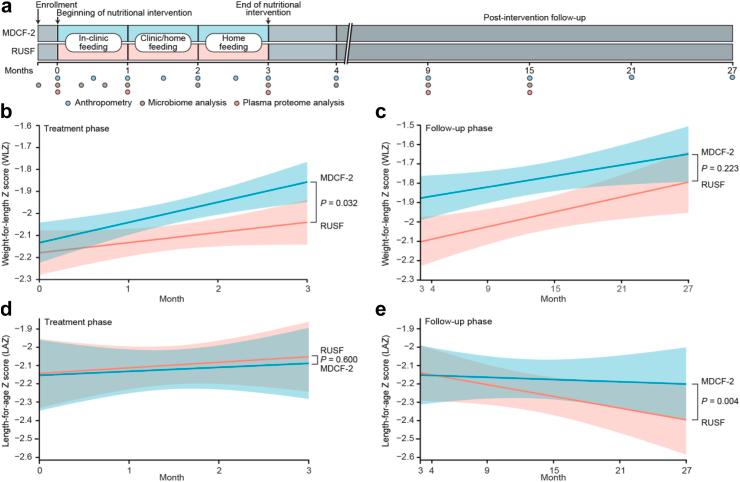
124 Bangladeshi children with moderate acute malnutrition (MAM) enrolled (at 12-18 months) in a previously reported 3-month RCT of a microbiota-directed complementary food (MDCF-2) were followed for two years. Weight and length were monitored by anthropometry, the abundances of bacterial strains were assessed by quantifying metagenome-assembled genomes (MAGs) in serially collected fecal samples and levels of growth-associated proteins were measured in plasma.
FINDINGS
Children who had received MDCF-2 were significantly less stunted during follow-up than those who received a standard ready-to-use supplementary food (RUSF) [linear mixed-effects model, β (95% CI) = 0.002 (0.001, 0.003); P = 0.004]. They also had elevated fecal abundances of Agathobacter faecis, Blautia massiliensis, Lachnospira and Dialister, plus increased levels of a group of 37 plasma proteins (linear model; FDR-adjusted P < 0.1), including IGF-1, neurotrophin receptor NTRK2 and multiple proteins linked to musculoskeletal and CNS development, that persisted for 6-months post-intervention.
INTERPRETATION
MDCF-2 treatment of Bangladeshi children with MAM, which produced significant improvements in wasting during intervention, also reduced stunting during follow-up. These results suggest that the effectiveness of supplementary foods for undernutrition may be improved by including ingredients that sponsor healthy microbiota-host co-development.
FUNDING
This work was supported by the BMGF (Grants OPP1134649/INV-000247).
背景
在全球范围内,发育迟缓影响了约 1.5 亿五岁以下儿童,而消瘦影响了近 5000 万人。目前的干预措施在改善营养不良的长期后果方面效果有限,包括发育迟缓、认知缺陷和免疫功能障碍。肠道微生物组发育的中断与营养不良的发病机制有关,为潜在的新治疗方法提供了依据。
方法
124 名患有中度急性营养不良 (MAM) 的孟加拉国儿童(12-18 个月)参加了之前报道的一项为期 3 个月的、针对微生物组导向的补充食品(MDCF-2)的 RCT,在随访 2 年后进行监测。通过人体测量法监测体重和长度,通过定量分析连续收集的粪便样本中的宏基因组组装基因组 (MAGs) 来评估细菌菌株的丰度,并测量血浆中的生长相关蛋白水平。
结果
在随访期间,接受 MDCF-2 治疗的儿童明显比接受标准即食补充食品 (RUSF) 治疗的儿童发育迟缓程度低 [线性混合效应模型,β(95%CI)=0.002(0.001,0.003);P=0.004]。他们的粪便中还存在 Agathobacter faecis、Blautia massiliensis、Lachnospira 和 Dialister 的丰度增加,以及一组 37 种血浆蛋白的水平升高(线性模型;FDR 调整的 P < 0.1),包括 IGF-1、神经营养素受体 NTRK2 和与肌肉骨骼和中枢神经系统发育相关的多种蛋白质,这些在干预后 6 个月内持续存在。
解释
MAM 孟加拉国儿童接受 MDCF-2 治疗,在干预期间显著改善消瘦,在随访期间也减少了发育迟缓。这些结果表明,通过添加促进健康微生物组 - 宿主共同发育的成分,可以提高补充食品对营养不良的有效性。
资金
这项工作得到了 BMGF(赠款 OPP1134649/INV-000247)的支持。


 Zotero 插件