
细胞外囊泡在感染中免疫应答调控中的意义。
Significance of extracellular vesicles in orchestration of immune responses in infection.
机构信息
Division of Inflammation and Infection, Department of Biomedical and Clinical Sciences, Linköping University, Linköping, Sweden.
Institute of Allergology, Charité - Universitätsmedizin Berlin, Corporate Member of Freie Universität Berlin and Humboldt-Universität zu Berlin, Berlin, Germany.
出版信息
Front Cell Infect Microbiol. 2024 May 21;14:1398077. doi: 10.3389/fcimb.2024.1398077. eCollection 2024.
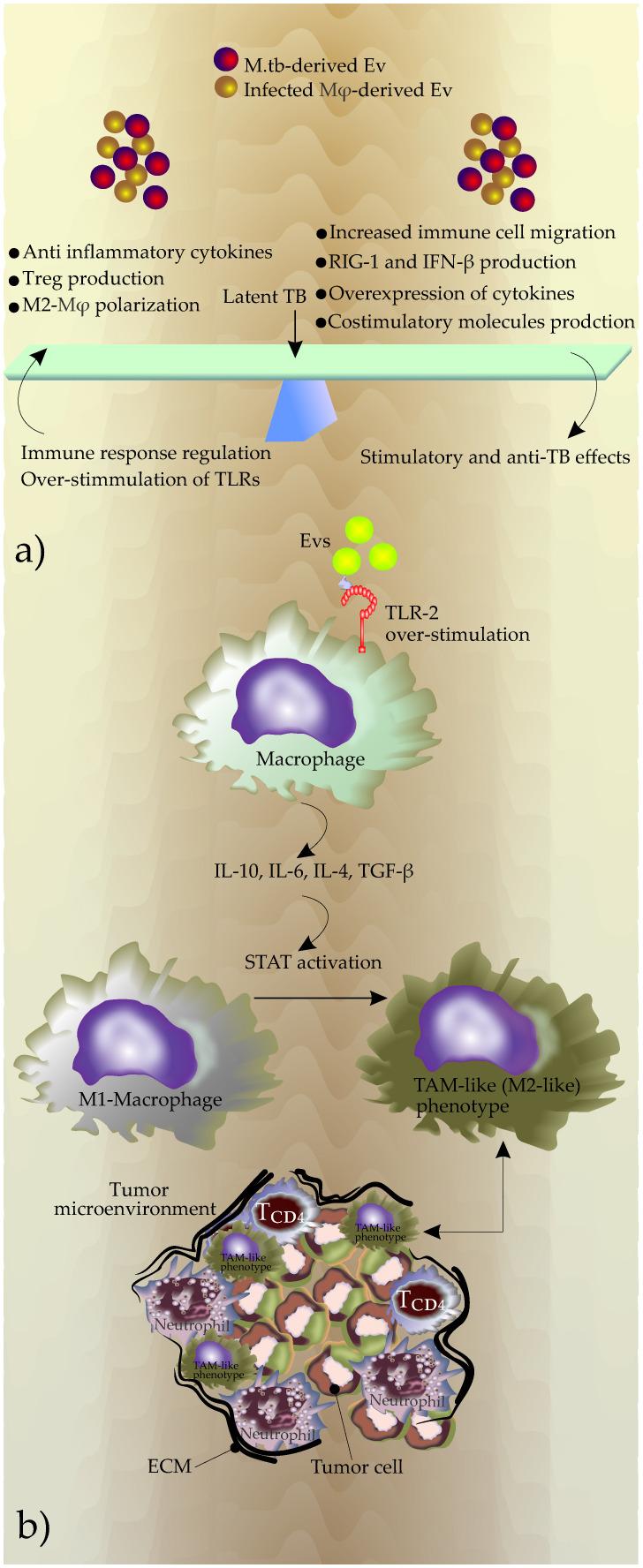
, the causative agent of Tuberculosis, is an intracellular bacterium well known for its ability to subvert host energy and metabolic pathways to maintain its intracellular survival. For this purpose, the bacteria utilize various mechanisms of which extracellular vehicles (EVs) related mechanisms attracted more attention. EVs are nanosized particles that are released by almost all cell types containing active biomolecules from the cell of origin and can target bioactive pathways in the recipient cells upon uptake. It is hypothesized that M.tb dictates the processes of host EV biogenesis pathways, selectively incorporating its molecules into the host EV to direct immune responses in its favor. During infection with , both mycobacteria and host cells release EVs. The composition of these EVs varies over time, influenced by the physiological and nutritional state of the host environment. Additionally, different EV populations contribute differently to the pathogenesis of disease at various stages of illness participating in a complex interplay between host cells and pathogens. These interactions ultimately influence immune responses and disease outcomes. However, the precise mechanisms and roles of EVs in pathogenicity and disease outcomes remain to be fully elucidated. In this review, we explored the properties and function of EVs in the context of M.tb infection within the host microenvironment and discussed their capacity as a novel therapeutic strategy to combat tuberculosis.
结核分枝杆菌是结核病的病原体,是一种细胞内细菌,以能够颠覆宿主的能量和代谢途径来维持其细胞内生存而闻名。为此,细菌利用了多种机制,其中细胞外囊泡(EVs)相关机制引起了更多关注。EVs 是由几乎所有细胞类型释放的纳米级颗粒,其中包含来自原始细胞的活性生物分子,在被摄取后可以靶向受体细胞中的生物活性途径。据推测,结核分枝杆菌决定了宿主 EV 生物发生途径的过程,将其分子选择性地纳入宿主 EV 中,以有利于其诱导免疫反应。在感染结核分枝杆菌时,分枝杆菌和宿主细胞都会释放 EVs。这些 EV 的组成随时间而变化,受宿主环境生理和营养状态的影响。此外,不同的 EV 群体在疾病的不同阶段对疾病的发病机制有不同的贡献,参与宿主细胞和病原体之间的复杂相互作用。这些相互作用最终影响免疫反应和疾病结局。然而,EVs 在致病性和疾病结局中的确切机制和作用仍有待充分阐明。在这篇综述中,我们探讨了 EVs 在宿主微环境中结核分枝杆菌感染背景下的特性和功能,并讨论了它们作为一种新型治疗策略来对抗结核病的潜力。

 Zotero 插件