
中国中老年人群抑郁症状与全因死亡率及其与慢性病的关系。
Depressive symptoms and all-cause mortality among middle-aged and older people in China and associations with chronic diseases.
机构信息
School of Education and Psychology, Key Research Institute of Humanities and Social Sciences of State Ethnic Affairs Commission, and Research Centre of Sichuan Minzu Education Development, Southwest Minzu University, Chengdu, China.
West China School of Public Health and West China Fourth Hospital, Sichuan University, Chengdu, Sichuan, China.
出版信息
Front Public Health. 2024 May 22;12:1381273. doi: 10.3389/fpubh.2024.1381273. eCollection 2024.
INTRODUCTION
It remains unclear whether depressive symptoms are associated with increased all-cause mortality and to what extent depressive symptoms are associated with chronic disease and all-cause mortality. The study aims to explore the relationship between depressive symptoms and all-cause mortality, and how depressive symptoms may, in turn, affect all-cause mortality among Chinese middle-aged and older people through chronic diseases.
METHODS
Data were collected from the China Health and Retirement Longitudinal Study (CHARLS). This cohort study involved 13,855 individuals from Wave 1 (2011) to Wave 6 (2020) of the CHARLS, which is a nationally representative survey that collects information from Chinese residents ages 45 and older to explore intrinsic mechanisms between depressive symptoms and all-cause mortality. The Center for Epidemiological Studies Depression Scale (CES-D-10) was validated through the CHARLS. Covariates included socioeconomic variables, living habits, and self-reported history of chronic diseases. Kaplan-Meier curves depicted mortality rates by depressive symptom levels, with Cox proportional hazards regression models estimating the hazard ratios (HRs) of all-cause mortality.
RESULTS
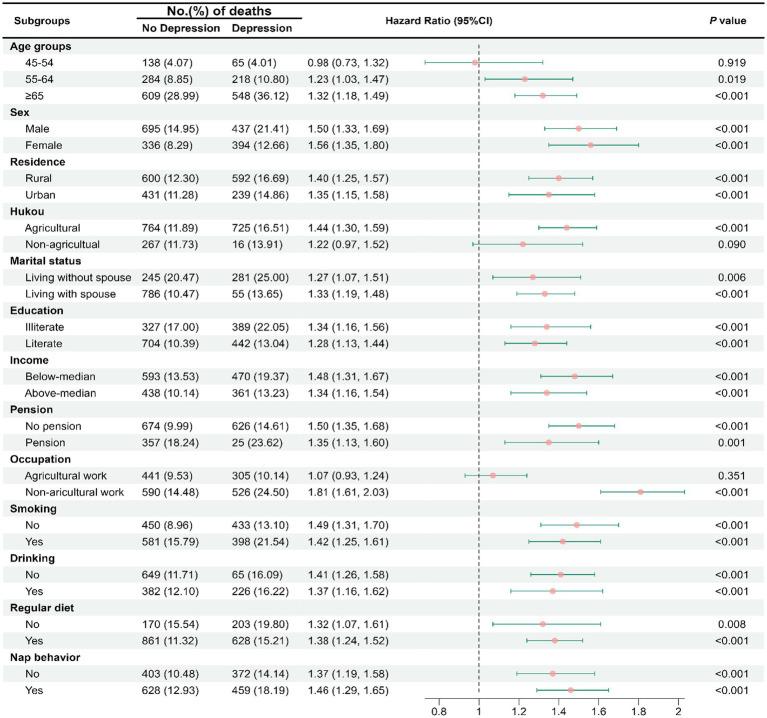
Out of the total 13,855 participants included, the median (1, 3) age was 58.00 (51.00, 63.00) years. Adjusted for all covariates, middle-aged and older adults with depressive symptoms had a higher all-cause mortality rate (HR = 1.20 [95% CI, 1.09-1.33]). An increased rate was observed for 55-64 years old (HR = 1.23 [95% CI, 1.03-1.47]) and more than 65 years old (HR = 1.32 [95% CI, 1.18-1.49]), agricultural Hukou (HR = 1.44, [95% CI, 1.30-1.59]), and nonagricultural workload (HR = 1.81 [95% CI, 1.61-2.03]). Depressive symptoms increased the risks of all-cause mortality among patients with hypertension (HR = 1.19 [95% CI, 1.00-1.40]), diabetes (HR = 1.41[95% CI, 1.02-1.95]), and arthritis (HR = 1.29 [95% CI, 1.09-1.51]).
CONCLUSION
Depressive symptoms raise all-cause mortality risk, particularly in those aged 55 and above, rural household registration (agricultural Hukou), nonagricultural workers, and middle-aged and older people with hypertension, diabetes, and arthritis. Our findings through the longitudinal data collected in this study offer valuable insights for interventions targeting depression, such as early detection, integrated chronic disease care management, and healthy lifestyles; and community support for depressive symptoms may help to reduce mortality in middle-aged and older people.
简介
目前尚不清楚抑郁症状是否与全因死亡率增加有关,以及抑郁症状与慢性病和全因死亡率之间的关系程度如何。本研究旨在探讨抑郁症状与全因死亡率之间的关系,以及抑郁症状如何通过慢性病影响中国中老年人群的全因死亡率。
方法
数据来自中国健康与退休纵向研究(CHARLS)。这项队列研究包括来自 CHARLS 的第 1 波(2011 年)至第 6 波(2020 年)的 13855 名个体,这是一项全国代表性调查,收集了中国 45 岁及以上居民的信息,以探讨抑郁症状与全因死亡率之间的内在机制。CHARLS 验证了流行病学研究中的抑郁量表(CES-D-10)。协变量包括社会经济变量、生活习惯和自我报告的慢性病史。通过抑郁症状水平绘制死亡率的 Kaplan-Meier 曲线,Cox 比例风险回归模型估计全因死亡率的风险比(HR)。
结果
在纳入的 13855 名参与者中,中位数(1, 3)年龄为 58.00(51.00,63.00)岁。调整所有协变量后,有抑郁症状的中老年人全因死亡率更高(HR=1.20[95%CI,1.09-1.33])。55-64 岁(HR=1.23[95%CI,1.03-1.47])和 65 岁以上(HR=1.32[95%CI,1.18-1.49])、农业户口(HR=1.44[95%CI,1.30-1.59])和非农工作量(HR=1.81[95%CI,1.61-2.03])的人观察到死亡率上升。抑郁症状增加了高血压(HR=1.19[95%CI,1.00-1.40])、糖尿病(HR=1.41[95%CI,1.02-1.95])和关节炎(HR=1.29[95%CI,1.09-1.51])患者的全因死亡率风险。
结论
抑郁症状会增加全因死亡率风险,尤其是在 55 岁及以上、农村户口(农业户口)、非农业劳动者以及患有高血压、糖尿病和关节炎的中老年人中。我们通过这项研究中收集的纵向数据得出的发现,为针对抑郁症状的干预措施提供了有价值的见解,例如早期发现、综合慢性病管理、健康生活方式;以及社区对抑郁症状的支持,可能有助于降低中老年人的死亡率。


 Zotero 插件