
基于机器学习的长非编码 RNA 在 COVID-19 生物标志物中的研究。
Long non-coding RNAs in biomarking COVID-19: a machine learning-based approach.
机构信息
Basic and Molecular Epidemiology of Gastrointestinal Disorders Research Center, Research Institute for Gastroenterology and Liver Diseases, Shahid Beheshti University of Medical Sciences, Tehran, Iran.
Bioinformatics and Computational Omics Lab (BioCOOL), Department of Biophysics, Faculty of Biological Sciences, Tarbiat Modares University, Tehran, Iran.
出版信息
Virol J. 2024 Jun 7;21(1):134. doi: 10.1186/s12985-024-02408-9.
BACKGROUND
The coronavirus pandemic that started in 2019 has caused the highest mortality and morbidity rates worldwide. Data on the role of long non-coding RNAs (lncRNAs) in coronavirus disease 2019 (COVID-19) is scarce. We aimed to elucidate the relationship of three important lncRNAs in the inflammatory states, H19, taurine upregulated gene 1 (TUG1), and colorectal neoplasia differentially expressed (CRNDE) with key factors in inflammation and fibrosis induction including signal transducer and activator of transcription3 (STAT3), alpha smooth muscle actin (α-SMA), tumor necrosis factor-alpha (TNF-α), and interleukin-6 (IL-6) in COVID-19 patients with moderate to severe symptoms.
METHODS
Peripheral blood mononuclear cells from 28 COVID-19 patients and 17 healthy controls were collected. The real-time quantitative polymerase chain reaction (RT-qPCR) was performed to evaluate the expression of RNAs and lncRNAs. Western blotting analysis was also performed to determine the expression levels of STAT3 and α-SMA proteins. Machine learning and receiver operating characteristic (ROC) curve analysis were carried out to evaluate the distinguishing ability of lncRNAs.
RESULTS
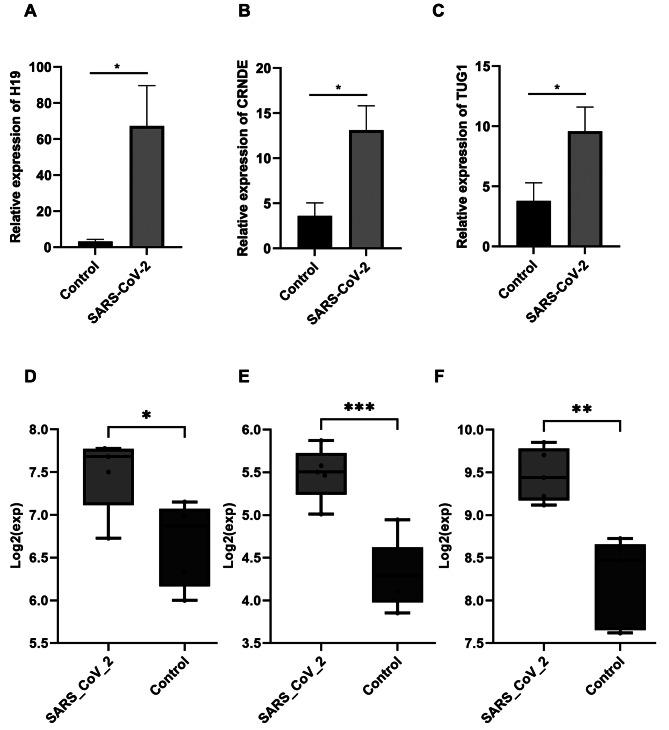
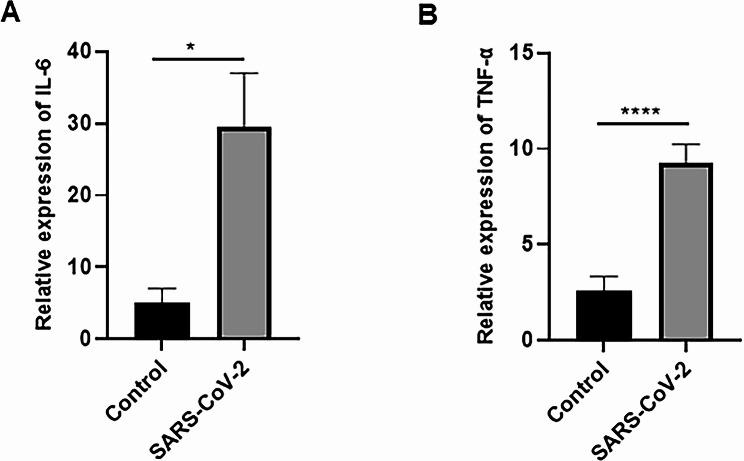
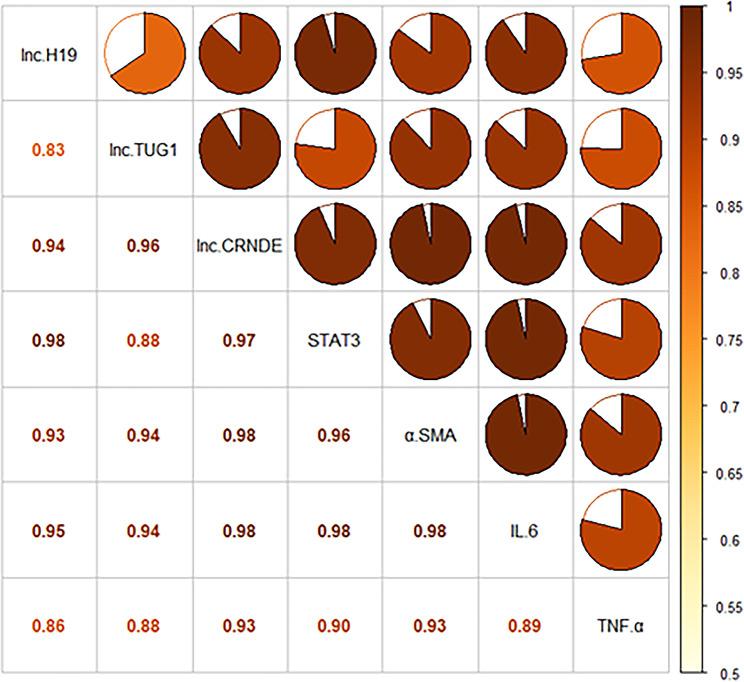
The expression levels of H19, TUG1, and CRNDE were significantly overexpressed in COVID-19 patients compared to healthy controls. Moreover, STAT3 and α-SMA expression levels were remarkedly increased at both transcript and protein levels in patients with COVID-19 compared to healthy subjects and were correlated with Three lncRNAs. Likewise, IL-6 and TNF-α were considerably upregulated in COVID-19 patients. Machine learning and ROC curve analysis showed that CRNDE-H19 panel has the proper ability to distinguish COVID-19 patients from healthy individuals (area under the curve (AUC) = 0.86).
CONCLUSION
The overexpression of three lncRNAs in COVID-19 patients observed in this study may align with significant manifestations of COVID-19. Furthermore, their co-expression with STAT3 and α-SMA, two critical factors implicated in inflammation and fibrosis induction, underscores their potential involvement in exacerbating cardiovascular, pulmonary and common symptoms and complications associated with COVID-19. The combination of CRNDE and H19 lncRNAs seems to be an impressive host-based biomarker panel for screening and diagnosis of COVID-19 patients from healthy controls. Research into lncRNAs can provide a robust platform to find new viral infection-related mediators and propose novel therapeutic strategies for viral infections and immune disorders.
背景
始于 2019 年的冠状病毒大流行导致了全球范围内最高的死亡率和发病率。关于长链非编码 RNA(lncRNA)在 2019 年冠状病毒病(COVID-19)中的作用的数据很少。我们旨在阐明三种重要的 lncRNA 在炎症状态下的关系,H19、牛磺酸上调基因 1(TUG1)和结直肠肿瘤差异表达(CRNDE)与炎症和纤维化诱导的关键因素之间的关系,包括信号转导和转录激活因子 3(STAT3)、α平滑肌肌动蛋白(α-SMA)、肿瘤坏死因子-α(TNF-α)和白细胞介素-6(IL-6)在 COVID-19 中症状中度至重度的患者。
方法
收集了 28 例 COVID-19 患者和 17 例健康对照者的外周血单核细胞。采用实时定量聚合酶链反应(RT-qPCR)检测 RNA 和 lncRNA 的表达。还进行了 Western blot 分析以确定 STAT3 和α-SMA 蛋白的表达水平。进行了机器学习和接收者操作特征(ROC)曲线分析,以评估 lncRNA 的鉴别能力。
结果
与健康对照组相比,COVID-19 患者的 H19、TUG1 和 CRNDE 表达水平显着升高。此外,COVID-19 患者的 STAT3 和α-SMA 表达水平在转录和蛋白水平均显着升高,与三种 lncRNA 相关。同样,IL-6 和 TNF-α在 COVID-19 患者中显着上调。机器学习和 ROC 曲线分析表明,CRNDE-H19 面板具有区分 COVID-19 患者与健康个体的适当能力(曲线下面积(AUC)=0.86)。
结论
本研究观察到 COVID-19 患者中三种 lncRNA 的过度表达可能与 COVID-19 的明显表现一致。此外,它们与 STAT3 和α-SMA 的共同表达,这两种关键因素与炎症和纤维化诱导有关,突出了它们在加重心血管、肺部和常见症状以及与 COVID-19 相关的并发症中的潜在作用。CRNDE 和 H19 lncRNA 的组合似乎是一种令人印象深刻的基于宿主的生物标志物面板,可用于从健康对照中筛选和诊断 COVID-19 患者。对 lncRNA 的研究可以为寻找新的病毒感染相关介质提供强大的平台,并为病毒感染和免疫紊乱提出新的治疗策略。


 Zotero 插件