
医疗废物全过程安全处置的风险管理:进展与挑战
Risk Management for Whole-Process Safe Disposal of Medical Waste: Progress and Challenges.
作者信息
Yang Ting, Du Yanan, Sun Mingzhen, Meng Jingjing, Li Yiyi
机构信息
School of Health Services Management, Anhui Medical University, Hefei, Anhui, 230032, People's Republic of China.
Intelligent Interconnected Systems Laboratory of Anhui Province (Hefei University of Technology), Hefei, Anhui, 230009, People's Republic of China.
出版信息
Risk Manag Healthc Policy. 2024 Jun 6;17:1503-1522. doi: 10.2147/RMHP.S464268. eCollection 2024.
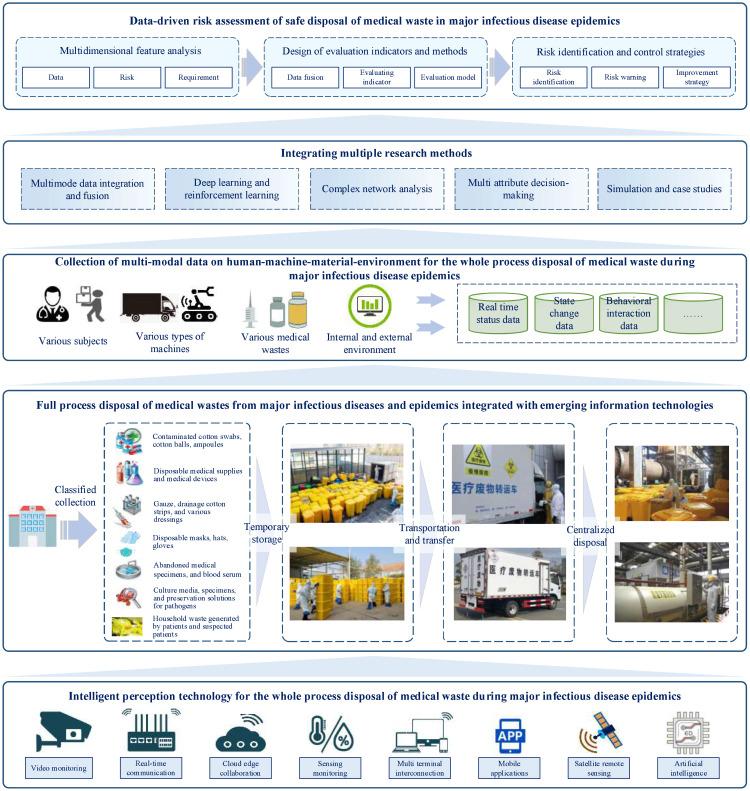
Over the past decade, the global outbreaks of SARS, influenza A (H1N1), COVID-19, and other major infectious diseases have exposed the insufficient capacity for emergency disposal of medical waste in numerous countries and regions. Particularly during epidemics of major infectious diseases, medical waste exhibits new characteristics such as accelerated growth rate, heightened risk level, and more stringent disposal requirements. Consequently, there is an urgent need for advanced theoretical approaches that can perceive, predict, evaluate, and control risks associated with safe disposal throughout the entire process in a timely, accurate, efficient, and comprehensive manner. This article provides a systematic review of relevant research on collection, storage, transportation, and disposal of medical waste throughout its entirety to illustrate the current state of safe disposal practices. Building upon this foundation and leveraging emerging information technologies like Internet of Things (IoT), cloud computing, big data analytics, and artificial intelligence (AI), we deeply contemplate future research directions with an aim to minimize risks across all stages of medical waste disposal while offering valuable references and decision support to further advance safe disposal practices.
在过去十年中,非典、甲型H1N1流感、新冠肺炎等全球重大传染病疫情暴露出众多国家和地区医疗废物应急处置能力不足的问题。特别是在重大传染病流行期间,医疗废物呈现出增长速度加快、风险水平提高、处置要求更严格等新特点。因此,迫切需要先进的理论方法,能够及时、准确、高效、全面地感知、预测、评估和控制整个安全处置过程中的风险。本文对医疗废物从收集、储存、运输到处置的全过程相关研究进行了系统综述,以阐明安全处置实践的现状。在此基础上,利用物联网、云计算、大数据分析和人工智能等新兴信息技术,深入思考未来的研究方向,旨在将医疗废物处置各阶段的风险降至最低,同时为进一步推进安全处置实践提供有价值的参考和决策支持。



 Zotero 插件