
我们是否在为生命增添无痛岁月?发病率压缩与扩张的检验。
Are We Adding Pain-Free Years to Life? A Test of Compression Versus Expansion of Morbidity.
作者信息
Zimmer Zachary, Sun Feinuo, Duynisveld Amber
机构信息
Department of Family Studies & Gerontology and The Global Aging Research Initiative, Mount Saint Vincent University, Halifax, Nova Scotia, Canada.
Department of Kinesiology, University of Texas at Arlington, Arlington, Texas, USA.
出版信息
J Gerontol A Biol Sci Med Sci. 2024 Aug 1;79(8). doi: 10.1093/gerona/glae157.
BACKGROUND
There has been debate regarding whether increases in longevity result in longer and healthier lives or more disease and suffering. To address the issue, this study uses health expectancy methods and tests an expansion versus compression of morbidity with respect to pain.
METHODS
Data are from 1993 to 2018 Health and Retirement Study. Pain is categorized as no pain, nonlimiting, and limiting pain. Multistate life tables examine 77 996 wave-to-wave transitions across pain states or death using the Stochastic Population Analysis for Complex Events program. Results are presented as expected absolute and relative years of life for 70-, 80-, and 90-year-old men and women. Confidence intervals assess significance of differences over time. Population- and status-based results are presented.
RESULTS
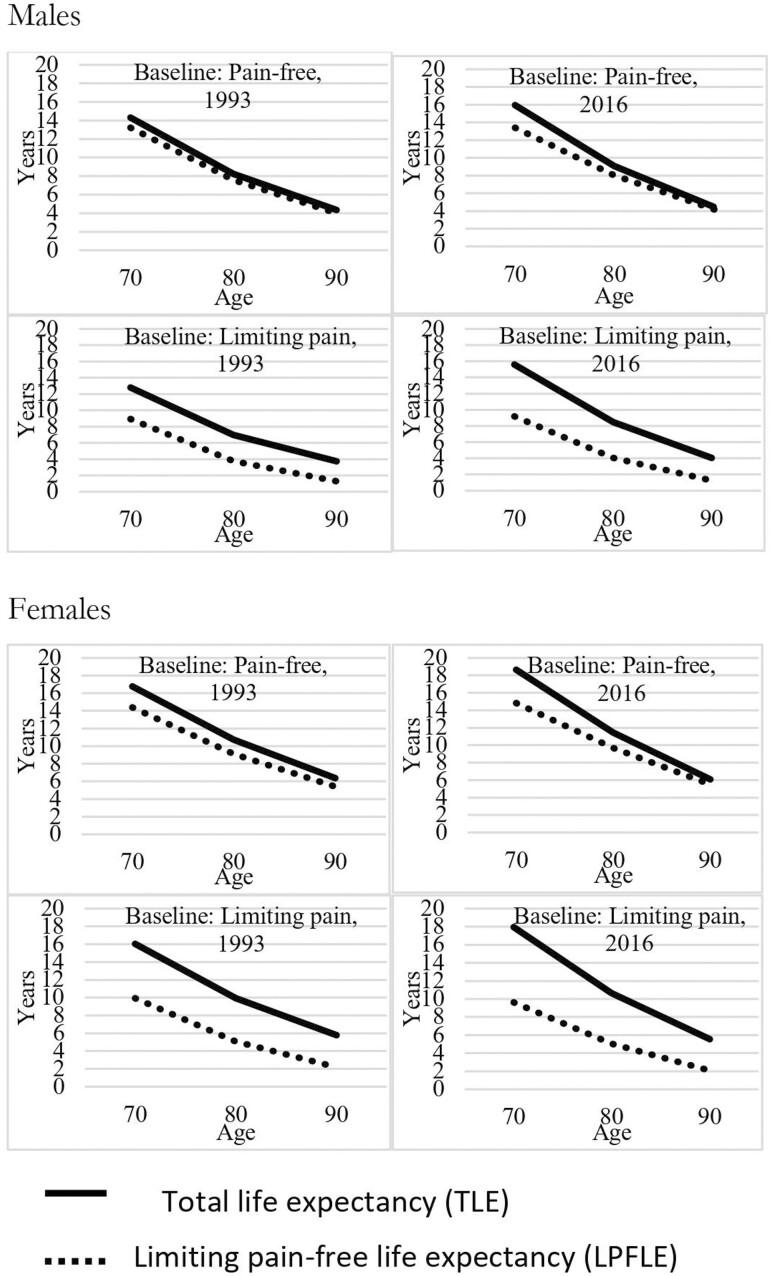
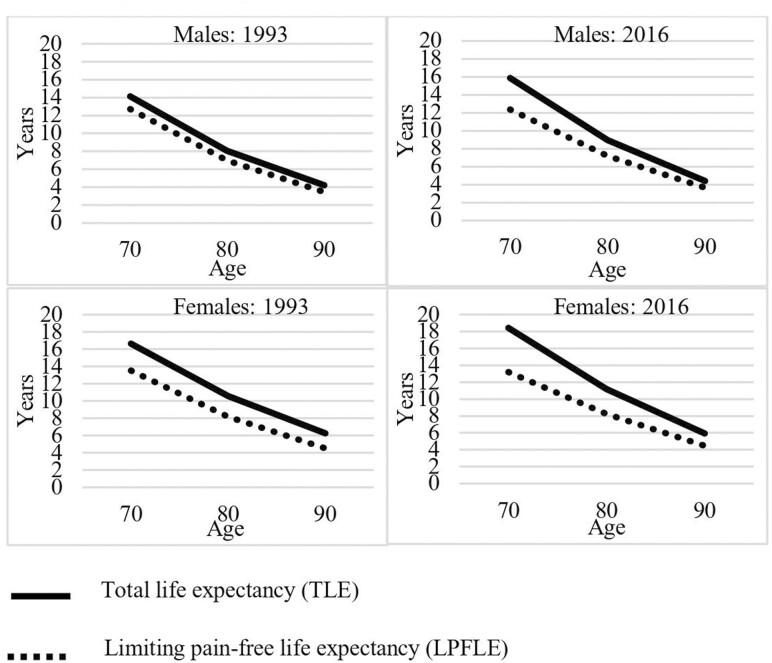
For those 70 and 80 years old, relative and absolute life with nonlimiting and limiting pain increased substantially for men and women, and despite variability on a wave-to-wave basis, results generally confirm an expanding pain morbidity trend. Results do not vary by baseline status, indicating those already in pain are just as likely to experience expansion of morbidity as those pain-free at baseline. Results are different for 90-year-olds who have not experienced expanding pain morbidity and do not show an increase in life expectancy.
CONCLUSIONS
Findings are consistent with extant literature indicating increasing pain prevalence among older Americans and portend a need for attention to pain-coping resources, therapies, and prevention strategies.
背景
关于寿命延长是否会带来更长且更健康的生命,还是会导致更多疾病和痛苦,一直存在争议。为解决这一问题,本研究采用健康期望寿命方法,并针对疼痛测试发病率的扩张与压缩情况。
方法
数据来自1993年至2018年的健康与退休研究。疼痛分为无疼痛、非限制性疼痛和限制性疼痛。多状态生命表使用复杂事件的随机人口分析程序,研究了77996次跨疼痛状态或死亡的逐波转变。结果以70岁、80岁和90岁男性及女性预期的绝对和相对生命年数呈现。置信区间评估随时间变化差异的显著性。呈现了基于人群和状态的结果。
结果
对于70岁和80岁的人群,男性和女性非限制性和限制性疼痛的相对和绝对生命年数大幅增加,尽管逐波存在变化,但结果总体上证实了疼痛发病率呈扩张趋势。结果不因基线状态而异,这表明已经处于疼痛状态的人与基线时无疼痛的人一样,都有可能经历发病率的扩张。90岁人群的结果有所不同,他们没有经历疼痛发病率的扩张,且预期寿命没有增加。
结论
研究结果与现有文献一致,表明美国老年人中疼痛患病率在上升,预示着需要关注疼痛应对资源、治疗方法和预防策略。
 Zotero 插件