
全基因组分析显示 MAPT、MOBP 和 APOE 基因座在散发型额颞叶痴呆中的潜在作用。
Genome-wide analyses reveal a potential role for the MAPT, MOBP, and APOE loci in sporadic frontotemporal dementia.
机构信息
UCL School of Pharmacy, London, UK.
Department of Clinical and Movement Neurosciences, UCL Queen Square Institute of Neurology, London, UK.
出版信息
Am J Hum Genet. 2024 Jul 11;111(7):1316-1329. doi: 10.1016/j.ajhg.2024.05.017. Epub 2024 Jun 17.
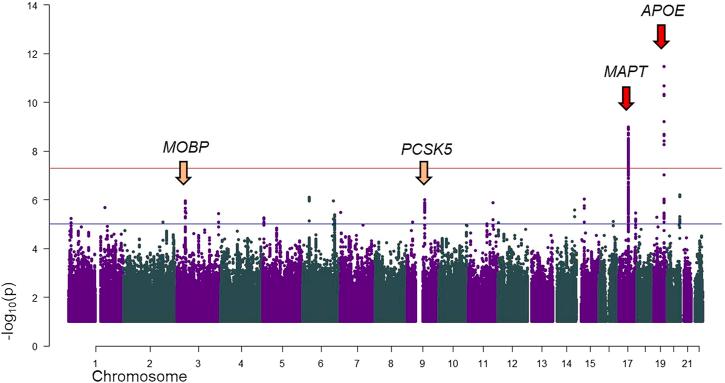
Frontotemporal dementia (FTD) is the second most common cause of early-onset dementia after Alzheimer disease (AD). Efforts in the field mainly focus on familial forms of disease (fFTDs), while studies of the genetic etiology of sporadic FTD (sFTD) have been less common. In the current work, we analyzed 4,685 sFTD cases and 15,308 controls looking for common genetic determinants for sFTD. We found a cluster of variants at the MAPT (rs199443; p = 2.5 × 10, OR = 1.27) and APOE (rs6857; p = 1.31 × 10, OR = 1.27) loci and a candidate locus on chromosome 3 (rs1009966; p = 2.41 × 10, OR = 1.16) in the intergenic region between RPSA and MOBP, contributing to increased risk for sFTD through effects on expression and/or splicing in brain cortex of functionally relevant in-cis genes at the MAPT and RPSA-MOBP loci. The association with the MAPT (H1c clade) and RPSA-MOBP loci may suggest common genetic pleiotropy across FTD and progressive supranuclear palsy (PSP) (MAPT and RPSA-MOBP loci) and across FTD, AD, Parkinson disease (PD), and cortico-basal degeneration (CBD) (MAPT locus). Our data also suggest population specificity of the risk signals, with MAPT and APOE loci associations mainly driven by Central/Nordic and Mediterranean Europeans, respectively. This study lays the foundations for future work aimed at further characterizing population-specific features of potential FTD-discriminant APOE haplotype(s) and the functional involvement and contribution of the MAPT H1c haplotype and RPSA-MOBP loci to pathogenesis of sporadic forms of FTD in brain cortex.
额颞叶痴呆(FTD)是继阿尔茨海默病(AD)之后第二常见的早发性痴呆病因。该领域的研究主要集中在家族性疾病(fFTDs),而散发性 FTD(sFTD)的遗传病因研究则相对较少。在目前的工作中,我们分析了 4685 例 sFTD 病例和 15308 例对照,寻找 sFTD 的常见遗传决定因素。我们在 MAPT(rs199443;p=2.5×10,OR=1.27)和 APOE(rs6857;p=1.31×10,OR=1.27)基因座以及染色体 3 上一个候选基因座(rs1009966;p=2.41×10,OR=1.16)发现了一组变异,这些变异位于 MAPT 和 APOE 基因座之间的 RPSA 和 MOBP 基因间区,通过影响 MAPT 和 RPSA-MOBP 基因座大脑皮层中功能相关顺式基因的表达和/或剪接,增加了 sFTD 的风险。与 MAPT(H1c 分支)和 RPSA-MOBP 基因座的关联可能表明 FTD 和进行性核上性麻痹(PSP)(MAPT 和 RPSA-MOBP 基因座)以及 FTD、AD、帕金森病(PD)和皮质基底节变性(CBD)(MAPT 基因座)之间存在共同的遗传多效性。我们的数据还表明,风险信号具有人群特异性,MAPT 和 APOE 基因座的关联主要由中欧/北欧和地中海欧洲人驱动。这项研究为进一步描述潜在 FTD 鉴别 APOE 单倍型(s)的人群特异性特征以及 MAPT H1c 单倍型和 RPSA-MOBP 基因座在大脑皮层中对散发性 FTD 发病机制的功能参与和贡献奠定了基础。



 Zotero 插件