
盐胁迫下油菜的表型、生物量、碳氮同化及抗氧化反应
Phenotype, Biomass, Carbon and Nitrogen Assimilation, and Antioxidant Response of Rapeseed under Salt Stress.
作者信息
Wang Long, Lin Guobing, Li Yiyang, Qu Wenting, Wang Yan, Lin Yaowei, Huang Yihang, Li Jing, Qian Chen, Yang Guang, Zuo Qingsong
机构信息
Jiangsu Key Laboratory of Crop Genetics and Physiology, Yangzhou University, Yangzhou 225009, China.
Jiangsu Co-Innovation Center for Modern Production Technology of Grain Crops, Yangzhou University, Yangzhou 225009, China.
出版信息
Plants (Basel). 2024 May 28;13(11):1488. doi: 10.3390/plants13111488.
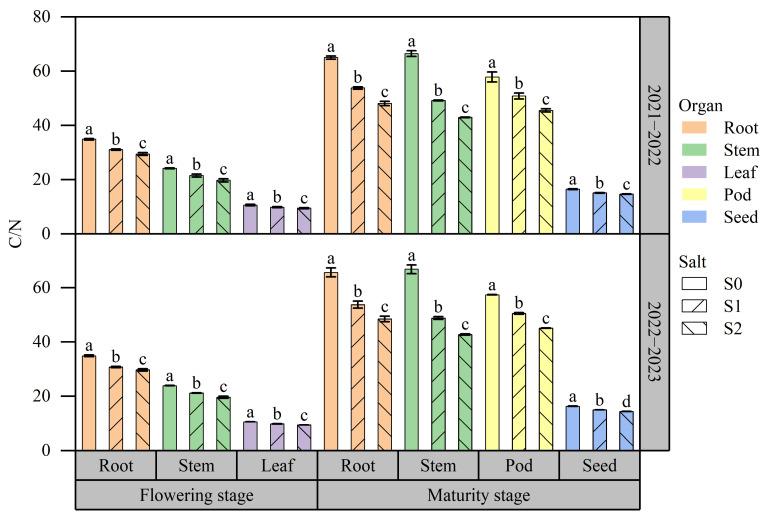
Salt stress is one of the major adverse factors affecting plant growth and crop production. Rapeseed is an important oil crop, providing high-quality edible oil for human consumption. This experiment was conducted to investigate the effects of salt stress on the phenotypic traits and physiological processes of rapeseed. The soil salinity was manipulated by setting three different levels: 0 g NaCl kg soil (referred to as S0), 1.5 g NaCl kg soil (referred to as S1), and 3.0 g NaCl kg soil (referred to as S2). In general, the results indicated that the plant height, leaf area, and root neck diameter decreased with an increase in soil salinity. In addition, the biomass of various organs at all growth stages decreased as soil salinity increased from S0 to S2. The increasing soil salinity improved the distribution of biomass in the root and leaf at the seedling and flowering stages, indicating that rapeseed plants subjected to salt stress during the vegetative stage are capable of adapting their growth pattern to sustain their capacity for nutrient and water uptake, as well as leaf photosynthesis. However, as the soil salinity increased, there was a decrease in the distribution of biomass in the pod and seed at the maturity stage, while an increase was observed in the root and stem, suggesting that salt stress inhibited carbohydrate transport into reproductive organs. Moreover, the C and N accumulation at the flowering and maturity stages exhibited a reduction in direct correlation with the increase in soil salinity. High soil salinity resulted in a reduction in the C/N, indicating that salt stress exerted a greater adverse effect on C assimilation compared to N assimilation, leading to an increase in seed protein content and a decrease in oil content. Furthermore, as soil salinity increased from S0 to S2, the activity of superoxide dismutase (SOD) and catalase (CAT) and the content of soluble protein and sugar increased by 58.39%, 33.38%, 15.57%, and 13.88% at the seedling stage, and 38.69%, 22.85%, 12.04%, and 8.26% at the flowering stage, respectively. In summary, this study revealed that salt stress inhibited C and N assimilation, leading to a suppressed phenotype and biomass accumulation. The imbalanced C and N assimilation under salt stress contributed to the alterations in the seed oil and protein content. Rapeseed had a certain degree of salt tolerance by improving antioxidants and osmolytes.
盐胁迫是影响植物生长和作物产量的主要不利因素之一。油菜是一种重要的油料作物,为人类提供优质食用油。本试验旨在研究盐胁迫对油菜表型性状和生理过程的影响。通过设置三个不同水平来控制土壤盐分:0 g NaCl/kg土壤(称为S0)、1.5 g NaCl/kg土壤(称为S1)和3.0 g NaCl/kg土壤(称为S2)。总体而言,结果表明,随着土壤盐分增加,株高、叶面积和根颈直径减小。此外,随着土壤盐分从S0增加到S2,各生长阶段各器官的生物量均下降。土壤盐分增加改善了苗期和花期根和叶中生物量的分配,表明营养生长阶段遭受盐胁迫的油菜植株能够调整其生长模式,以维持养分和水分吸收以及叶片光合作用的能力。然而,随着土壤盐分增加,成熟期荚果和种子中生物量的分配减少,而根和茎中生物量增加,这表明盐胁迫抑制了碳水化合物向生殖器官的转运。此外,花期和成熟期的碳氮积累随着土壤盐分增加呈下降趋势,且与土壤盐分增加直接相关。高土壤盐分导致碳氮比降低,表明盐胁迫对碳同化的不利影响大于氮同化,导致种子蛋白质含量增加而油含量降低。此外,随着土壤盐分从S0增加到S2,苗期超氧化物歧化酶(SOD)和过氧化氢酶(CAT)的活性以及可溶性蛋白和糖的含量分别增加了58.39%、33.38%、15.57%和13.88%,花期分别增加了38.69%、22.85%、12.04%和8.26%。总之,本研究表明盐胁迫抑制了碳氮同化,导致表型受抑制和生物量积累。盐胁迫下碳氮同化失衡导致种子油和蛋白质含量发生变化。油菜通过提高抗氧化剂和渗透调节物质具有一定程度的耐盐性。


 Zotero 插件