
优化抗菌肽设计:细胞穿透肽、淀粉样片段和氨基酸残基修饰的整合。
Optimizing Antimicrobial Peptide Design: Integration of Cell-Penetrating Peptides, Amyloidogenic Fragments, and Amino Acid Residue Modifications.
机构信息
Institute of Environmental and Agricultural Biology (X-BIO), Tyumen State University, 625003 Tyumen, Russia.
Biology Faculty, Lomonosov Moscow State University, 119991 Moscow, Russia.
出版信息
Int J Mol Sci. 2024 May 30;25(11):6030. doi: 10.3390/ijms25116030.
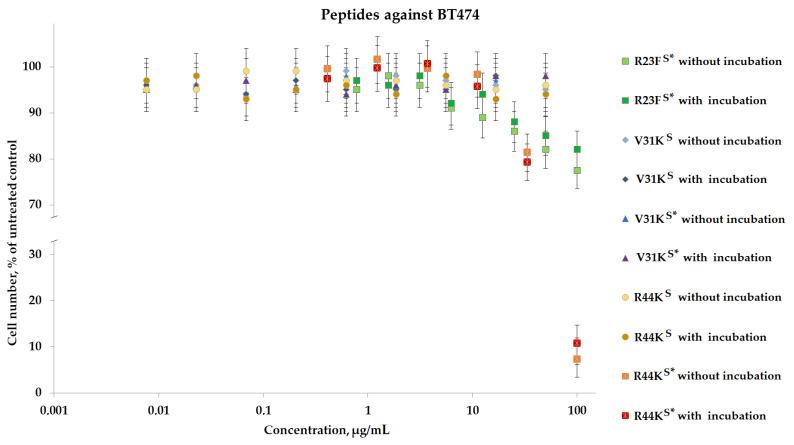
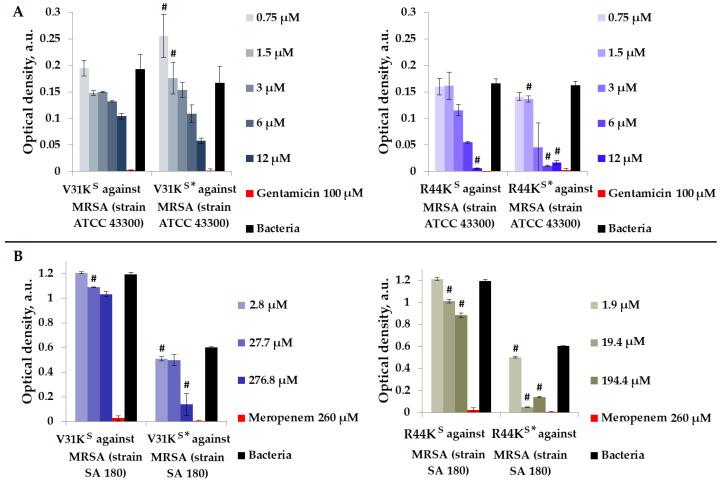
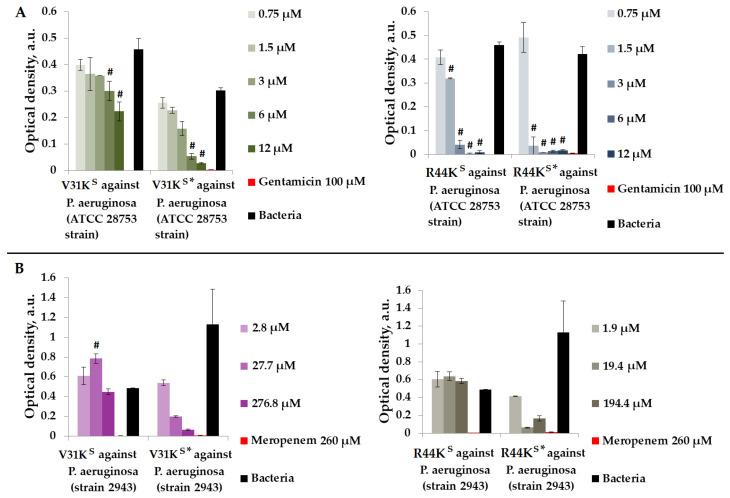
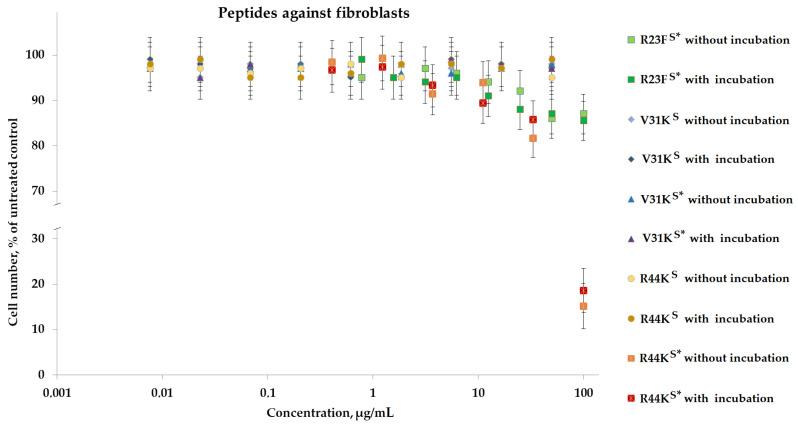
The escalating threat of multidrug-resistant pathogens necessitates innovative approaches to combat infectious diseases. In this study, we examined peptides R23F*, V31K*, and R44K*, which were engineered to include an amyloidogenic fragment sourced from the S1 protein of , along with one or two cell-penetrating peptide (CPP) components. We assessed the antimicrobial efficacy of these peptides in a liquid medium against various strains of both Gram-positive bacteria, including (209P and 129B strains), MRSA (SA 180 and ATCC 43300 strains), and (strain IP 5832), and Gram-negative bacteria such as (ATCC 28753 and 2943 strains) and (MG1655 and K12 strains). Peptides R23F*, V31K*, and R44K* exhibited antimicrobial activity comparable to gentamicin and meropenem against all tested bacteria at concentrations ranging from 24 to 48 μM. The peptides showed a stronger antimicrobial effect against . Notably, peptide R44K* displayed high efficacy compared to peptides R23F* and V31K*, particularly evident at lower concentrations, resulting in significant inhibition of bacterial growth. Furthermore, modified peptides V31K* and R44K* demonstrated enhanced inhibitory effects on bacterial growth across different strains compared to their unmodified counterparts V31K and R44K. These results highlight the potential of integrating cell-penetrating peptides, amyloidogenic fragments, and amino acid residue modifications to advance the innovation in the field of antimicrobial peptides, thereby increasing their effectiveness against a broad spectrum of pathogens.
多药耐药病原体的威胁不断升级,需要创新方法来对抗传染病。在这项研究中,我们研究了经过工程改造的肽 R23F*、V31K和 R44K,它们包含源自 S1 蛋白的淀粉样片段,以及一个或两个细胞穿透肽 (CPP) 成分。我们评估了这些肽在液体培养基中对各种革兰氏阳性菌菌株的抗菌功效,包括 (209P 和 129B 株)、MRSA(SA 180 和 ATCC 43300 株)和 (IP 5832 株),以及革兰氏阴性菌,如 (ATCC 28753 和 2943 株)和 (MG1655 和 K12 株)。肽 R23F*、V31K和 R44K在 24 至 48 μM 的浓度范围内对所有测试的细菌表现出与庆大霉素和美罗培南相当的抗菌活性。这些肽对 表现出更强的抗菌作用。值得注意的是,与肽 R23F和 V31K相比,肽 R44K显示出更高的功效,尤其是在较低浓度下,导致细菌生长受到显著抑制。此外,与未经修饰的肽 V31K 和 R44K 相比,修饰后的肽 V31K和 R44K*在不同菌株中对细菌生长表现出更强的抑制作用。这些结果突出了整合细胞穿透肽、淀粉样片段和氨基酸残基修饰以推进抗菌肽领域创新的潜力,从而提高其对广谱病原体的有效性。




 Zotero 插件