
早期肠内营养(48 小时内)对脓毒症或脓毒性休克患者的影响:一项系统评价和荟萃分析。
Early Enteral Nutrition (within 48 h) for Patients with Sepsis or Septic Shock: A Systematic Review and Meta-Analysis.
机构信息
Department of Internal Medicine, School of Medicine, Pontificia Universidad Javeriana, Bogotá 110231, Colombia.
Department of Obstetrics & Gynecology, School of Medicine, Universidad Nacional de Colombia, Bogotá 111321, Colombia.
出版信息
Nutrients. 2024 May 22;16(11):1560. doi: 10.3390/nu16111560.
OBJECTIVE
Medical nutrition therapy provides the opportunity to compensate for muscle wasting and immune response activation during stress and trauma. The objective of this systematic review is to assess the safety and effectiveness of early enteral nutrition (EEN) in adults with sepsis or septic shock.
METHODS
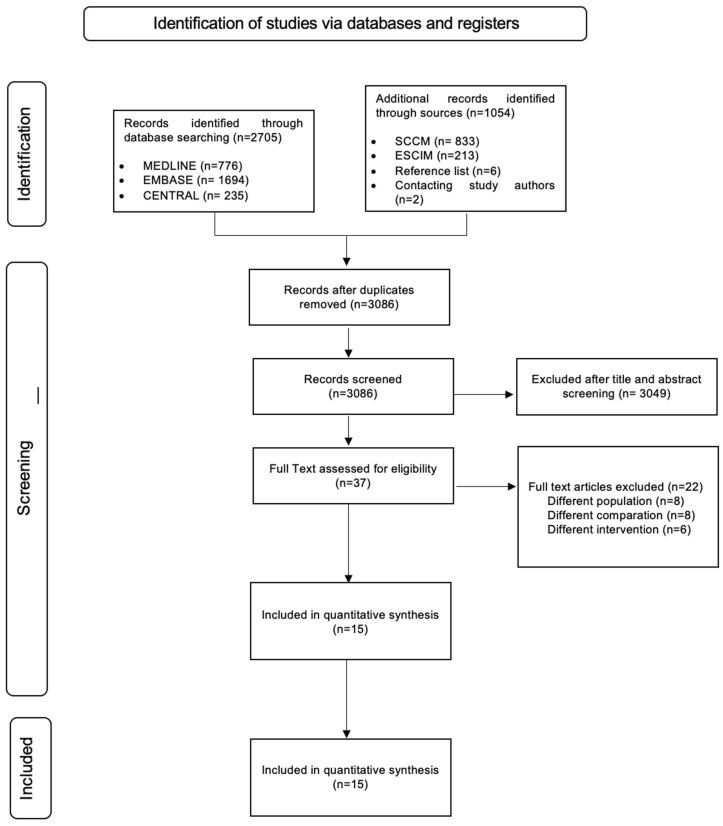
The MEDLINE, Embase, CENTRAL, CINAHL, ClinicalTrials.gov, and ICTRP tools were searched from inception until July 2023. Conference proceedings, the reference lists of included studies, and expert content were queried to identify additional publications. Two review authors completed the study selection, data extraction, and risk of bias assessment; disagreements were resolved through discussion. Inclusion criteria were randomized controlled trials (RCTs) and non-randomized studies (NRSs) comparing the administration of EEN with no or delayed enteral nutrition (DEE) in adult populations with sepsis or septic shock.
RESULTS
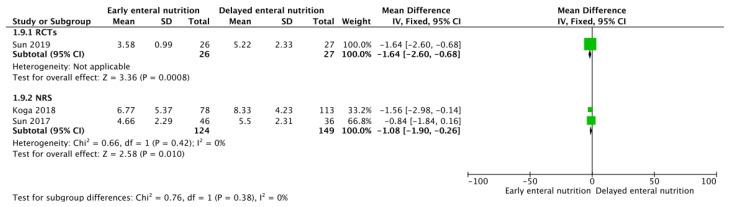
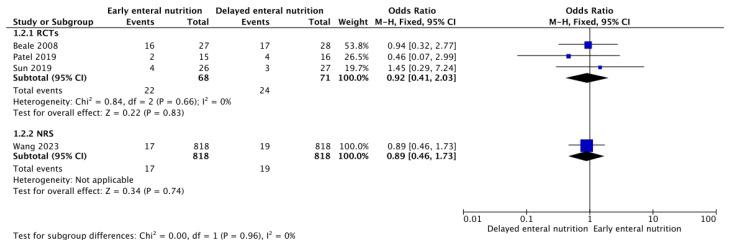
Five RCTs ( = 442 participants) and ten NRSs ( = 3724 participants) were included. Low-certainty evidence from RCTs and NRSs suggests that patients receiving EEN could require fewer days of mechanical ventilation (MD -2.65; 95% CI, -4.44-0.86; and MD -2.94; 95% CI, -3.64--2.23, respectively) and may show lower SOFA scores during follow-up (MD -1.64 points; 95% CI, -2.60--0.68; and MD -1.08 points; 95% CI, -1.90--0.26, respectively), albeit with an increased frequency of diarrhea episodes (OR 2.23, 95% CI 1.115-4.34). Even though the patients with EEN show a lower in-hospital mortality rate both in RCTs (OR 0.69; 95% CI, 0.39-1.23) and NRSs (OR 0.89; 95% CI, 0.69-1.13), this difference does not achieve statistical significance. There were no apparent differences for other outcomes.
CONCLUSIONS
Low-quality evidence suggests that EEN may be a safe and effective intervention for the management of critically ill patients with sepsis or septic shock.
目的
医学营养疗法为补偿应激和创伤期间的肌肉消耗和免疫反应激活提供了机会。本系统评价的目的是评估早期肠内营养(EEN)在脓毒症或脓毒性休克成人中的安全性和有效性。
方法
从创建到 2023 年 7 月,检索了 MEDLINE、Embase、CENTRAL、CINAHL、ClinicalTrials.gov 和 ICTRP 工具。查询会议记录、纳入研究的参考文献列表和专家内容,以确定其他出版物。两名综述作者完成了研究选择、数据提取和偏倚风险评估;通过讨论解决分歧。纳入标准为比较 EEN 与无肠内营养或延迟肠内营养(DEE)在脓毒症或脓毒性休克成人中应用的随机对照试验(RCT)和非随机研究(NRS)。
结果
纳入了 5 项 RCT(=442 名参与者)和 10 项 NRS(=3724 名参与者)。来自 RCT 和 NRS 的低确定性证据表明,接受 EEN 的患者可能需要更少天数的机械通气(MD-2.65;95%CI,-4.44-0.86;和 MD-2.94;95%CI,-3.64--2.23),并且在随访期间可能显示出较低的 SOFA 评分(MD-1.64 分;95%CI,-2.60--0.68;和 MD-1.08 分;95%CI,-1.90--0.26),尽管腹泻发作频率更高(OR 2.23,95%CI 1.115-4.34)。尽管在 RCT(OR 0.69;95%CI,0.39-1.23)和 NRS(OR 0.89;95%CI,0.69-1.13)中,接受 EEN 的患者的院内死亡率均较低,但这一差异无统计学意义。对于其他结局,没有明显差异。
结论
低质量证据表明,EEN 可能是治疗脓毒症或脓毒性休克危重症患者的安全有效的干预措施。



 Zotero 插件