
基于嵌合抗原受体T细胞的癌症免疫疗法:潜力、局限性与未来前景
CAR-T-Cell-Based Cancer Immunotherapies: Potentials, Limitations, and Future Prospects.
作者信息
Choudhery Mahmood S, Arif Taqdees, Mahmood Ruhma, Harris David T
机构信息
Department of Human Genetics & Molecular Biology, University of Health Sciences, Lahore 54600, Pakistan.
Jinnah Hospital, Allama Iqbal Medical College, Lahore 54700, Pakistan.
出版信息
J Clin Med. 2024 May 29;13(11):3202. doi: 10.3390/jcm13113202.
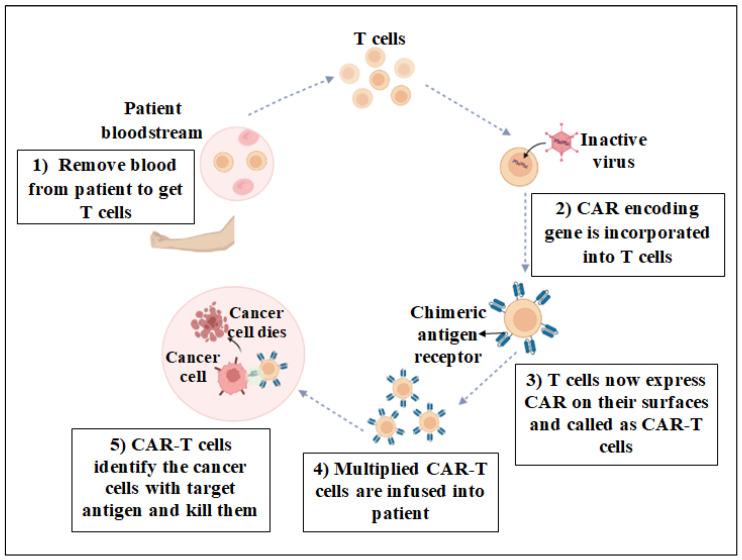
Cancer encompasses various elements occurring at the cellular and genetic levels, necessitating an immunotherapy capable of efficiently addressing both aspects. T cells can combat cancer cells by specifically recognizing antigens on them. This innate capability of T cells has been used to develop cellular immunotherapies, but most of them can only target antigens through major histocompatibility complexes (MHCs). New gene-editing techniques such as clustered regularly interspaced short palindromic repeat (CRISPR)-associated protein 9 (CRISPR-cas9) can precisely edit the DNA sequences. CRISPR-cas9 has made it possible to generate genetically engineered chimeric antigen receptors (CARs) that can overcome the problems associated with old immunotherapies. In chimeric antigen receptor T (CAR-T) cell therapy, the patient's T cells are isolated and genetically modified to exhibit synthetic CAR(s). CAR-T cell treatment has shown remarkably positive clinical outcomes in cancers of various types. Nevertheless, there are various challenges that reduce CAR-T effectiveness in solid tumors. It is required to address these challenges in order to make CAR-T cell therapy a better and safer option. Combining CAR-T treatment with other immunotherapies that target multiple antigens has shown positive outcomes. Moreover, recently generated Boolean logic-gated advanced CARs along with artificial intelligence has expanded its potential to treat solid tumors in addition to blood cancers. This review aims to describe the structure, types, and various methods used to develop CAR-T cells. The clinical applications of CAR-T cells in hematological malignancies and solid tumours have been described in detail. In addition, this discussion has addressed the limitations associated with CAR-T cells, explored potential strategies to mitigate CAR-T-related toxicities, and delved into future perspectives.
癌症包含在细胞和基因水平上发生的各种因素,因此需要一种能够有效应对这两个方面的免疫疗法。T细胞可以通过特异性识别癌细胞上的抗原来对抗癌细胞。T细胞的这种先天能力已被用于开发细胞免疫疗法,但其中大多数只能通过主要组织相容性复合体(MHC)靶向抗原。新的基因编辑技术,如成簇规律间隔短回文重复序列(CRISPR)相关蛋白9(CRISPR-cas9),可以精确编辑DNA序列。CRISPR-cas9使生成基因工程嵌合抗原受体(CAR)成为可能,这些受体可以克服与旧免疫疗法相关的问题。在嵌合抗原受体T(CAR-T)细胞疗法中,患者的T细胞被分离出来并进行基因改造,以展示合成的CAR。CAR-T细胞治疗在各种类型的癌症中都显示出显著的积极临床效果。然而,在实体瘤中存在各种挑战,这些挑战降低了CAR-T的有效性。需要应对这些挑战,以使CAR-T细胞疗法成为更好、更安全的选择。将CAR-T治疗与其他靶向多种抗原的免疫疗法相结合已显示出积极效果。此外,最近产生的布尔逻辑门控先进CAR以及人工智能,除了血液癌症外,还扩大了其治疗实体瘤的潜力。本综述旨在描述用于开发CAR-T细胞的结构、类型和各种方法。详细描述了CAR-T细胞在血液系统恶性肿瘤和实体瘤中的临床应用。此外,本讨论还涉及了与CAR-T细胞相关的局限性,探索了减轻CAR-T相关毒性的潜在策略,并深入探讨了未来前景。


 Zotero 插件