
恶性疟原虫配子体的产生与寄生虫复制的遗传标记相关,但不受实验性蚊子叮咬暴露的影响。
Plasmodium falciparum gametocyte production correlates with genetic markers of parasite replication but is not influenced by experimental exposure to mosquito biting.
机构信息
Department of Medical Microbiology, Radboud University Medical Centre, Nijmegen, the Netherlands.
Groupe de Recherche Action en Santé (GRAS), Ouagadougou, Burkina Faso.
出版信息
EBioMedicine. 2024 Jul;105:105190. doi: 10.1016/j.ebiom.2024.105190. Epub 2024 Jun 19.
BACKGROUND
Plasmodium blood-stage parasites balance asexual multiplication with gametocyte development. Few studies link these dynamics with parasite genetic markers in vivo; even fewer in longitudinally monitored infections. Environmental influences on gametocyte formation, such as mosquito exposure, may influence the parasite's investment in gametocyte production.
METHODS
We investigated gametocyte production and asexual multiplication in two Plasmodium falciparum infected populations; a controlled human malaria infection (CHMI) study and a 28-day observational study in naturally infected individuals in Burkina Faso with controlled mosquito exposure. We measured gene transcript levels previously related to gametocyte formation (ap2-g, surfin1.2, surfin13.1, gexp-2) or inhibition of asexual multiplication (sir2a) and compared transcript levels to ring-stage parasite and mature gametocyte densities.
FINDINGS
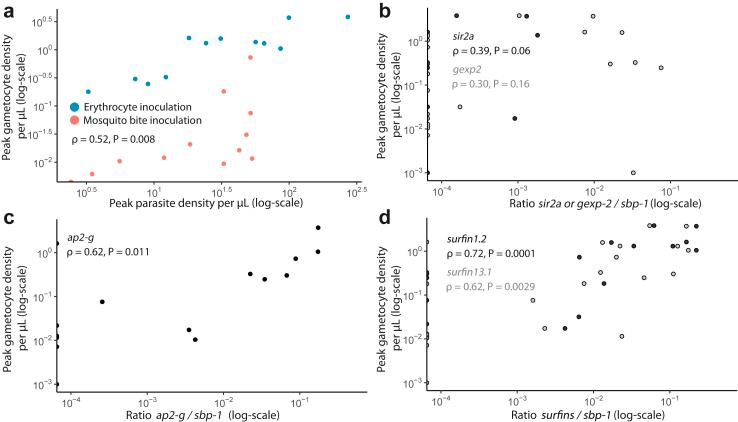
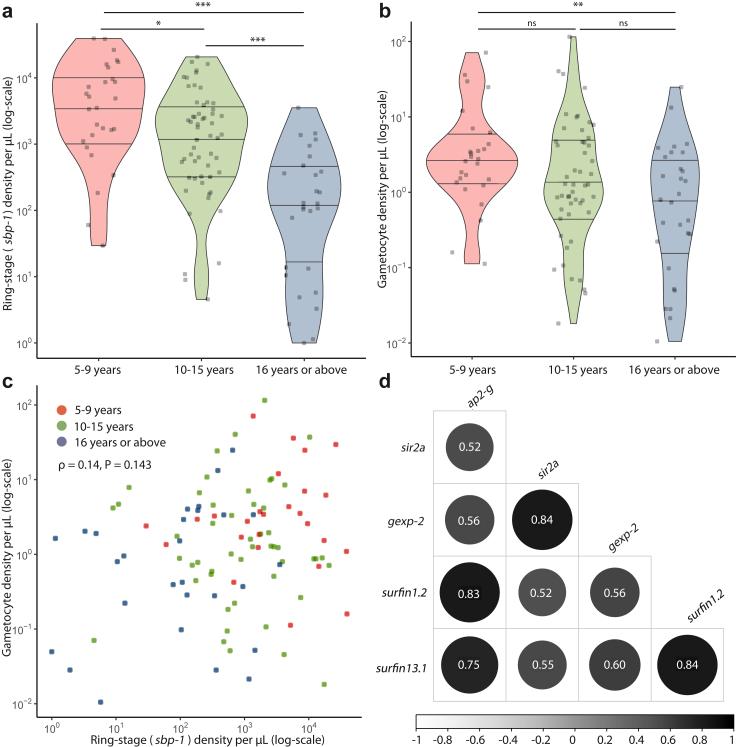
Three of the five markers (ap2-g, surfin1.2, surfin13.1) predicted peak gametocytaemia in the CHMI study. An increase in all five markers in natural infections was associated with an increase in mature gametocytes 14 days later; the effect of sir2a on future gametocytes was strongest (fold change = 1.65, IQR = 1.22-2.24, P = 0.004). Mosquito exposure was not associated with markers of gametocyte formation (ap2-g P = 0.277; sir2a P = 0.499) or carriage of mature gametocytes (P = 0.379).
INTERPRETATION
All five parasite genetic markers predicted gametocyte formation over a single cycle of gametocyte formation and maturation in vivo; sir2a and ap2-g were most closely associated with gametocyte growth dynamics. We observed no evidence to support the hypothesis that exposure to Anopheles mosquito bites stimulates gametocyte formation.
FUNDING
This work was funded by the Bill & Melinda Gates Foundation (INDIE OPP1173572), the European Research Council fellowship (ERC-CoG 864180) and UKRI Medical Research Council (MR/T016272/1) and Wellcome Center (218676/Z/19/Z).
背景
疟原虫血阶段寄生虫在无性繁殖和配子体发育之间保持平衡。很少有研究将这些动态与体内寄生虫遗传标记联系起来;在纵向监测感染中更是如此。环境对配子体形成的影响,如蚊子暴露,可能会影响寄生虫对配子体产生的投资。
方法
我们在两个感染了恶性疟原虫的人群中研究了配子体的产生和无性繁殖;一项人体疟疾感染控制(CHMI)研究和在布基纳法索自然感染人群中进行的为期 28 天的观察性研究,这些人群中蚊子暴露受到控制。我们测量了以前与配子体形成相关的基因转录水平(ap2-g、surfin1.2、surfin13.1、gexp-2)或抑制无性繁殖的水平(sir2a),并将转录水平与环状体寄生虫和成熟配子体密度进行了比较。
结果
在 CHMI 研究中,五个标记中的三个(ap2-g、surfin1.2、surfin13.1)预测了配子体血症的峰值。在自然感染中,所有五个标记的增加都与 14 天后成熟配子体的增加有关;sir2a 对未来配子体的影响最大(倍数变化为 1.65,IQR 为 1.22-2.24,P=0.004)。蚊子暴露与配子体形成标记(ap2-g,P=0.277;sir2a,P=0.499)或成熟配子体的携带无关(P=0.379)。
解释
所有五个寄生虫遗传标记都预测了体内配子体形成的一个周期;sir2a 和 ap2-g 与配子体生长动态最密切相关。我们没有发现证据支持蚊子叮咬暴露会刺激配子体形成的假说。
资金来源
这项工作得到了比尔和梅琳达盖茨基金会(INDIE OPP1173572)、欧洲研究理事会研究员奖(ERC-CoG 864180)和英国研究理事会(MR/T016272/1)和惠康中心(218676/Z/19/Z)的资助。

 Zotero 插件