
亚甲蓝在感染性休克中的应用:系统评价和荟萃分析。
Methylene Blue in Septic Shock: A Systematic Review and Meta-Analysis.
机构信息
Department of Critical Care, Lakeridge Health Corporation, Oshawa, ON, Canada.
Clinical Epidemiology Program, Ottawa Hospital Research Institute, Ottawa, ON, Canada.
出版信息
Crit Care Explor. 2024 Jun 21;6(7):e1110. doi: 10.1097/CCE.0000000000001110. eCollection 2024 Jul 1.
OBJECTIVES
Although clinicians may use methylene blue (MB) in refractory septic shock, the effect of MB on patient-important outcomes remains uncertain. We conducted a systematic review and meta-analysis to investigate the benefits and harms of MB administration in patients with septic shock.
DATA SOURCES
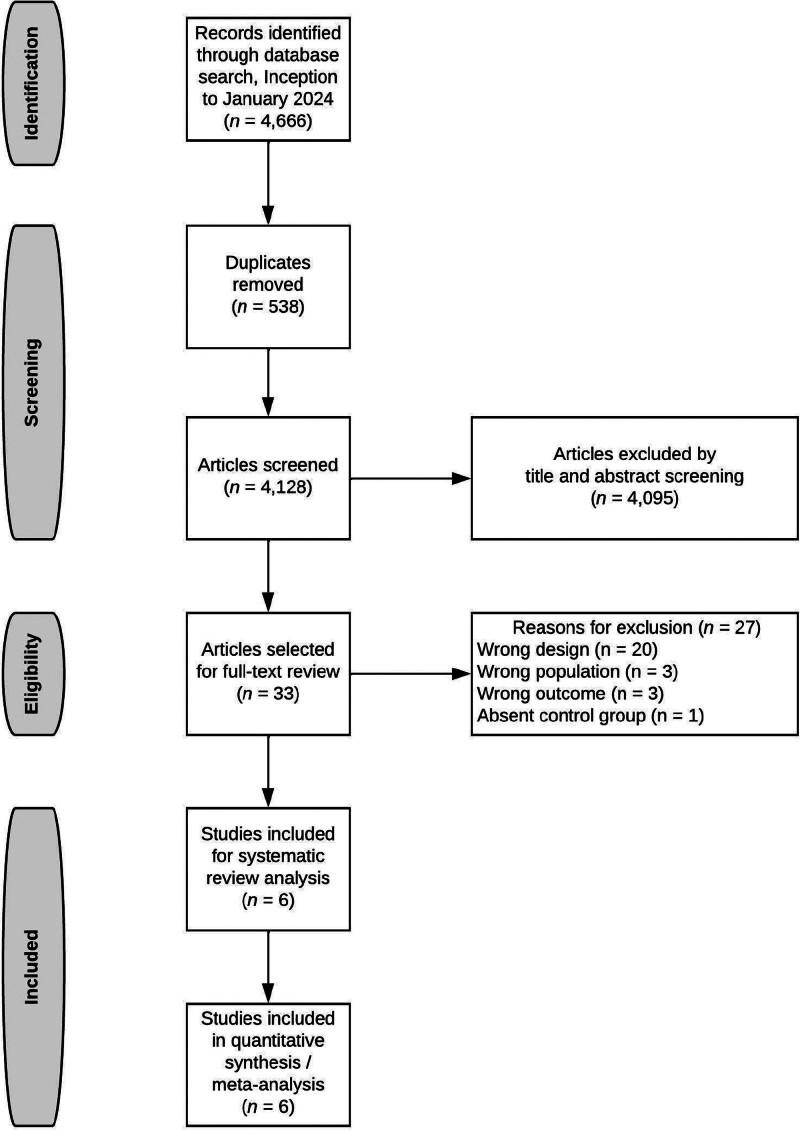
We searched six databases (including PubMed, Embase, and Medline) from inception to January 10, 2024.
STUDY SELECTION
We included randomized clinical trials (RCTs) of critically ill adults comparing MB with placebo or usual care without MB administration.
DATA EXTRACTION
Two reviewers performed screening, full-text review, and data extraction. We pooled data using a random-effects model, assessed the risk of bias using the modified Cochrane tool, and used Grading of Recommendations Assessment, Development, and Evaluation to rate certainty of effect estimates.
DATA SYNTHESIS
We included six RCTs (302 patients). Compared with placebo or no MB administration, MB may reduce short-term mortality (RR [risk ratio] 0.66 [95% CI, 0.47-0.94], low certainty) and hospital length of stay (mean difference [MD] -2.1 d [95% CI, -1.4 to -2.8], low certainty). MB may also reduce duration of vasopressors (MD -31.1 hr [95% CI, -16.5 to -45.6], low certainty), and increase mean arterial pressure at 6 hours (MD 10.2 mm Hg [95% CI, 6.1-14.2], low certainty) compared with no MB administration. The effect of MB on serum methemoglobin concentration was uncertain (MD 0.9% [95% CI, -0.2% to 2.0%], very low certainty). We did not find any differences in adverse events.
CONCLUSIONS
Among critically ill adults with septic shock, based on low-certainty evidence, MB may reduce short-term mortality, duration of vasopressors, and hospital length of stay, with no evidence of increased adverse events. Rigorous randomized trials evaluating the efficacy of MB in septic shock are needed.
REGISTRATION
Center for Open Science (https://osf.io/hpy4j).
目的
尽管临床医生可能会在难治性感染性休克中使用亚甲蓝(MB),但其对患者重要结局的影响仍不确定。我们进行了一项系统评价和荟萃分析,以调查 MB 给药在感染性休克患者中的益处和危害。
数据来源
我们从建库至 2024 年 1 月 10 日在六个数据库(包括 PubMed、Embase 和 Medline)中进行了检索。
研究选择
我们纳入了比较 MB 与安慰剂或无 MB 给药的常规治疗的重症成人随机临床试验(RCT)。
数据提取
两名审查员进行了筛选、全文审查和数据提取。我们使用随机效应模型汇总数据,使用改良 Cochrane 工具评估偏倚风险,并使用推荐评估、制定与评价分级(Grading of Recommendations Assessment, Development, and Evaluation)来评估效果估计的确定性。
数据综合
我们纳入了六项 RCT(302 名患者)。与安慰剂或无 MB 给药相比,MB 可能降低短期死亡率(RR [风险比] 0.66 [95% CI,0.47-0.94],低确定性)和住院时间(平均差值 [MD] -2.1 天 [95% CI,-1.4 至 -2.8],低确定性)。MB 还可能缩短血管加压素的使用时间(MD -31.1 小时 [95% CI,-16.5 至 -45.6],低确定性),并在 6 小时时增加平均动脉压(MD 10.2 毫米汞柱 [95% CI,6.1-14.2],低确定性),与无 MB 给药相比。MB 对血清高铁血红蛋白浓度的影响不确定(MD 0.9% [95% CI,-0.2% 至 2.0%],极低确定性)。我们未发现不良事件存在差异。
结论
在感染性休克的重症成人中,基于低确定性证据,MB 可能降低短期死亡率、血管加压素使用时间和住院时间,且无增加不良事件的证据。需要严格的随机试验来评估 MB 在感染性休克中的疗效。
注册
开放科学中心(https://osf.io/hpy4j)。

 Zotero 插件