
程序性细胞死亡配体 1 血液标志物在免疫检查点抑制剂治疗非小细胞肺癌中的预后意义:系统评价和荟萃分析。
Prognostic significance of programmed cell death ligand 1 blood markers in non-small cell lung cancer treated with immune checkpoint inhibitors: a systematic review and meta-analysis.
机构信息
Department of Oncology, Heping Hospital Affiliated to Changzhi Medical College, Changzhi, Shanxi, China.
出版信息
Front Immunol. 2024 Jun 10;15:1400262. doi: 10.3389/fimmu.2024.1400262. eCollection 2024.
BACKGROUND
Immune checkpoint inhibitors (ICIs) are effective for non-small cell lung cancer (NSCLC) treatment, but the response rate remains low. Programmed cell death ligand 1 (PD-L1) in peripheral blood, including soluble form (sPD-L1), expression on circulating tumor cells (CTCs PD-L1) and exosomes (exoPD-L1), are minimally invasive and promising markers for patient selection and management, but their prognostic significance remains inconclusive. Here, we performed a meta-analysis for the prognostic value of PD-L1 blood markers in NSCLC patients treated with ICIs.
METHODS
Eligible studies were obtained by searching PubMed, EMBAS, Web of Science, and Cochrane Library prior to November 30, 2023. The associations between pre-treatment, post-treatment and dynamic changes of blood PD-L1 levels and progression-free survival (PFS)/over survival (OS) were analyzed by estimating hazard ratio (HR) and 95% confidence interval (CI).
RESULTS
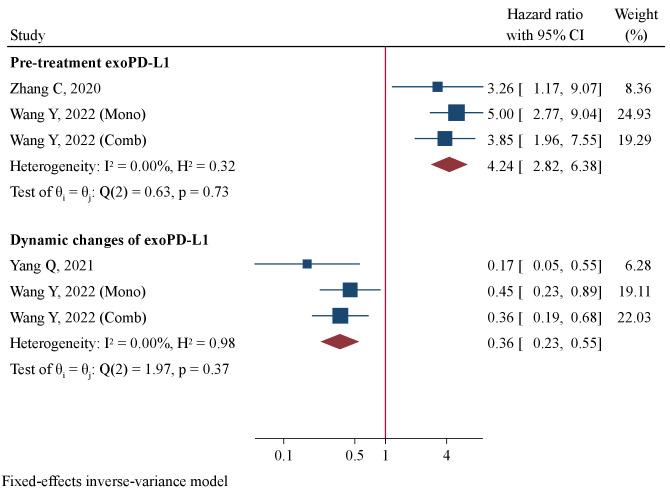
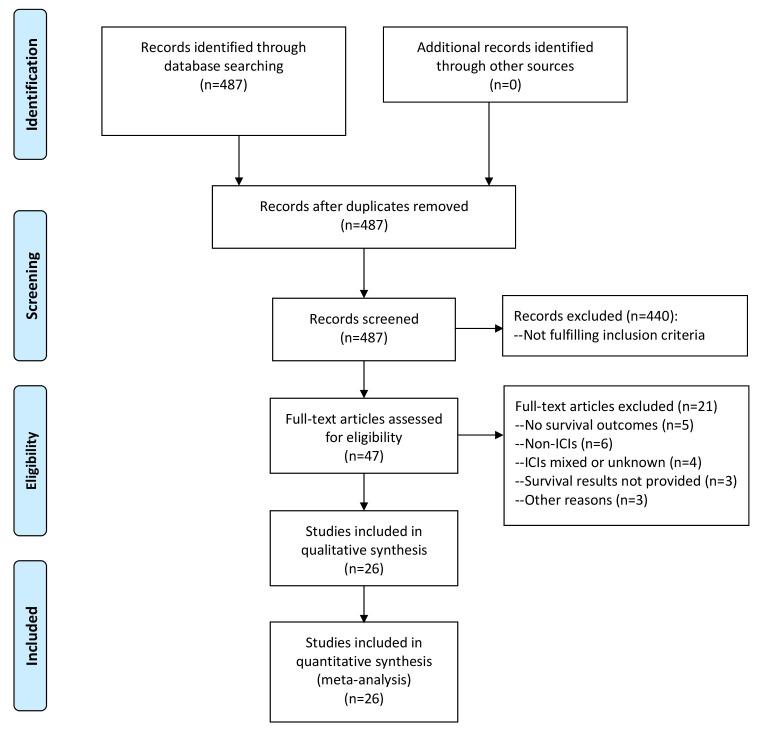
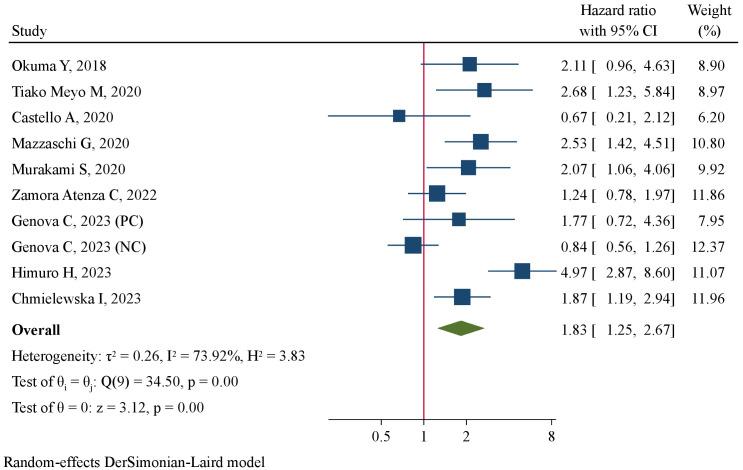
A total of 26 studies comprising 1606 patients were included. High pre- or post-treatment sPD-L1 levels were significantly associated with worse PFS (pre-treatment: HR=1.49, 95%CI 1.13-1.95; post-treatment: HR=2.09, 95%CI 1.40-3.12) and OS (pre-treatment: HR=1.83, 95%CI 1.25-2.67; post-treatment: HR=2.60, 95%CI 1.09-6.20, P=0.032). High pre-treatment exoPD-L1 levels predicted a worse PFS (HR=4.24, 95%CI 2.82-6.38, P<0.001). Pre-treatment PD-L1 CTCs tended to be correlated with prolonged PFS (HR=0.63, 95%CI 0.39-1.02) and OS (HR=0.58, 95%CI 0.36-0.93). Patients with up-regulated exoPD-L1 levels, but not sPD-L1, after ICIs treatment had significantly favorable PFS (HR=0.36, 95%CI 0.23-0.55) and OS (HR=0.24, 95%CI 0.08-0.68).
CONCLUSION
PD-L1 blood markers, including sPD-L1, CTCs PD-L1 and exoPD-L1, can effectively predict prognosis, and may be potentially utilized for patient selection and treatment management for NSCLC patients receiving ICIs.
背景
免疫检查点抑制剂(ICIs)在非小细胞肺癌(NSCLC)治疗中有效,但反应率仍然较低。外周血中的程序性死亡配体 1(PD-L1),包括可溶性形式(sPD-L1)、循环肿瘤细胞(CTCs PD-L1)上的表达和外泌体(exoPD-L1),是具有前景的微创标志物,可用于患者选择和管理,但它们的预后意义仍不确定。在这里,我们对接受 ICI 治疗的 NSCLC 患者的 PD-L1 血液标志物的预后价值进行了荟萃分析。
方法
在 2023 年 11 月 30 日之前,通过搜索 PubMed、EMBAS、Web of Science 和 Cochrane Library 获得了符合条件的研究。通过估计风险比(HR)和 95%置信区间(CI)来分析治疗前、治疗后和血液 PD-L1 水平的动态变化与无进展生存期(PFS)/总生存期(OS)之间的关系。
结果
共有 26 项研究纳入了 1606 名患者。高治疗前或治疗后 sPD-L1 水平与更差的 PFS(治疗前:HR=1.49,95%CI 1.13-1.95;治疗后:HR=2.09,95%CI 1.40-3.12)和 OS(治疗前:HR=1.83,95%CI 1.25-2.67;治疗后:HR=2.60,95%CI 1.09-6.20,P=0.032)显著相关。高治疗前外泌体 PD-L1 水平预测更差的 PFS(HR=4.24,95%CI 2.82-6.38,P<0.001)。治疗前 PD-L1 CTCs 倾向于与延长的 PFS(HR=0.63,95%CI 0.39-1.02)和 OS(HR=0.58,95%CI 0.36-0.93)相关。ICI 治疗后 exoPD-L1 水平上调的患者的 PFS(HR=0.36,95%CI 0.23-0.55)和 OS(HR=0.24,95%CI 0.08-0.68)明显更有利。
结论
PD-L1 血液标志物,包括 sPD-L1、CTCs PD-L1 和外泌体 PD-L1,可有效预测预后,并可能为接受 ICI 治疗的 NSCLC 患者的患者选择和治疗管理提供潜在依据。



 Zotero 插件