
安大略省髋部骨折发生率和骨质疏松症治疗:一项基于人群的回顾性队列研究。
Hip fracture rate and osteoporosis treatment in Ontario: A population-based retrospective cohort study.
机构信息
Department of Health Research Methods, Evidence, and Impact, McMaster University, Hamilton, Canada.
Department of Medicine, McMaster University, Hamilton, Canada.
出版信息
Arch Osteoporos. 2024 Jun 25;19(1):53. doi: 10.1007/s11657-024-01402-6.
UNLABELLED
This population-based study analyzes hip fracture and osteoporosis treatment rates among older adults, stratified by place of residence prior to fracture. Hip fracture rates were higher among older adults living in the community and discharged to long-term care (LTC) after fracture, compared to LTC residents and older adults living in the community. Only 23% of LTC residents at high fracture risk received osteoporosis treatment.
PURPOSE
This population-based study examines hip fracture rate and osteoporosis management among long-term care (LTC) residents > 65 years of age compared to community-dwelling older adults at the time of fracture and admitted to LTC after fracture, in Ontario, Canada.
METHODS
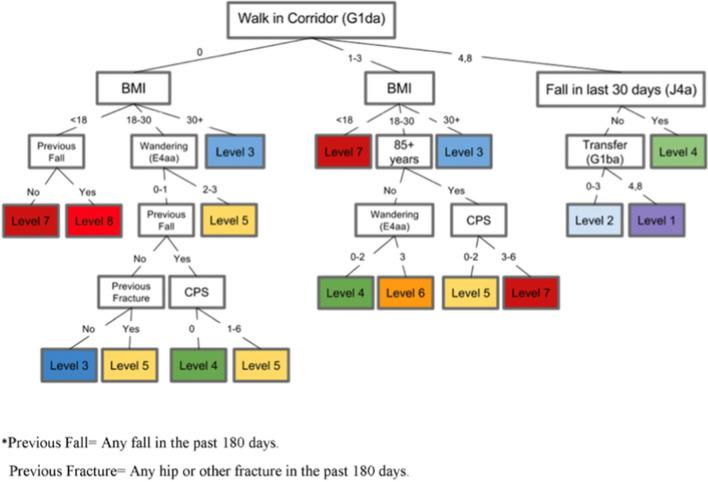
Healthcare utilization and administrative databases were linked using unique, encoded identifiers from the ICES Data Repository to estimate hip fractures (identified using the Public Health Agency of Canada algorithm and International Classification of Diseases (ICD)-10 codes) and osteoporosis management (pharmacotherapy) among adults > 66 years from April 1, 2014 to March 31, 2018. Sex-specific and age-standardized rates were compared by pre-fracture residency and discharge location (i.e., LTC to LTC, community to LTC, or community to community). Fracture risk was determined using the Fracture Risk Scale (FRS).
RESULTS
At baseline (2014/15), the overall age-standardized hip fracture rate among LTC residents was 223 per 10,000 person-years (173 per 10,000 females and 157 per 10,000 males), 509 per 10,000 person-years (468 per 10,000 females and 320 per 10,000 males) among the community to LTC cohort, and 31.5 per 10,000 person-years (43.1 per 10,000 females and 25.6 per 10,000 males). During the 5-year observation period, the overall annual average percent change (APC) for hip fracture increased significantly in LTC (AAPC = + 8.6 (95% CI 5.0 to 12.3; p = 0.004) compared to the community to LTC group (AAPC = + 2.5 (95% CI - 3.0 to 8.2; p = 0.248)) and the community-to-community cohort (AAPC - 3.8 (95% CI - 6.7 to - 0.7; p = 030)). However, hip fracture rate remained higher in the community to LTC group over the study period. There were 33,594 LTC residents identified as high risk of fracture (FRS score 4 +), of which 7777 were on treatment (23.3%).
CONCLUSION
Overall, hip fracture rates have increased in LTC and among community-dwelling adults admitted to LTC after fracture. However, hip fracture rates among community-dwelling adults have decreased over time. A non-significant increase in osteoporosis treatment rates was observed among LTC residents at high risk of fracture (FRS4 +). Residents in LTC are at very high risk for fracture and require individualized based on goals of care and life expectancy.
本基于人群的研究分析了老年人髋部骨折和骨质疏松症治疗率,按骨折前的居住地进行分层。与骨折后入住长期护理 (LTC) 的社区居住者相比,居住在社区但出院至 LTC 的老年人的髋部骨折发生率更高。只有 23% 的高骨折风险的 LTC 居民接受了骨质疏松症治疗。
目的
本基于人群的研究调查了加拿大安大略省与社区居住的老年人相比,65 岁以上 LTC 居民髋部骨折发生率和骨质疏松症管理情况,这些老年人在骨折时居住在社区,骨折后入住 LTC。
方法
使用来自 ICES 数据存储库的唯一编码标识符将医疗保健利用和行政数据库链接起来,以估计 2014 年 4 月 1 日至 2018 年 3 月 31 日期间年龄在 66 岁以上的成年人(通过加拿大公共卫生署算法和国际疾病分类 (ICD)-10 代码识别)的髋部骨折(识别)和骨质疏松症管理(药物治疗)。根据骨折前的居住地点和出院地点(即 LTC 至 LTC、社区至 LTC 或社区至社区)比较性别特异性和年龄标准化率。使用骨折风险评分 (FRS) 确定骨折风险。
结果
在基线 (2014/15 年),LTC 居民的总体年龄标准化髋部骨折率为每 10,000 人年 223 例(每 10,000 名女性 173 例,每 10,000 名男性 157 例),社区至 LTC 队列每 10,000 人年 509 例(每 10,000 名女性 468 例,每 10,000 名男性 320 例),而社区每 10,000 人年 31.5 例(每 10,000 名女性 43.1 例,每 10,000 名男性 25.6 例)。在 5 年观察期内,LTC 中髋部骨折的总体年平均百分比变化 (APC) 显著增加(APC=+8.6(95%CI 5.0 至 12.3;p=0.004)),与社区至 LTC 组(APC=+2.5(95%CI-3.0 至 8.2;p=0.248))和社区至社区队列(APC=-3.8(95%CI-6.7 至-0.7;p=0.30))相比。然而,在研究期间,社区至 LTC 组的髋部骨折率仍然较高。确定了 33594 名 LTC 居民为高骨折风险(FRS 评分 4+),其中 7777 人接受治疗(23.3%)。
结论
总体而言,LTC 和骨折后入住 LTC 的社区居住成年人的髋部骨折率有所增加。然而,随着时间的推移,社区居住成年人的髋部骨折率有所下降。观察到高骨折风险(FRS4+)的 LTC 居民的骨质疏松症治疗率呈非显著增加。居住在 LTC 的居民骨折风险非常高,需要根据护理目标和预期寿命进行个体化治疗。


 Zotero 插件