
TP-LMMSG:一种融合了灵活的氨基酸性质表示的肽预测图神经网络。
TP-LMMSG: a peptide prediction graph neural network incorporating flexible amino acid property representation.
机构信息
Department of Computer Science, City University of Hong Kong, 83 Tat Chee Ave, Kowloon Tong, Kowloon, Hong Kong SAR.
School of Artificial Intelligence, Jilin University, Chang Chun, Ji Lin, China.
出版信息
Brief Bioinform. 2024 May 23;25(4). doi: 10.1093/bib/bbae308.
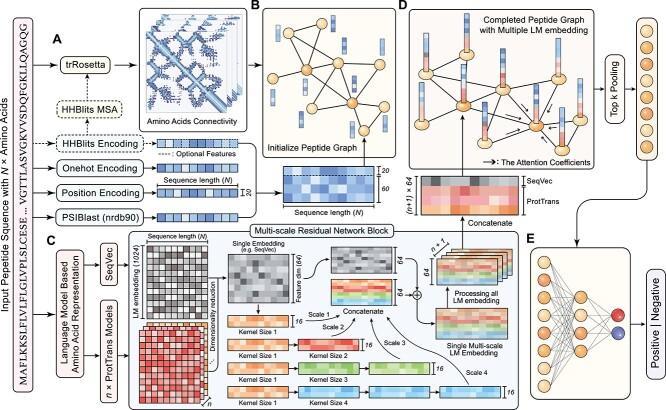
Bioactive peptide therapeutics has been a long-standing research topic. Notably, the antimicrobial peptides (AMPs) have been extensively studied for its therapeutic potential. Meanwhile, the demand for annotating other therapeutic peptides, such as antiviral peptides (AVPs) and anticancer peptides (ACPs), also witnessed an increase in recent years. However, we conceive that the structure of peptide chains and the intrinsic information between the amino acids is not fully investigated among the existing protocols. Therefore, we develop a new graph deep learning model, namely TP-LMMSG, which offers lightweight and easy-to-deploy advantages while improving the annotation performance in a generalizable manner. The results indicate that our model can accurately predict the properties of different peptides. The model surpasses the other state-of-the-art models on AMP, AVP and ACP prediction across multiple experimental validated datasets. Moreover, TP-LMMSG also addresses the challenges of time-consuming pre-processing in graph neural network frameworks. With its flexibility in integrating heterogeneous peptide features, our model can provide substantial impacts on the screening and discovery of therapeutic peptides. The source code is available at https://github.com/NanjunChen37/TP_LMMSG.
生物活性肽治疗一直是一个长期的研究课题。值得注意的是,抗菌肽(AMPs)因其治疗潜力而被广泛研究。同时,近年来,对注释其他治疗性肽(如抗病毒肽(AVPs)和抗癌肽(ACPs)的需求也有所增加。然而,我们认为,现有方案中并没有充分研究肽链的结构和氨基酸之间的内在信息。因此,我们开发了一种新的图深度学习模型,即 TP-LMMSG,它具有轻量级和易于部署的优点,同时以可推广的方式提高注释性能。结果表明,我们的模型可以准确预测不同肽的性质。该模型在多个经过实验验证的数据集上在 AMP、AVP 和 ACP 预测方面均优于其他最先进的模型。此外,TP-LMMSG 还解决了图神经网络框架中耗时的预处理挑战。通过灵活地整合异构肽特征,我们的模型可以对治疗性肽的筛选和发现产生重大影响。源代码可在 https://github.com/NanjunChen37/TP_LMMSG 获得。



 Zotero 插件