
20 年间英国 2200 万人心血管疾病发病率趋势:基于人群的研究。
Trends in cardiovascular disease incidence among 22 million people in the UK over 20 years: population based study.
机构信息
School of Cardiovascular and Metabolic Health, British Heart Foundation Cardiovascular Research Centre, University of Glasgow, Glasgow, UK
Department of Cardiovascular Sciences, KU Leuven, Leuven, Belgium.
出版信息
BMJ. 2024 Jun 26;385:e078523. doi: 10.1136/bmj-2023-078523.
OBJECTIVE
To investigate the incidence of cardiovascular disease (CVD) overall and by age, sex, and socioeconomic status, and its variation over time, in the UK during 2000-19.
DESIGN
Population based study.
SETTING
UK.
PARTICIPANTS
1 650 052 individuals registered with a general practice contributing to Clinical Practice Research Datalink and newly diagnosed with at least one CVD from 1 January 2000 to 30 June 2019.
MAIN OUTCOME MEASURES
The primary outcome was incident diagnosis of CVD, comprising acute coronary syndrome, aortic aneurysm, aortic stenosis, atrial fibrillation or flutter, chronic ischaemic heart disease, heart failure, peripheral artery disease, second or third degree heart block, stroke (ischaemic, haemorrhagic, and unspecified), and venous thromboembolism (deep vein thrombosis or pulmonary embolism). Disease incidence rates were calculated individually and as a composite outcome of all 10 CVDs combined and were standardised for age and sex using the 2013 European standard population. Negative binomial regression models investigated temporal trends and variation by age, sex, and socioeconomic status.
RESULTS
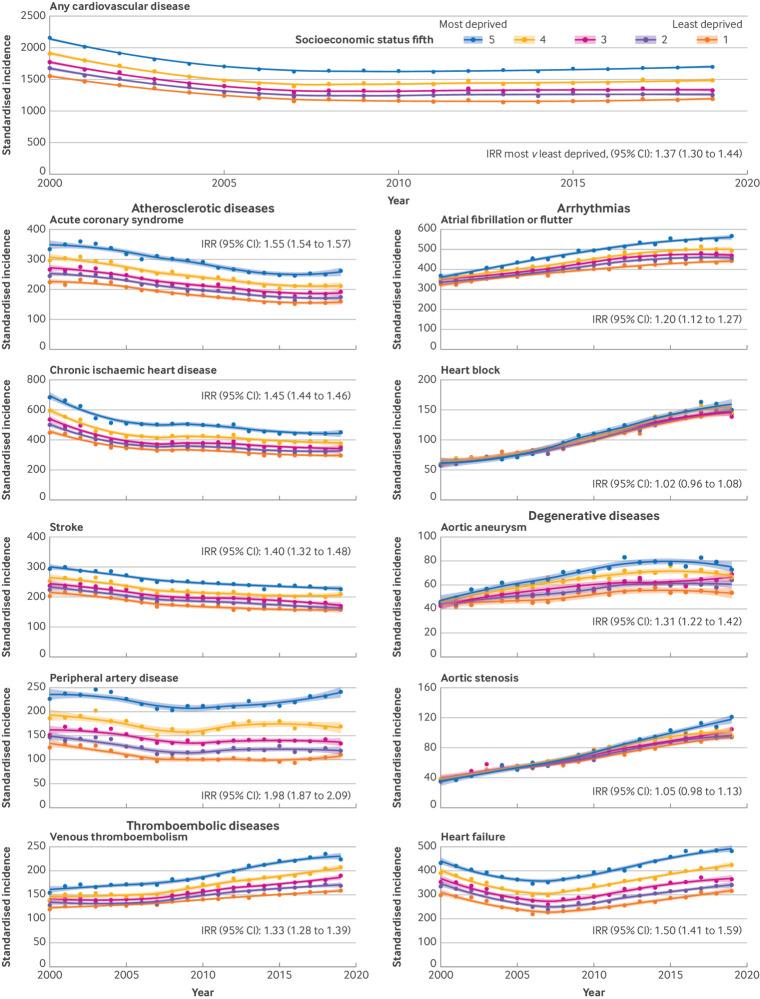
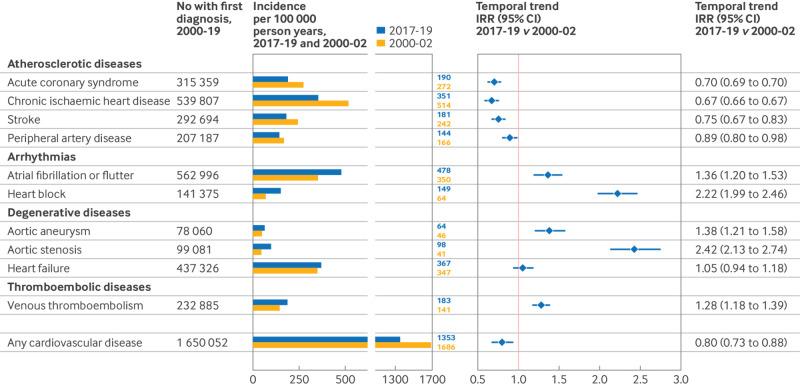
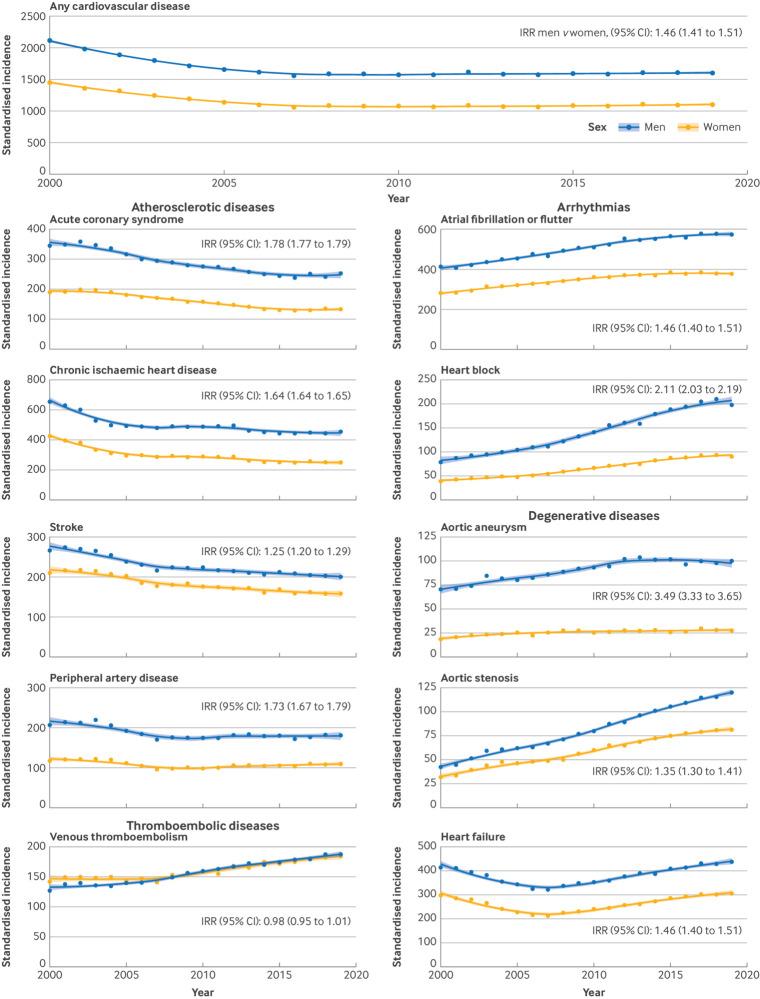
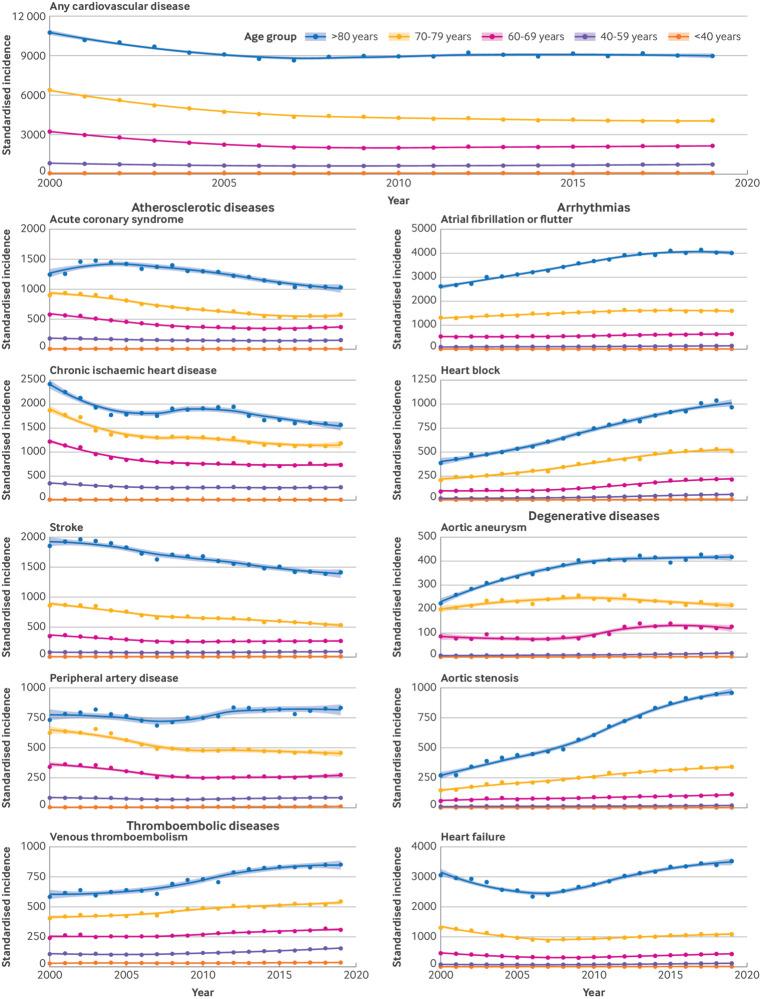
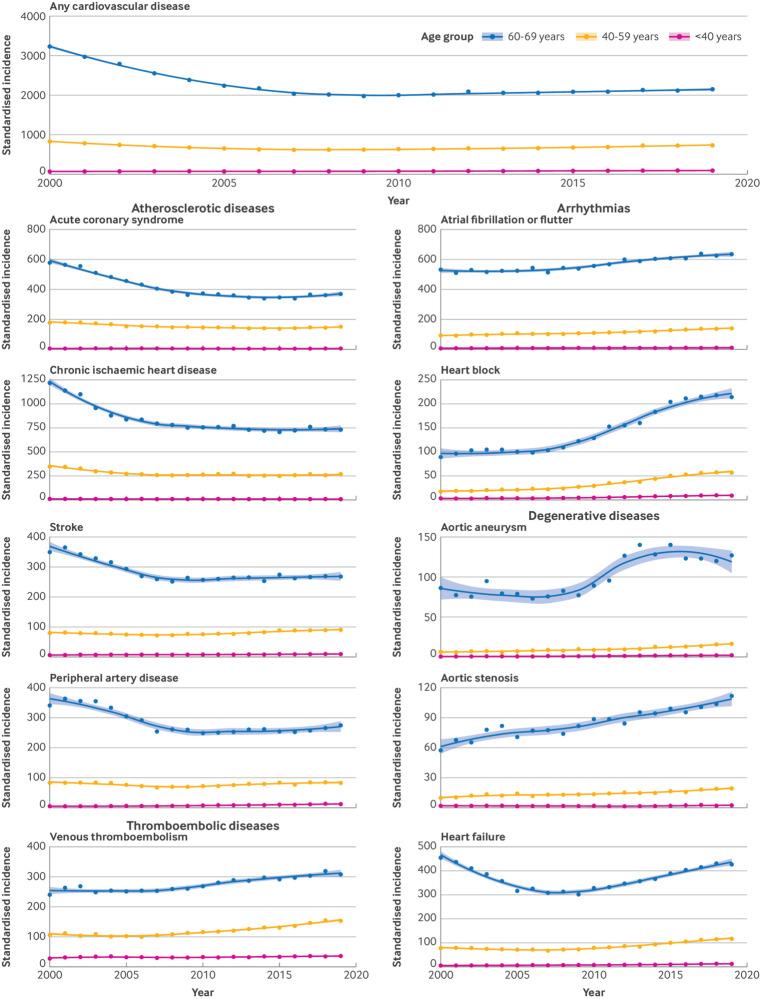
The mean age of the population was 70.5 years and 47.6% (n=784 904) were women. The age and sex standardised incidence of all 10 prespecified CVDs declined by 19% during 2000-19 (incidence rate ratio 2017-19 2000-02: 0.80, 95% confidence interval 0.73 to 0.88). The incidence of coronary heart disease and stroke decreased by about 30% (incidence rate ratios for acute coronary syndrome, chronic ischaemic heart disease, and stroke were 0.70 (0.69 to 0.70), 0.67 (0.66 to 0.67), and 0.75 (0.67 to 0.83), respectively). In parallel, an increasing number of diagnoses of cardiac arrhythmias, valve disease, and thromboembolic diseases were observed. As a result, the overall incidence of CVDs across the 10 conditions remained relatively stable from the mid-2000s. Age stratified analyses further showed that the observed decline in coronary heart disease incidence was largely restricted to age groups older than 60 years, with little or no improvement in younger age groups. Trends were generally similar between men and women. A socioeconomic gradient was observed for almost every CVD investigated. The gradient did not decrease over time and was most noticeable for peripheral artery disease (incidence rate ratio most deprived least deprived: 1.98 (1.87 to 2.09)), acute coronary syndrome (1.55 (1.54 to 1.57)), and heart failure (1.50 (1.41 to 1.59)).
CONCLUSIONS
Despite substantial improvements in the prevention of atherosclerotic diseases in the UK, the overall burden of CVDs remained high during 2000-19. For CVDs to decrease further, future prevention strategies might need to consider a broader spectrum of conditions, including arrhythmias, valve diseases, and thromboembolism, and examine the specific needs of younger age groups and socioeconomically deprived populations.
目的
调查 2000-19 年期间英国心血管疾病(CVD)的总体发病率以及按年龄、性别和社会经济地位的发病率,并探讨其随时间的变化。
设计
基于人群的研究。
设置
英国。
参与者
1650052 名在一般实践中注册并为临床实践研究数据链接做出贡献的个体,他们在 2000 年 1 月 1 日至 2019 年 6 月 30 日期间至少被诊断出患有一种 CVD。
主要观察指标
主要结局是 CVD 的首发诊断,包括急性冠状动脉综合征、主动脉瘤、主动脉瓣狭窄、心房颤动或扑动、慢性缺血性心脏病、心力衰竭、外周动脉疾病、二级或三级心脏阻滞、中风(缺血性、出血性和未特指性)和静脉血栓栓塞症(深静脉血栓形成或肺栓塞)。单独计算了疾病发病率,并将所有 10 种 CVD 组合的复合结局进行了标准化,使用 2013 年欧洲标准人口对年龄和性别进行了标准化。负二项回归模型探讨了时间趋势和按年龄、性别和社会经济地位的变化。
结果
人群的平均年龄为 70.5 岁,47.6%(n=784904)为女性。2000-19 年期间,所有 10 种预先指定的 CVD 的年龄和性别标准化发病率下降了 19%(发病率比 2017-19 年比 2000-02 年:0.80,95%置信区间 0.73 至 0.88)。冠心病和中风的发病率下降了约 30%(急性冠状动脉综合征、慢性缺血性心脏病和中风的发病率比分别为 0.70(0.69 至 0.70)、0.67(0.66 至 0.67)和 0.75(0.67 至 0.83))。与此同时,越来越多的心律失常、瓣膜病和血栓栓塞性疾病的诊断被观察到。因此,在这 10 种情况下,CVD 的总体发病率在整个 2000 年代中期仍相对稳定。分层年龄分析进一步表明,冠心病发病率的下降主要局限于年龄大于 60 岁的人群,年轻人群的发病率几乎没有改善或没有改善。男性和女性的趋势基本相似。几乎每一种研究的 CVD 都存在社会经济梯度。随着时间的推移,这种梯度并没有减少,在周围动脉疾病(最贫困与最富裕之间的发病率比:1.98(1.87 至 2.09))、急性冠状动脉综合征(1.55(1.54 至 1.57))和心力衰竭(1.50(1.41 至 1.59))方面最为明显。
结论
尽管英国在动脉粥样硬化疾病的预防方面取得了重大进展,但 2000-19 年期间 CVD 的总体负担仍然很高。为了进一步降低 CVD 的发病率,未来的预防策略可能需要考虑更广泛的疾病谱,包括心律失常、瓣膜病和血栓栓塞,并检查年轻人群和社会经济弱势群体的特定需求。
 Zotero 插件