
利用人脑类器官芯片进行药物研发中的血脑屏障(BBB)功能障碍和免疫细胞迁移建模。
Modeling of Blood-Brain Barrier (BBB) Dysfunction and Immune Cell Migration Using Human BBB-on-a-Chip for Drug Discovery Research.
机构信息
Applied Research & Operations, Astellas Pharma Inc., Tsukuba 305-8585, Ibaraki, Japan.
Department of Neurology and Clinical Neuroscience, Graduate School of Medicine, Yamaguchi University, Ube 755-8505, Yamaguchi, Japan.
出版信息
Int J Mol Sci. 2024 Jun 12;25(12):6496. doi: 10.3390/ijms25126496.
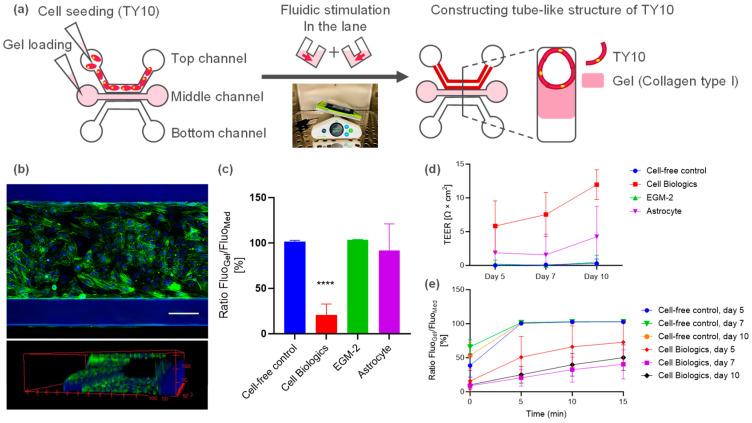
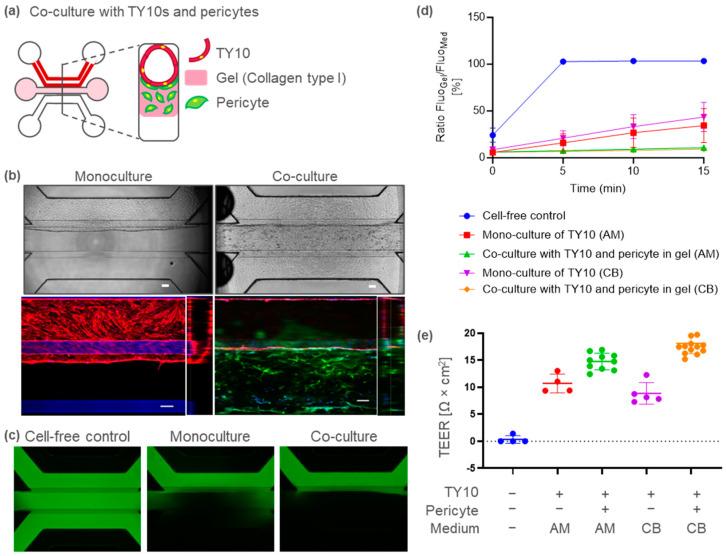
Blood-brain barrier (BBB) dysfunction is a key feature in neuroimmunological and neurodegenerative diseases. In this study, we developed a microfluidic human BBB-on-a-chip to model barrier dysfunction and immune cell migration using immortalized TY10 brain endothelial cells, pericytes, and astrocytes. It was found that immortalized TY10 brain endothelial cells developed a microvascular structure under flow. Pericytes were localized on the basal side surrounding the TY10 microvascular structure, showing an in vivo-like structure. Barrier integrity increased under co-culture with pericytes. In addition, both ethylenediaminetetraacetic acid (EDTA) and anti-Claudin-5 (CLDN5) neutralizing antibody caused a decrease in the transendothelial electrical resistance (TEER). EDTA caused the leakage of 20 kDa dextran, suggesting different effects on the BBB based on the mechanism of action, whereas anti-CLDN5 antibody did not cause leakage. In the tri-culture model, human T cells migrated through endothelial vessels towards basal C-X-C motif chemokine ligand 12 (CXCL12). The live-imaging analysis confirmed the extravasation of fluorescence-labelled T cells in a CXCL12-concentration- and time-dependent manner. Our BBB model had an in vivo-like structure and successfully represented barrier dysfunction and transendothelial T cell migration. In addition, our study suggests that the inhibition of CLDN5 attenuates the BBB in humans. This platform has various potential uses in relation to the BBB in both drug discovery research and in elucidating the mechanisms of central nervous system diseases.
血脑屏障 (BBB) 功能障碍是神经免疫和神经退行性疾病的一个关键特征。在这项研究中,我们开发了一种微流控人 BBB-on-a-chip,使用永生化 TY10 脑内皮细胞、周细胞和星形胶质细胞来模拟屏障功能障碍和免疫细胞迁移。结果发现,永生化 TY10 脑内皮细胞在流动下形成了微血管结构。周细胞定位于 TY10 微血管结构的基底侧,呈现出类似于体内的结构。与周细胞共培养可增加屏障完整性。此外,乙二胺四乙酸 (EDTA) 和抗紧密连接蛋白 5 (CLDN5) 中和抗体均导致跨内皮电阻 (TEER) 降低。EDTA 导致 20 kDa 葡聚糖渗漏,表明基于作用机制对 BBB 具有不同的影响,而抗 CLDN5 抗体则不会导致渗漏。在三细胞培养模型中,人 T 细胞穿过内皮血管向基底 C-X-C 基序趋化因子配体 12 (CXCL12) 迁移。实时成像分析证实了荧光标记的 T 细胞以 CXCL12 浓度和时间依赖性方式发生了渗出。我们的 BBB 模型具有类似于体内的结构,并成功地模拟了屏障功能障碍和跨内皮 T 细胞迁移。此外,我们的研究表明,CLDN5 的抑制可减弱人类的 BBB。该平台在药物发现研究和阐明中枢神经系统疾病的机制方面,在涉及 BBB 的各种应用中具有潜力。



 Zotero 插件