
季铵化合物与精油成分的协同杀菌作用。
Synergistic Bactericidal Effects of Quaternary Ammonium Compounds with Essential Oil Constituents.
作者信息
Pedreira Adrián, Fernandes Susana, Simões Manuel, García Míriam R, Vázquez José Antonio
机构信息
Group of Recycling and Valorization of Waste Materials (REVAL), Spanish National Research Council (IIM-CSIC), Rúa Eduardo Cabello 6, 36208 Vigo, Spain.
Biosystems and Bioprocess Engineering Group (Bio2Eng), Spanish National Research Council (IIM-CSIC), Rúa Eduardo Cabello 6, 36208 Vigo, Spain.
出版信息
Foods. 2024 Jun 11;13(12):1831. doi: 10.3390/foods13121831.
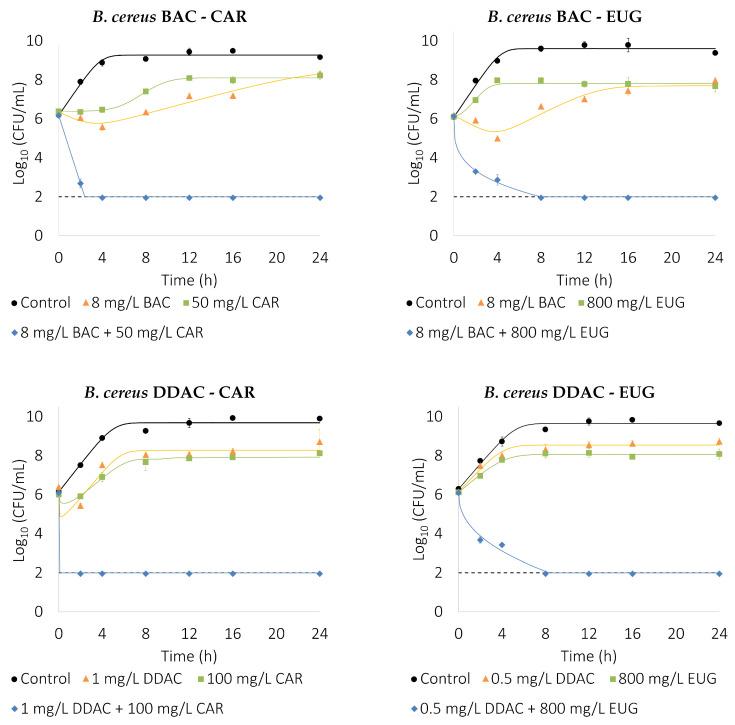
Antimicrobial tolerance is a significant concern in the food industry, as it poses risks to food safety and public health. To overcome this challenge, synergistic combinations of antimicrobials have emerged as a potential solution. In this study, the combinations of two essential oil constituents (EOCs), namely carvacrol (CAR) and eugenol (EUG), with the quaternary ammonium compounds (QACs) benzalkonium chloride (BAC) and didecyldimethylammonium chloride (DDAC) were evaluated for their antimicrobial effects against and , two common foodborne bacteria. The checkerboard assay was employed to determine the fractional inhibitory concentration index (FICI) and the fractional bactericidal concentration index (FBCI), indicating the presence of bactericidal, but not bacteriostatic, synergy in all QAC-EOC combinations. Bactericidal synergism was clearly supported by Bliss independence analysis. The bactericidal activity of the promising synergistic combinations was further validated by time-kill curves, achieving a >4-log reduction of initial bacterial load, which is significant compared to typical industry standards. The combinations containing DDAC showed the highest efficiency, resulting in the eradication of bacterial population in less than 2-4 h. These findings emphasize the importance of considering both bacteriostatic and bactericidal effects when evaluating antimicrobial combinations and the potential of EOC-QAC combinations for sanitization and disinfection in the food industry.
抗菌耐受性是食品工业中的一个重大问题,因为它对食品安全和公众健康构成风险。为了克服这一挑战,抗菌剂的协同组合已成为一种潜在的解决方案。在本研究中,评估了两种精油成分(EOC),即香芹酚(CAR)和丁香酚(EUG),与季铵化合物(QAC)苯扎氯铵(BAC)和二癸基二甲基氯化铵(DDAC)的组合对两种常见食源细菌和的抗菌效果。采用棋盘法测定分数抑菌浓度指数(FICI)和分数杀菌浓度指数(FBCI),表明所有QAC-EOC组合均存在杀菌而非抑菌协同作用。Bliss独立性分析明确支持杀菌协同作用。通过时间-杀菌曲线进一步验证了有前景的协同组合的杀菌活性,初始细菌载量降低了>4个对数,与典型的行业标准相比具有显著意义。含有DDAC的组合显示出最高的效率,在不到2-4小时内即可消除细菌种群。这些发现强调了在评估抗菌组合时考虑抑菌和杀菌效果的重要性,以及EOC-QAC组合在食品工业中用于卫生和消毒的潜力。


 Zotero 插件