
尿毒症毒素、氧化应激和肾纤维化在慢性肾脏病中的作用
Role of Uremic Toxins, Oxidative Stress, and Renal Fibrosis in Chronic Kidney Disease.
作者信息
Frąk Weronika, Dąbek Bartłomiej, Balcerczyk-Lis Marta, Motor Jakub, Radzioch Ewa, Młynarska Ewelina, Rysz Jacek, Franczyk Beata
机构信息
Department of Nephrocardiology, Medical Univeristy of Lodz, ul. Zeromskiego 113, 90-549 Lodz, Poland.
Department of Nephrology, Hypertension and Family Medicine, Medical University of Lodz, ul. Zeromskiego 113, 90-549 Lodz, Poland.
出版信息
Antioxidants (Basel). 2024 Jun 3;13(6):687. doi: 10.3390/antiox13060687.
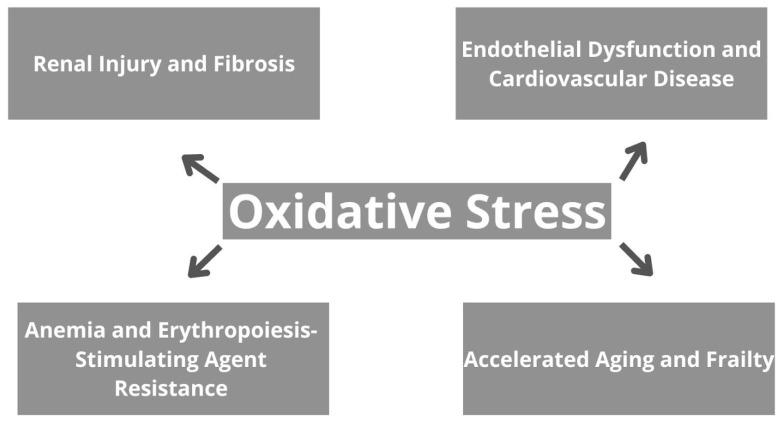
Affecting millions of people worldwide, chronic kidney disease is a serious medical problem. It results in a decrease in glomerular filtration rate below 60 mL/min/1.73 m, albuminuria, abnormalities in urine sediment and pathologies detected by imaging studies lasting a minimum of 3 months. Patients with CKD develop uremia, and as a result of the accumulation of uremic toxins in the body, patients can be expected to suffer from a number of medical consequences such as progression of CKD with renal fibrosis, development of atherosclerosis or increased incidence of cardiovascular events. Another key element in the pathogenesis of CKD is oxidative stress, resulting from an imbalance between the production of antioxidants and the production of reactive oxygen species. Oxidative stress contributes to damage to cellular proteins, lipids and DNA and increases inflammation, perpetuating kidney dysfunction. Additionally, renal fibrogenesis involving the accumulation of fibrous tissue in the kidneys occurs. In our review, we also included examples of forms of therapy for CKD. To improve the condition of CKD patients, pharmacotherapy can be used, as described in our review. Among the drugs that improve the prognosis of patients with CKD, we can include: GLP-1 analogues, SGLT2 inhibitors, Finerenone monoclonal antibody-Canakinumab and Sacubitril/Valsartan.
慢性肾脏病影响着全球数百万人,是一个严重的医学问题。它导致肾小球滤过率降至60 mL/分钟/1.73平方米以下、蛋白尿、尿沉渣异常以及影像学检查发现的病理改变,且持续至少3个月。慢性肾脏病患者会发展为尿毒症,由于体内尿毒症毒素的积累,患者可能会出现许多医学后果,如慢性肾脏病伴肾纤维化进展、动脉粥样硬化的发展或心血管事件发生率增加。慢性肾脏病发病机制中的另一个关键因素是氧化应激,它是由抗氧化剂产生与活性氧产生之间的失衡引起的。氧化应激会导致细胞蛋白质、脂质和DNA损伤,并加剧炎症,使肾功能障碍持续存在。此外,还会发生肾纤维化,即肾脏中纤维组织的积累。在我们的综述中,我们还列举了慢性肾脏病的治疗方法实例。如我们的综述所述,为改善慢性肾脏病患者的状况,可以采用药物治疗。在改善慢性肾脏病患者预后的药物中,我们可以列举:胰高血糖素样肽-1类似物、钠-葡萄糖协同转运蛋白2抑制剂、非奈利酮单克隆抗体——卡那单抗以及沙库巴曲/缬沙坦。



 Zotero 插件