
光动力疗法对……菌属的影响及其在牙科中的应用:一项范围综述
The Effect of Photodynamic Therapy on spp. and Its Application in Dentistry: A Scoping Review.
作者信息
Rubilar-Huenchuman Mariaignacia, Ortega-Villanueva Camilo, González Iván A, Palavecino Christian Erick
机构信息
Laboratorio de Microbiología Celular, Facultad de Medicina y Ciencias de la Salud, Universidad Central de Chile, Lord Cochrane 418, Santiago 8330546, Chile.
Departamento de Química, Facultad de Ciencias Naturales, Matemática y del Medio Ambiente, Universidad Tecnológica Metropolitana, Las Palmeras 3360, Ñuñoa, Santiago 7800003, Chile.
出版信息
Pharmaceutics. 2024 Jun 18;16(6):825. doi: 10.3390/pharmaceutics16060825.
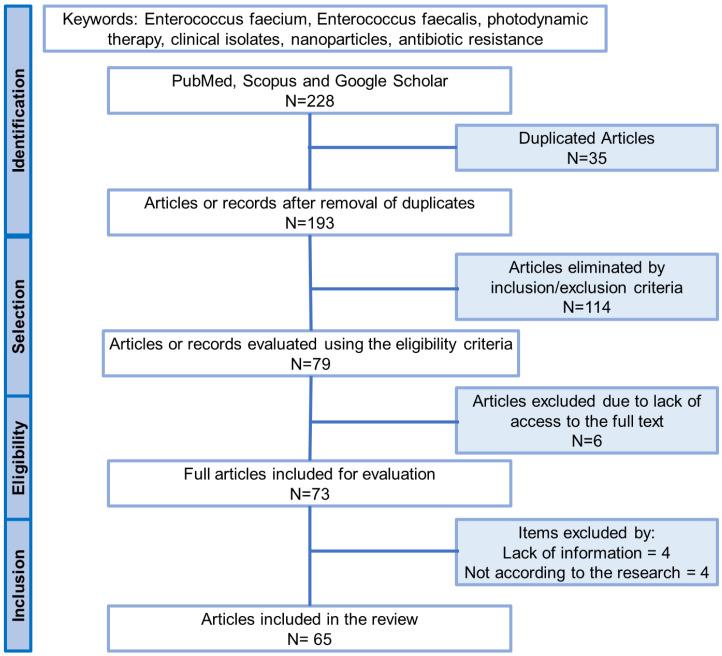
spp. are Gram-positive bacteria that cause mild to severe infections, many associated with the oral cavity, such as periapical infections and healthcare-associated infections (HAIs). Many of these infections become serious diseases that are difficult to resolve, specifically when multidrug-resistant (MDR) strains cause them. In recent years, the number of MDR strains of spp. has increased significantly. This increased prevalence of MDR strains produces significant pressure to generate more antimicrobial therapies, but there is a decline in the production of new antibiotics, driving the development of complementary therapies, such as photodynamic therapy (PDT). PDT combines a photosensitizer agent (PS), light, and oxygen to cause photooxidative stress in bacterial cells. PDT can eradicate spp. contaminations, improve the classic cleaning processes, and eradicate the bacteria in dental pieces. PDT's effectiveness can be improved with nanoparticles that function as carriers. Our work aims to describe the advances in PDT against spp. as a complement to antibiotic therapy, focusing on infections by and , dental hygiene, and using nanoparticles to improve the antimicrobial effect. A systematic bibliographic search without a meta-analysis was conducted on various databases, using inclusion and exclusion criteria to identify the most relevant research. Of the 193 non-redundant articles found, 65 were selected for a systematic review, from which a summary table was created and a manual description was made. Photodynamic therapy for treating and is a widely studied area, with promising results concerning bactericidal effectiveness and reductions in biofilm formation, particularly in regard to dental hygiene. Because most of the studies were conducted in vitro or ex vivo, the results indicated that there were not sufficient data to initiate clinical trials for safety and efficacy studies on humans.
[细菌名称]属革兰氏阳性菌,可引起从轻度到重度的感染,许多感染与口腔有关,如根尖周感染和医疗保健相关感染(HAIs)。其中许多感染会发展成难以解决的严重疾病,特别是当多重耐药(MDR)菌株引起这些感染时。近年来,[细菌名称]属的多重耐药菌株数量显著增加。多重耐药菌株的这种增加的流行率对开发更多抗菌疗法产生了巨大压力,但新抗生素的产量却在下降,这推动了诸如光动力疗法(PDT)等补充疗法的发展。光动力疗法将光敏剂(PS)、光和氧气结合起来,在细菌细胞中引起光氧化应激。光动力疗法可以根除[细菌名称]属的污染,改善传统的清洁过程,并消除牙科器械上的细菌。作为载体的纳米颗粒可以提高光动力疗法的有效性。我们的工作旨在描述光动力疗法针对[细菌名称]属作为抗生素治疗补充的进展,重点关注[细菌名称]和[细菌名称]引起的感染、口腔卫生以及使用纳米颗粒提高抗菌效果。我们在各种数据库中进行了无元分析的系统文献检索,使用纳入和排除标准来确定最相关的研究。在找到的193篇非冗余文章中,65篇被选进行系统综述,从中创建了一个汇总表并进行了人工描述。用于治疗[细菌名称]和[细菌名称]的光动力疗法是一个广泛研究的领域,在杀菌效果和减少生物膜形成方面有令人鼓舞的结果,特别是在口腔卫生方面。由于大多数研究是在体外或离体条件下进行的,结果表明没有足够的数据启动关于人类安全性和有效性研究的临床试验。
 Zotero 插件