
对背痛和骨关节炎的扑热息痛联合治疗:系统评价和荟萃分析。
Paracetamol Combination Therapy for Back Pain and Osteoarthritis: A Systematic Review and Meta-Analyses.
机构信息
Sydney School of Public Health, The University of Sydney, Sydney, NSW, Australia.
Institute for Musculoskeletal Health, Sydney Local Health District, Sydney, NSW, Australia.
出版信息
Drugs. 2024 Aug;84(8):953-967. doi: 10.1007/s40265-024-02065-w. Epub 2024 Jun 28.
BACKGROUND AND OBJECTIVE
Although paracetamol (acetaminophen) combined with other analgesics can reduce pain intensity in some pain conditions, its effectiveness in managing low back pain and osteoarthritis is unclear. This systematic review investigated whether paracetamol combination therapy is more effective and safer than monotherapy or placebo in low back pain and osteoarthritis.
METHODS
Online database searches were conducted for randomised trials that evaluated paracetamol combined with another analgesic compared to a placebo or the non-paracetamol ingredient in the combination (monotherapy) in low back pain and osteoarthritis. The primary outcome was a change in pain. Secondary outcomes were (serious) adverse events, changes in disability and quality of life. Follow-up was immediate (≤ 2 weeks), short (> 2 weeks but ≤ 3 months), intermediate (> 3 months but < 12 months) or long term (≥ 12 months). A random-effects meta-analysis was conducted. Risk of bias was assessed using the original Cochrane tool, and quality of evidence using Grading of Recommendations Assessment, Development and Evaluation (GRADE).
RESULTS
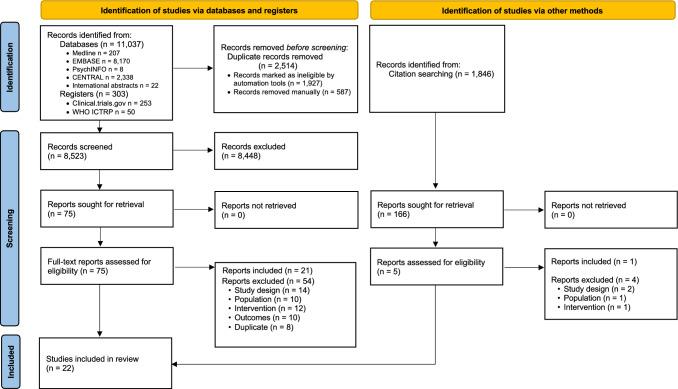
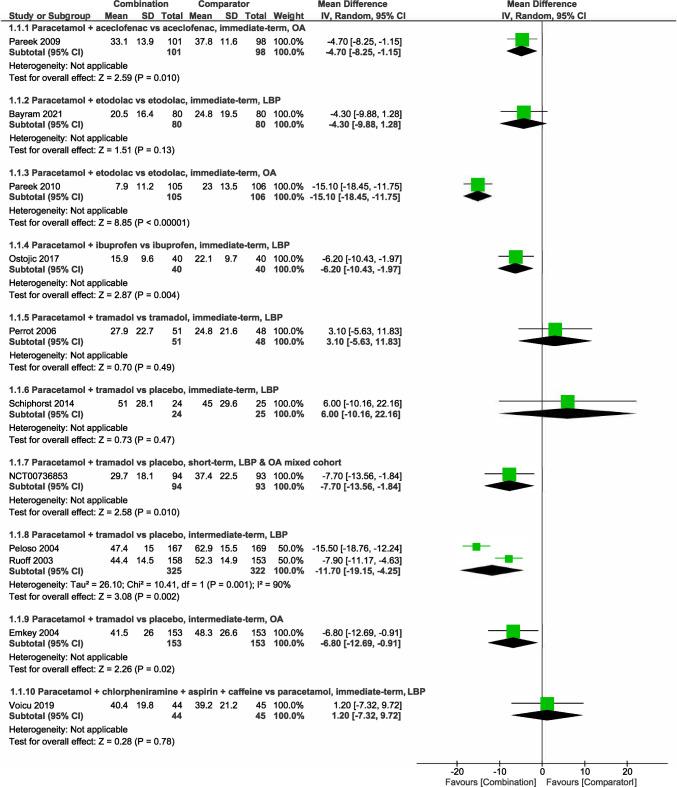
Twenty-two studies were included. Pain was reduced with oral paracetamol plus a non-steroidal anti-inflammatory drug (NSAID) at immediate term in low back pain (paracetamol plus ibuprofen vs ibuprofen [mean difference (MD) - 6.2, 95% confidence interval (CI) -10.4 to -2.0, moderate evidence]) and in osteoarthritis (paracetamol plus aceclofenac vs aceclofenac [MD - 4.7, 95% CI - 8.3 to - 1.2, moderate certainty evidence] and paracetamol plus etodolac vs etodolac [MD - 15.1, 95% CI - 18.5 to - 11.8; moderate certainty evidence]). Paracetamol plus oral tramadol reduced pain compared with placebo at intermediate term for low back pain (MD - 11.7, 95% CI - 19.2 to - 4.3; very low certainty evidence) and osteoarthritis (MD - 6.8, 95% CI - 12.7 to -0.9; moderate certainty evidence). Disability scores improved in half the comparisons. Quality of life was infrequently measured. All paracetamol plus NSAID combinations did not increase the risk of adverse events compared to NSAID monotherapy.
CONCLUSIONS
Low-to-moderate quality evidence supports the oral use of some paracetamol plus NSAID combinations for short-term pain relief with no increased risk of harm for low back pain and osteoarthritis compared to its non-paracetamol monotherapy comparator.
背景与目的
尽管对乙酰氨基酚(扑热息痛)与其他镇痛药联合使用可以降低某些疼痛状况下的疼痛强度,但它在管理腰痛和骨关节炎方面的有效性尚不清楚。本系统评价旨在调查扑热息痛联合治疗是否比单药治疗或安慰剂更有效和更安全,用于腰痛和骨关节炎。
方法
对评估扑热息痛联合另一种镇痛药与安慰剂或联合用药中非扑热息痛成分(单药治疗)治疗腰痛和骨关节炎的随机试验进行了在线数据库检索。主要结局是疼痛变化。次要结局为(严重)不良事件、残疾和生活质量变化。随访时间为即时(≤2 周)、短期(>2 周但≤3 个月)、中期(>3 个月但<12 个月)或长期(≥12 个月)。采用随机效应荟萃分析。使用原始 Cochrane 工具评估偏倚风险,并使用 Grading of Recommendations Assessment, Development and Evaluation (GRADE) 评估证据质量。
结果
共纳入 22 项研究。在腰痛中,口服扑热息痛加非甾体抗炎药(NSAID)在即时期可减轻疼痛(扑热息痛加布洛芬与布洛芬相比[平均差值(MD)-6.2,95%置信区间(CI)-10.4 至-2.0,中等质量证据]),在骨关节炎中(扑热息痛加醋氯芬酸与醋氯芬酸相比[MD-4.7,95%CI-8.3 至-1.2,中等确定性证据]和扑热息痛加依托度酸与依托度酸相比[MD-15.1,95%CI-18.5 至-11.8;中等确定性证据])。与安慰剂相比,扑热息痛加口服曲马多在腰痛的中期可减轻疼痛(MD-11.7,95%CI-19.2 至-4.3;极低确定性证据)和骨关节炎(MD-6.8,95%CI-12.7 至-0.9;中等确定性证据)。半数比较中残疾评分有所改善。生活质量很少被测量。与 NSAID 单药治疗相比,所有扑热息痛加 NSAID 联合用药并未增加不良事件的风险。
结论
低至中等质量证据支持短期使用某些扑热息痛加 NSAID 联合治疗腰痛和骨关节炎,与非扑热息痛单药治疗相比,疼痛缓解效果更好,且不会增加伤害风险。

 Zotero 插件