
富含白细胞介素-1β的炎性巨噬细胞在急性主动脉夹层中的强烈作用。
Intense impact of IL-1β expressing inflammatory macrophages in acute aortic dissection.
机构信息
Division of Cardiovascular Surgery, Department of Surgery, Kobe University Graduate School of Medicine, 7-5-2 Kusunoki-cho, Chuo-ku, Kobe, 6500017, Japan.
Division of Cardiovascular Medicine, Department of Internal Medicine, Kobe University Graduate School of Medicine, Kobe, Japan.
出版信息
Sci Rep. 2024 Jun 28;14(1):14893. doi: 10.1038/s41598-024-65931-3.
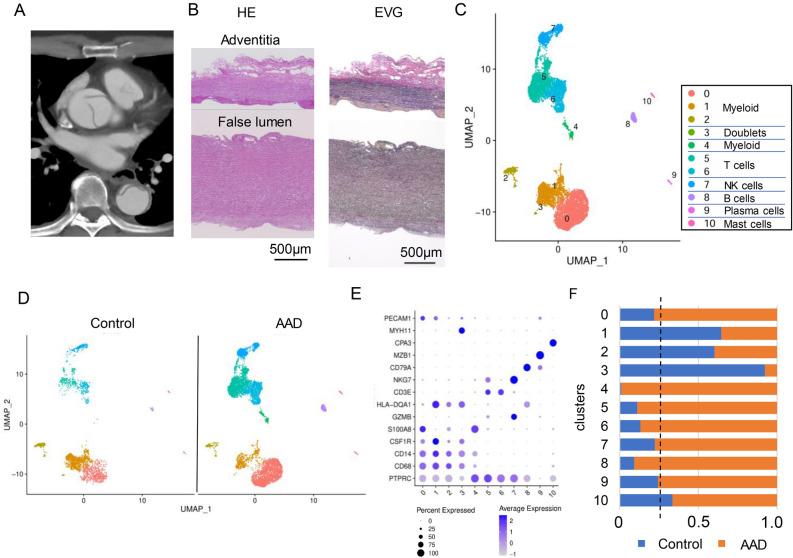
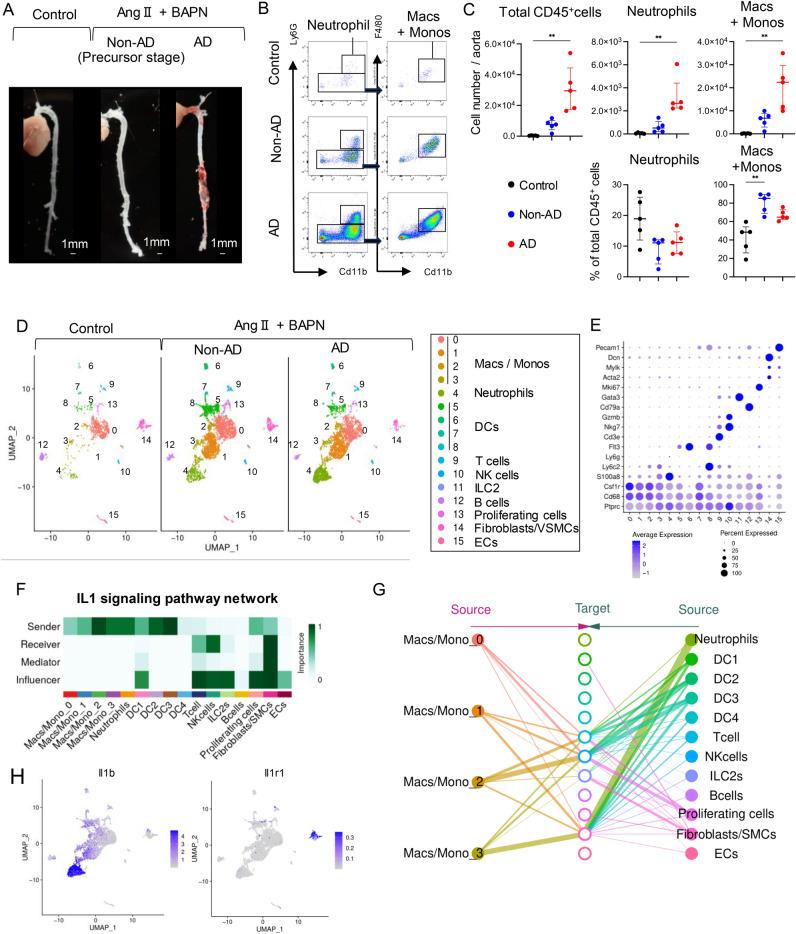
There is no treatment for acute aortic dissection (AAD) targeting inflammatory cells. We aimed to identify the new therapeutic targets associated with inflammatory cells. We characterized the specific distribution of myeloid cells of both human type A AAD samples and a murine AAD model generated using angiotensin II (ANGII) and β-aminopropionitrile (BAPN) by single-cell RNA sequencing (scRNA-seq). We also examined the effect of an anti-interleukin-1β (IL-1β) antibody in the murine AAD model. IL1B inflammatory macrophages and classical monocytes were increased in human AAD samples. Trajectory analysis demonstrated that IL1B inflammatory macrophages differentiated from S100A8/9/12 classical monocytes uniquely observed in the aorta of AAD. We found increased infiltration of neutrophils and monocytes with the expression of inflammatory cytokines in the aorta and accumulation of inflammatory macrophages before the onset of macroscopic AAD in the murine AAD model. In blocking experiments using an anti-IL-1β antibody, it improved survival of murine AAD model by preventing elastin degradation. We observed the accumulation of inflammatory macrophages expressing IL-1β in both human AAD samples and in a murine AAD model. Anti-IL-1β antibody could improve the mortality rate in mice, suggesting that it may be a treatment option for AAD.
针对炎症细胞的急性主动脉夹层(AAD)尚无治疗方法。我们旨在确定与炎症细胞相关的新治疗靶点。我们通过单细胞 RNA 测序(scRNA-seq)对来自人类 AAD 样本和使用血管紧张素 II(ANGII)和β-氨基丙腈(BAPN)生成的小鼠 AAD 模型的髓样细胞的特定分布进行了特征描述。我们还检查了抗白细胞介素-1β(IL-1β)抗体在小鼠 AAD 模型中的作用。在人类 AAD 样本中,IL1B 炎性巨噬细胞和经典单核细胞增加。轨迹分析表明,IL1B 炎性巨噬细胞从 S100A8/9/12 经典单核细胞分化而来,仅在 AAD 的主动脉中观察到。我们发现,在小鼠 AAD 模型中,主动脉中中性粒细胞和单核细胞的浸润增加,表达炎症细胞因子,并在出现宏观 AAD 之前,炎症巨噬细胞积聚。在使用抗 IL-1β 抗体的阻断实验中,它通过防止弹性蛋白降解改善了小鼠 AAD 模型的存活率。我们观察到在人类 AAD 样本和小鼠 AAD 模型中均积累了表达 IL-1β 的炎症巨噬细胞。抗 IL-1β 抗体可提高小鼠的死亡率,表明它可能是 AAD 的一种治疗选择。



 Zotero 插件