
与经典心肌炎相比,COVID-19疫苗相关心肌炎的心脏磁共振成像
Cardiac Magnetic Resonance Imaging in COVID-19 Vaccine-Associated Myocarditis Compared With Classical Myocarditis.
作者信息
Aviv Yaron, Shiyovich Arthur, Plakht Ygal, Witberg Guy, Weissman Maya, Shafir Gideon, Kornowski Ran, Hamdan Ashraf
机构信息
Department of Cardiology, Rabin Medical Center, Petah Tikva, Israel.
Faculty of Medicine, Tel-Aviv University, Tel Aviv, Israel.
出版信息
JACC Adv. 2023 Nov 24;2(10):100726. doi: 10.1016/j.jacadv.2023.100726. eCollection 2023 Dec.
BACKGROUND
Studies comparing COVID-19 vaccine-associated and classical myocarditis (CM) are lacking.
OBJECTIVES
The purpose of this study was to compare cardiac magnetic resonance (CMR) imaging findings and short-term clinical outcomes in patients with messenger RNA COVID-19 postvaccination myocarditis (PVM) and CM.
METHODS
This was a retrospective study of patients with myocarditis: 31 with PVM and 46 with CM. Patients underwent a CMR protocol scan including T1 and T2 sequences. Late gadolinium enhancement (LGE) was expressed as percentage of left ventricular myocardial mass and the extracellular volume was calculated based on precontrast and postcontrast T1 images. Clinical outcomes included heart failure hospitalizations and mortality.
RESULTS
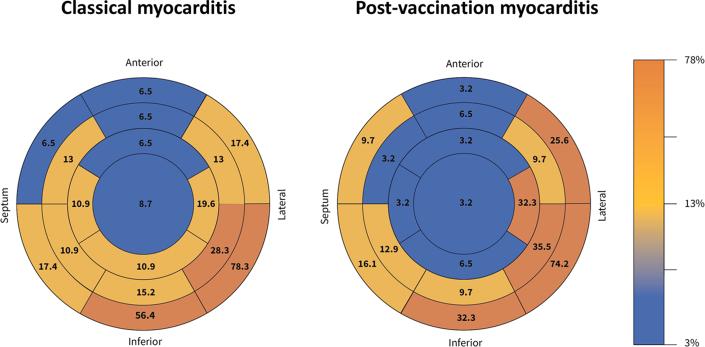
Study patients were predominantly male (81% in PVM vs 89% in CM, = 0.330). Patients with PVM had lower T1 values compared with CM (1,064.2 ± 67.0 ms vs 1,081.6 ± 41.9 ms, = 0.032), although T2 and extracellular volume values were similar in both groups. Left ventricular ejection fraction and LGE were similar in both groups. The most frequent location of LGE was the basal inferolateral wall. PVM more commonly demonstrated a mid-wall LGE pattern while CM demonstrated a subepicardial LGE pattern. Compared with CM, patients with PVM were more likely to have a pericardial effusion (42% vs 17%, = 0.018) and pericardial LGE (38% vs 13%, = 0.009). During short-term follow-up (median 300 days for PVM, 319 days for CM), there were no deaths or heart failure hospitalizations in either group.
CONCLUSIONS
Our study shows similar CMR imaging findings and short-term outcomes in PVM and CM, although PVM was associated with milder myocardial abnormalities and more frequent pericardial involvement.
背景
缺乏比较新型冠状病毒肺炎(COVID-19)疫苗相关心肌炎和经典心肌炎(CM)的研究。
目的
本研究旨在比较信使核糖核酸COVID-19疫苗接种后心肌炎(PVM)患者和CM患者的心脏磁共振(CMR)成像结果及短期临床结局。
方法
这是一项对心肌炎患者的回顾性研究:31例PVM患者和46例CM患者。患者接受了包括T1和T2序列的CMR方案扫描。延迟钆增强(LGE)以左心室心肌质量的百分比表示,并根据对比剂前和对比剂后T1图像计算细胞外容积。临床结局包括因心力衰竭住院和死亡率。
结果
研究患者以男性为主(PVM组为81%,CM组为89%,P = 0.330)。与CM患者相比,PVM患者的T1值较低(1064.2±67.0毫秒对1081.6±41.9毫秒,P = 0.032),尽管两组的T2值和细胞外容积值相似。两组的左心室射血分数和LGE相似。LGE最常见的部位是基底下侧壁。PVM更常表现为中层心肌LGE模式,而CM表现为心外膜下LGE模式。与CM相比,PVM患者更易出现心包积液(42%对17%,P = 0.018)和心包LGE(38%对13%,P = 0.009)。在短期随访期间(PVM组中位随访300天,CM组中位随访319天),两组均无死亡或因心力衰竭住院的情况。
结论
我们的研究表明,PVM和CM在CMR成像结果和短期结局方面相似,尽管PVM与较轻的心肌异常和更频繁的心包受累有关。



 Zotero 插件