
传染病中的细胞外囊泡与内皮功能障碍
Extracellular vesicles and endothelial dysfunction in infectious diseases.
作者信息
Zhang Linfang, Chi Jingshu, Wu Hao, Xia Xiujuan, Xu Canxia, Hao Hong, Liu Zhenguo
机构信息
Department of Gastroenterology The Second Affiliated Hospital of Nanchang University Nanchang Jiangxi China.
Center for Precision Medicine and Division of Cardiovascular Medicine Department of Medicine University of Missouri School of Medicine Columbia Missouri USA.
出版信息
J Extracell Biol. 2024 Apr 12;3(4):e148. doi: 10.1002/jex2.148. eCollection 2024 Apr.
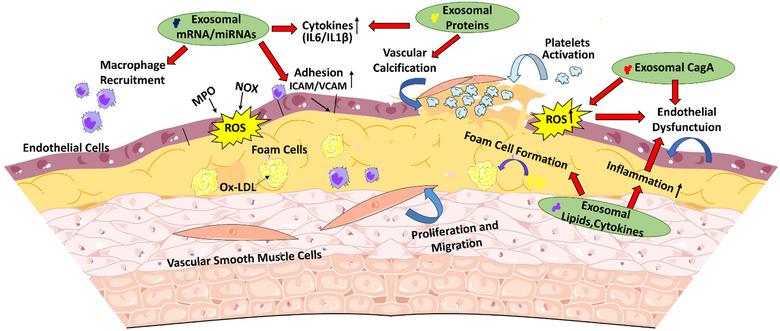
Cardiovascular diseases (CVDs) remain the leading cause of mortality and morbidity globally. Studies have shown that infections especially bacteraemia and sepsis are associated with increased risks for endothelial dysfunction and related CVDs including atherosclerosis. Extracellular vesicles (EVs) are small, sealed membrane-derived structures that are released into body fluids and blood from cells and/or microbes and are critically involved in a variety of important cell functions and disease development, including intercellular communications, immune responses and inflammation. It is known that EVs-mediated mechanism(s) is important in the development of endothelial dysfunction in infections with a diverse spectrum of microorganisms including , , SARS-CoV-2 (the virus for COVID-19) and . infection is one of the most common infections globally. During infection, EVs can carry components, such as lipopolysaccharide, cytotoxin-associated gene A, or vacuolating cytotoxin A, and transfer these substances into endothelial cells, triggering inflammatory responses and endothelial dysfunction. This review is to illustrate the important role of EVs in the pathogenesis of infectious diseases, and the development of endothelial dysfunction in infectious diseases especially infection, and to discuss the potential mechanisms and clinical implications.
心血管疾病(CVDs)仍然是全球范围内导致死亡和发病的主要原因。研究表明,感染尤其是菌血症和败血症与内皮功能障碍及相关心血管疾病(包括动脉粥样硬化)风险增加有关。细胞外囊泡(EVs)是从细胞和/或微生物释放到体液和血液中的小型、密封的膜衍生结构,在多种重要细胞功能和疾病发展中起关键作用,包括细胞间通讯、免疫反应和炎症。已知EVs介导的机制在包括 、 、严重急性呼吸综合征冠状病毒2(SARS-CoV-2,即导致新冠肺炎的病毒)和 在内的多种微生物感染所致内皮功能障碍的发展中很重要。 感染是全球最常见的感染之一。在 感染期间,EVs可携带 成分,如脂多糖、细胞毒素相关基因A或空泡毒素A,并将这些物质转移到内皮细胞中,引发炎症反应和内皮功能障碍。本综述旨在阐述EVs在传染病发病机制中的重要作用,以及在传染病尤其是 感染中内皮功能障碍的发展,并探讨潜在机制和临床意义。

 Zotero 插件