
控制嘈杂的畜群。
Controlling noisy herds.
作者信息
Chakrabortty Tuhin, Bhamla Saad
机构信息
Georgia Institute of Technology, USA.
出版信息
ArXiv. 2025 Jan 21:arXiv:2406.06912v2.
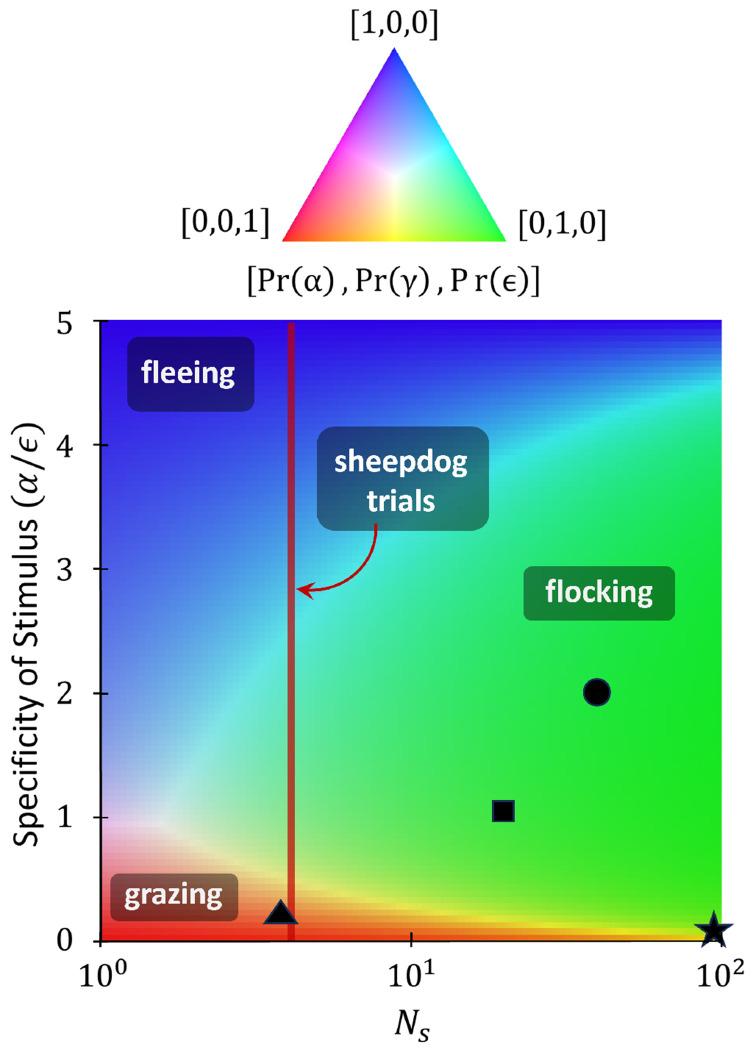
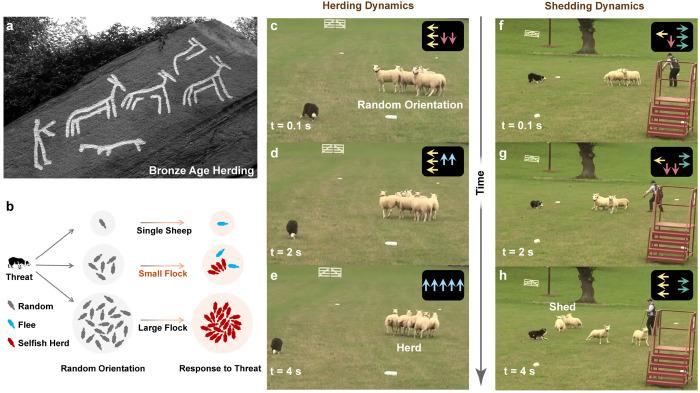
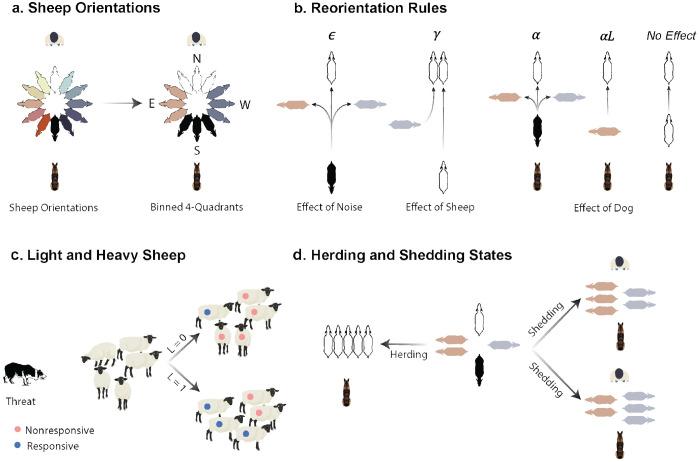
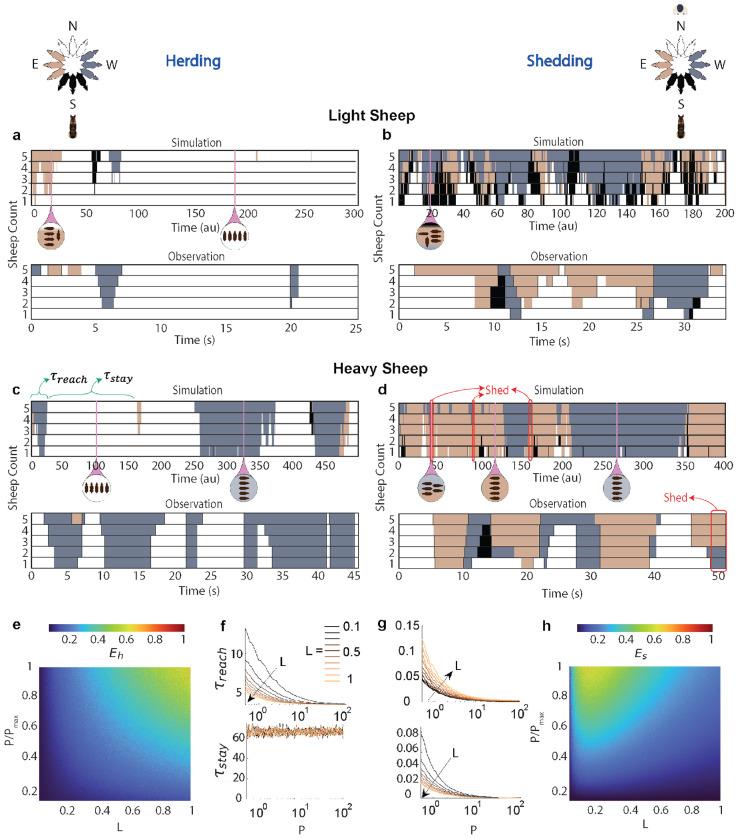
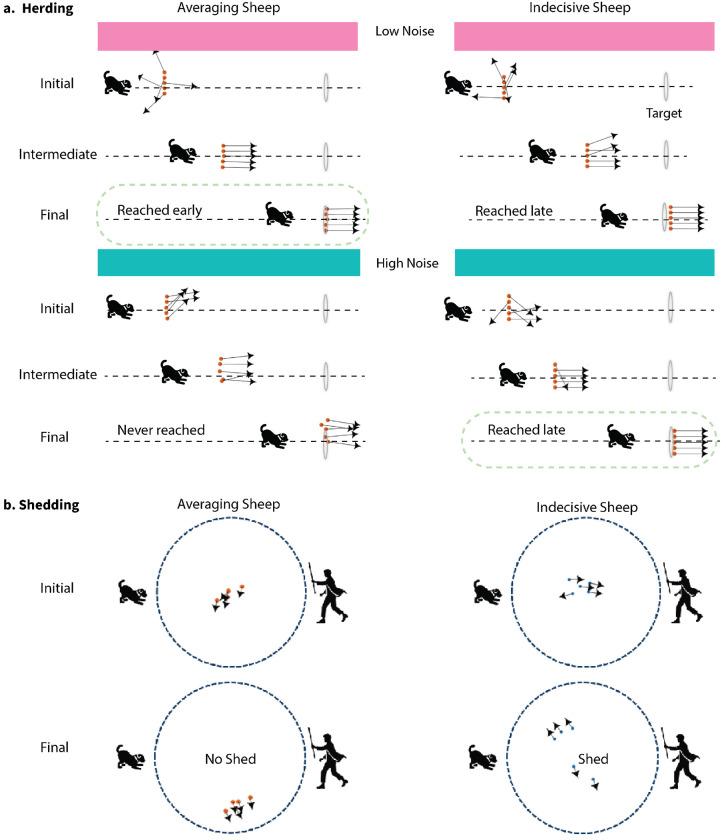
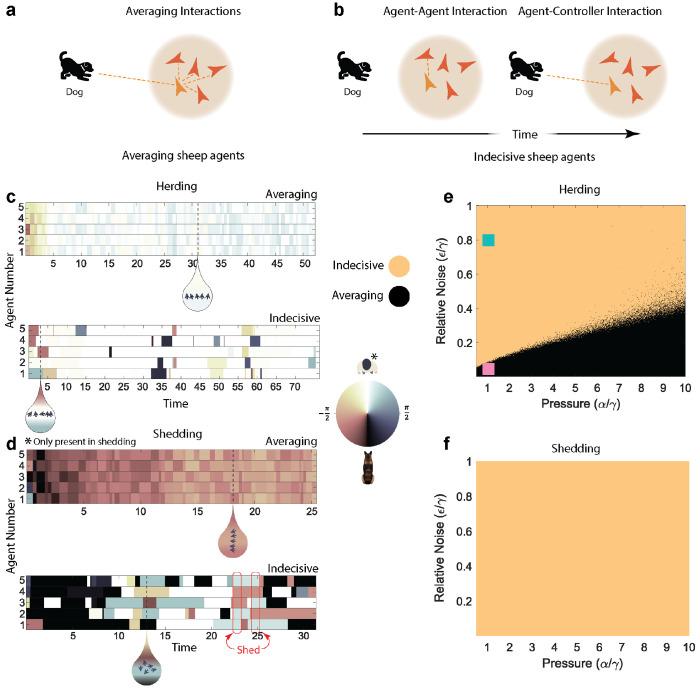
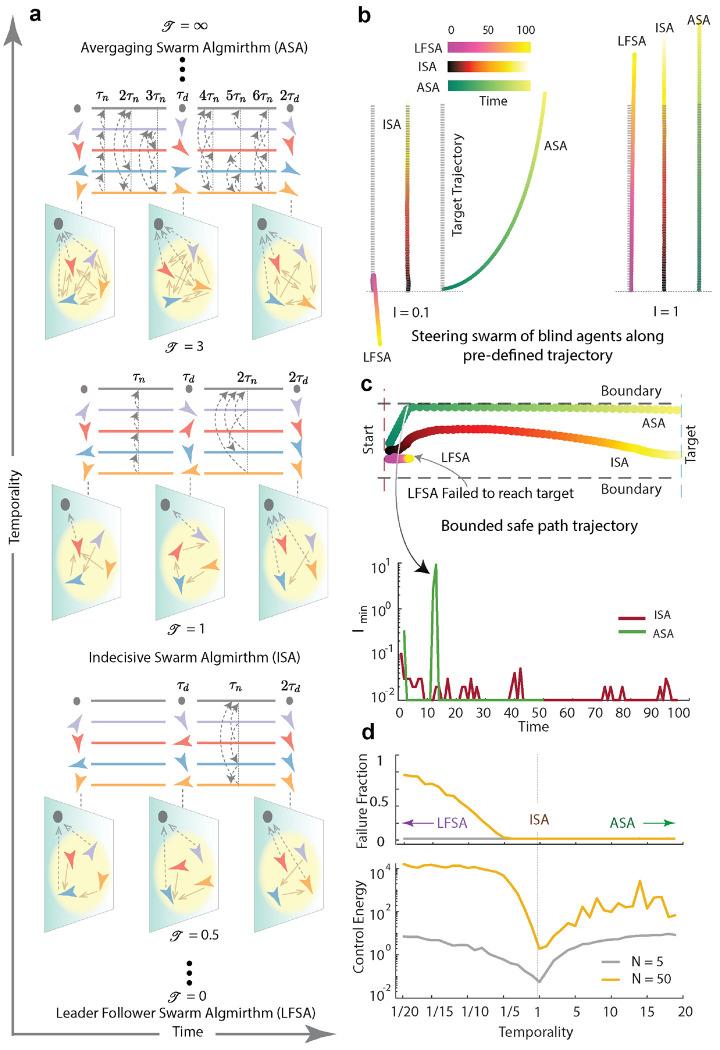
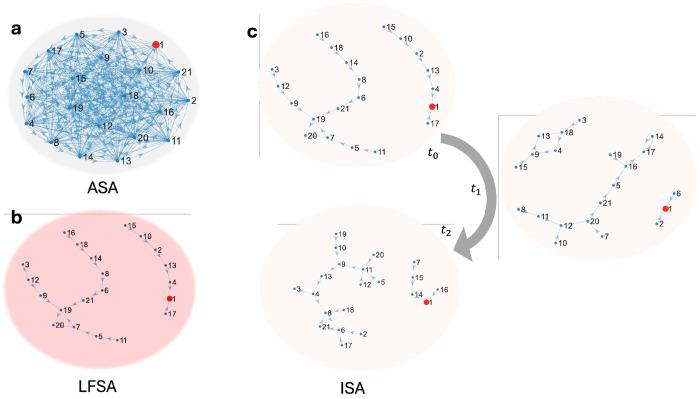
Controlling multi-agent systems is a persistent challenge in organismal, robotic, and social collectives, especially when agents exhibit stochastic indecisiveness - frequently switching between conflicting behavioral rules. Here, we investigate the control of such noisy indecisive collectives through the lens of century-old sheepdog trials, where small groups of sheep exhibit unpredictable switching between fleeing and following behaviors. Unlike cohesive large flocks, these small indecisive groups are difficult to control, yet skilled dog-handler teams excel at both herding and precisely splitting them (shedding) on demand. Using a stochastic model, we introduce two central parameters - pressure (stimulus intensity) and lightness (response isotropy) - to simulate and quantify herding and shedding dynamics. Light sheep rapidly reach stable herding states, while heavy sheep exhibit intermittent herding and orthogonal alignment to the dog. High response isotropy fosters group cohesion but complicates splitting tasks, highlighting the nuanced trade-offs in collective control of noisy herds. Surprisingly, we find that stochastic indecisiveness, typically perceived as a challenge, can be leveraged as a critical tool for efficient control, enabling controlled herding and splitting of noisy groups. Building on these insights, we develop the Indecisive Swarm Algorithm (ISA) for artificial agents and benchmark its performance against standard algorithms, including the Averaging-Based Swarm Algorithm (ASA) and the Leader-Follower Swarm Algorithm (LFSA). ISA minimizes control energy in trajectory-following tasks, outperforming alternatives under noisy conditions. By framing these results within a stochastic temporal network framework, we show that even with a probabilistic description of the future dynamics, network restructuring (temporality) enhances control efficiency in a specific class of control problems. These insights establish a scalable framework for controlling noisy, behavior-switching collectives, with applications in swarm robotics, cellular engineering, opinion dynamics, and temporal networks.
控制多智能体系统在生物、机器人和社会群体中一直是一项挑战,尤其是当智能体表现出随机的犹豫不决——频繁地在相互冲突的行为规则之间切换时。在此,我们通过百年前牧羊犬试验的视角来研究此类嘈杂的犹豫不决群体的控制问题,在这些试验中,一小群羊在逃跑和跟随行为之间表现出不可预测的切换。与紧密的大羊群不同,这些小的犹豫不决群体难以控制,但熟练的训犬师团队在放牧以及根据需要精确地将它们分开(驱散)方面表现出色。我们使用一个随机模型引入两个核心参数——压力(刺激强度)和轻快度(响应各向同性),以模拟和量化放牧及驱散动态。轻快的羊群能迅速达到稳定的放牧状态,而沉重的羊群则表现出间歇性的放牧以及与狗呈正交排列。高响应各向同性促进了群体凝聚力,但使分开任务变得复杂,突出了在嘈杂羊群的集体控制中细微的权衡。令人惊讶的是,我们发现通常被视为挑战的随机犹豫不决可以被用作有效控制的关键工具,从而实现对嘈杂群体的可控放牧和分开。基于这些见解,我们为人工智能体开发了犹豫不决群体算法(ISA),并将其性能与标准算法进行基准测试,包括基于平均的群体算法(ASA)和领导者 - 跟随者群体算法(LFSA)。ISA在轨迹跟踪任务中使控制能量最小化,在嘈杂条件下优于其他算法。通过将这些结果置于随机时间网络框架内,我们表明即使对未来动态有概率描述,网络重构(时间性)在特定一类控制问题中也能提高控制效率。这些见解为控制嘈杂的、行为切换的群体建立了一个可扩展的框架,可应用于群体机器人技术、细胞工程、舆论动态和时间网络。
 Zotero 插件