
[受 kisspeptin 调控的 Notch1/Akt/Foxo1 信号通路参与复发性自然流产患者的子宫内膜蜕膜化过程]
[Notch1/Akt/Foxo1 Pathway Regulated by Kisspeptin Is Involved in Endometrial Decidualization in Patients With Recurrent Spontaneous Abortion].
作者信息
Yang Yanhong, Zhang Jianliang, Li Dongxiao, Liu Cuiping, Guo Rong, Xiao Yi, Zhou Ling, Tong Lingxia, Zhang Hong
机构信息
( 215004) Department of Obstetrics and Gynecology, The Second Affiliated Hospital of Soochow University, Suzhou 215004, China.
( 215021) Jiangsu Institute of Clinical Immunology, The First Affiliated Hospital of Soochow University, Suzhou 215021, China.
出版信息
Sichuan Da Xue Xue Bao Yi Xue Ban. 2024 May 20;55(3):542-551. doi: 10.12182/20240560206.
OBJECTIVE
Kisspeptin, a protein encoded by the gene, functions as an essential factor in suppressing tumor growth. The intricate orchestration of cellular processes such as proliferation and differentiation is governed by the Notch1/Akt/Foxo1 signaling pathway, which assumes a central role in maintaining cellular homeostasis. In the specific context of this investigation, the focal point lies in a meticulous exploration of the intricate mechanisms underlying the regulatory effect of kisspeptin on the process of endometrial decidualization. This investigation delves into the interplay between kisspeptin and the Notch1/Akt/Foxo1 signaling pathway, aiming to elucidate its significance in the pathophysiology of recurrent spontaneous abortion (RSA).
METHODS
We enrolled a cohort comprising 45 individuals diagnosed with RSA, who were admitted to the outpatient clinic of the Reproductive Center at the Second Affiliated Hospital of Soochow University between June 2020 and December 2020. On the other hand, an additional group of 50 women undergoing elective abortion at the outpatient clinic of the Family Planning Department during the same timeframe was also included. To comprehensively assess the molecular landscape, Western blot and RT-qPCR were performed to analyze the expression levels of kisspeptin (and its gene ), IGFBP1 (an established marker of decidualization), Notch1, Akt, and Foxo1 within the decidua. Human endometrial stromal cells (hESC) were given targeted interventions, including treatment with siRNA to disrupt or exposure to kisspeptin10 (the bioactive fragment of kisspeptin), and were subsequently designated as the siKP group or the KP10 group, respectively. A control group comprised hESC was transfected with blank siRNA, and cell proliferation was meticulously evaluated with CCK8 assay. Following induction for decidualization across the three experimental groups, immunofluorescence assay was performed to identify differences in Notch1 expression and decidualization morphology between the siKP and the KP10 groups. Furthermore, RT-qPCR and Western blot were performed to gauge the expression levels of IGFBP1, Notch1, Akt, and Foxo1 across the three cell groups. Subsequently, decidualization was induced in hESC by adding inhibitors targeting Notch1, Akt, and Foxo1. The expression profiles of the aforementioned proteins and genes in the four groups were then examined, with hESC induced for decidualization without adding inhibitors serving as the normal control group. To establish murine models of normal pregnancy (NP) and RSA, CBA/J×BALB/c and CBA/J×DBA/2 mice were used. The mice were respectively labeled as the NP model and RSA model. The experimental groups received intraperitoneal injections of kisspeptin10 and kisspeptin234 (acting as a blocker) and were designated as RSA-KP10 and NP-KP234 groups. On the other hand, the control groups received intraperitoneal injections of normal saline (NS) and were referred to as RSA-NS and NP-NS groups. Each group comprised 6 mice, and uterine tissues from embryos at 9.5 days of gestation were meticulously collected for observation of embryo absorption and examination of the expression of the aforementioned proteins and genes.
RESULTS
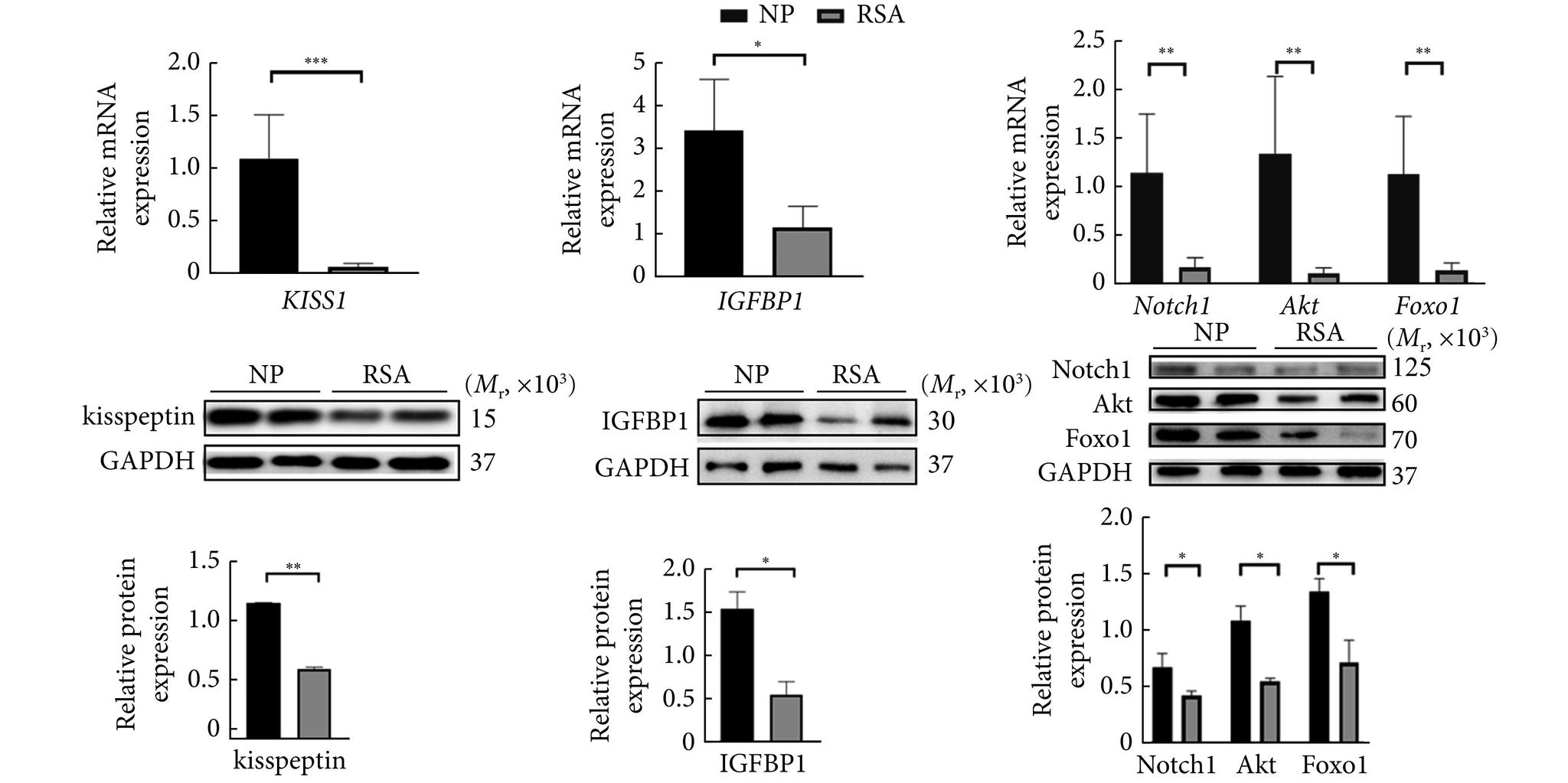
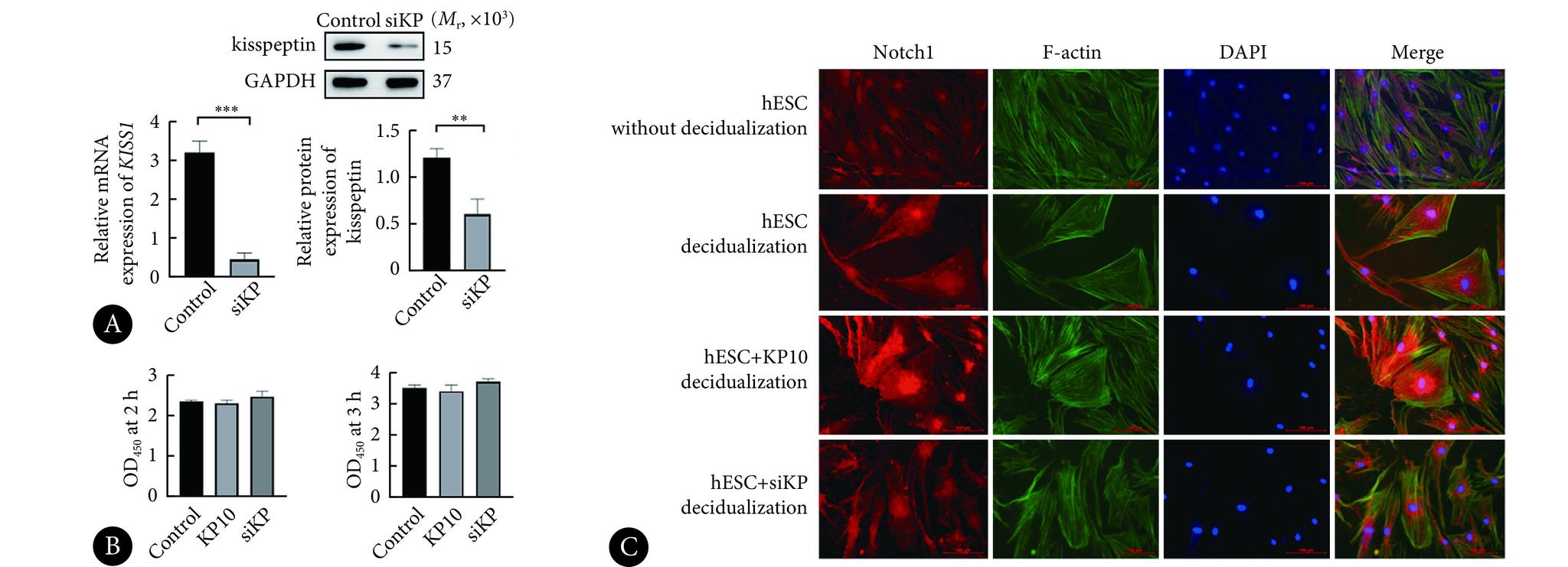
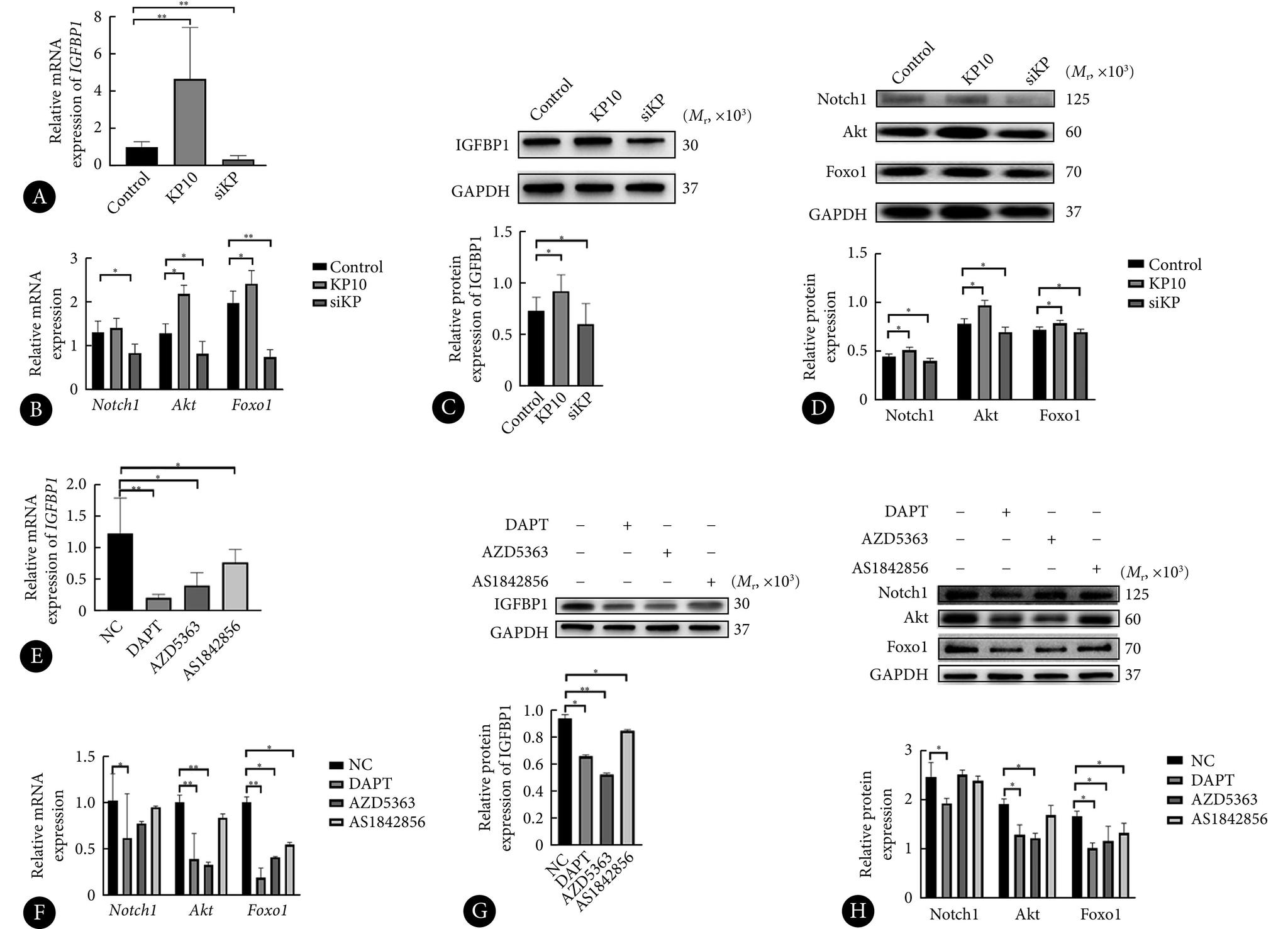
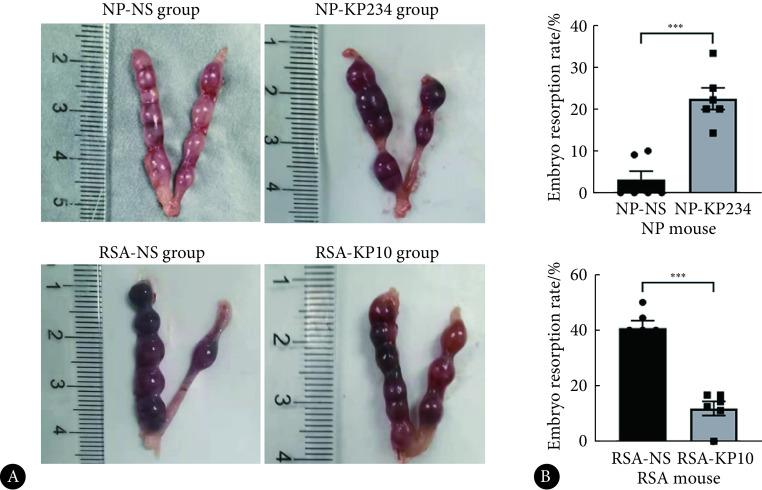
The analysis revealed that the expression levels of kisspeptin, IGFBP1, Notch1, Akt, and Foxo1 were significantly lower in patients diagnosed with RSA compared to those in women with NP (<0.01 for kisspeptin and <0.05 for IGFBP1, Notch1, Akt, and Foxo1). After the introduction of kisspeptin10 to hESC, there was an observed enhancement in decidualization capability. Subsequently, the expression levels of Notch1, Akt, and Foxo1 showed an increase, but they decreased after interference with . Through immunofluorescence analysis, it was observed that proliferative hESC displayed a slender morphology, but they transitioned to a rounder and larger morphology post-decidualization. Concurrently, the expression of Notch1 increased, suggesting enhanced decidualization upon the administration of kisspeptin10, but the expression decreased after interference with . Further experimentation involved treating hESC with inhibitors specific to Notch1, Akt, and Foxo1 separately, revealing a regulatory sequence of Notch1/Akt/Foxo1 (<0.05). In comparison to the NS group, NP mice administered with kisspeptin234 exhibited increased fetal absorption rates (<0.001) and decreased expression of IGFBP1, Notch1, Akt, and Foxo1 (<0.05). Conversely, RSA mice administered with kisspeptin10 demonstrated decreased fetal absorption rates (<0.001) and increased expression levels of the aforementioned molecules (<0.05).
CONCLUSION
It is suggested that kisspeptin might exert its regulatory influence on the process of decidualization through the modulation of the Notch1/Akt/Foxo1 signaling cascade. A down-regulation of the expression levels of kisspeptin could result in suboptimal decidualization, which in turn might contribute to the development or progression of RSA.
目的
Kisspeptin是一种由该基因编码的蛋白质,在抑制肿瘤生长中起着重要作用。细胞增殖和分化等复杂的细胞过程由Notch1/Akt/Foxo1信号通路调控,该通路在维持细胞稳态中起核心作用。在本研究的特定背景下,重点在于深入探究Kisspeptin对子宫内膜蜕膜化过程调节作用的复杂机制。本研究深入探讨了Kisspeptin与Notch1/Akt/Foxo1信号通路之间的相互作用,旨在阐明其在复发性自然流产(RSA)病理生理学中的意义。
方法
我们纳入了45例被诊断为RSA的患者队列,这些患者于2020年6月至2020年12月期间在苏州大学附属第二医院生殖中心门诊就诊。另一方面,同期在计划生育科门诊进行选择性流产的另外50名女性也被纳入研究。为全面评估分子格局,采用蛋白质免疫印迹法(Western blot)和实时定量聚合酶链反应(RT-qPCR)分析蜕膜中Kisspeptin(及其基因)、胰岛素样生长因子结合蛋白1(IGFBP1,一种已确定的蜕膜化标志物)、Notch1、Akt和Foxo1的表达水平。对人子宫内膜基质细胞(hESC)进行靶向干预,包括用小干扰RNA(siRNA)干扰以破坏,或用Kisspeptin10(Kisspeptin的生物活性片段)处理,随后分别指定为siKP组或KP10组。对照组为转染空白siRNA的hESC,用CCK8法仔细评估细胞增殖情况。在三个实验组诱导蜕膜化后,进行免疫荧光分析以确定siKP组和KP10组之间Notch1表达和蜕膜化形态的差异。此外,对三个细胞组进行RT-qPCR和蛋白质免疫印迹法检测,以测定IGFBP1、Notch1、Akt和Foxo1的表达水平。随后,通过添加靶向Notch1、Akt和Foxo1的抑制剂诱导hESC蜕膜化。然后检测四组中上述蛋白质和基因的表达谱,以未添加抑制剂诱导蜕膜化的hESC作为正常对照组。为建立正常妊娠(NP)和RSA的小鼠模型,使用CBA/J×BALB/c和CBA/J×DBA/2小鼠。将小鼠分别标记为NP模型和RSA模型。实验组腹腔注射Kisspeptin10和Kisspeptin234(作为阻滞剂),分别指定为RSA-KP10组和NP-KP234组。另一方面,对照组腹腔注射生理盐水(NS),称为RSA-NS组和NP-NS组。每组包括6只小鼠,仔细收集妊娠9.5天胚胎的子宫组织,观察胚胎吸收情况并检测上述蛋白质和基因的表达。
结果
分析显示,与NP女性相比,被诊断为RSA的患者中Kisspeptin、IGFBP1、Notch1、Akt和Foxo1的表达水平显著降低(Kisspeptin<0.0l,IGFBP1、Notch1、Akt和Foxo1<0.05)。将Kisspeptin10引入hESC后,观察到蜕膜化能力增强。随后,Notch1、Akt和Foxo1的表达水平升高,但干扰后降低。通过免疫荧光分析观察到,增殖的hESC形态细长,但蜕膜化后转变为更圆更大的形态。同时,Notch1的表达增加,表明给予Kisspeptin10后蜕膜化增强,但干扰后表达降低。进一步实验分别用Notch1、Akt和Foxo1的特异性抑制剂处理hESC,发现Notch1/Akt/Foxo1存在调控序列(<0.05)。与NS组相比,给予Kisspeptin234的NP小鼠胚胎吸收率增加(<0.001),IGFBP1、Notch1、Akt和Foxo1的表达降低(<0.05)。相反,给予Kisspeptin10的RSA小鼠胚胎吸收率降低(<0.001),上述分子的表达水平升高(<0.05)。
结论
提示Kisspeptin可能通过调节Notch1/Akt/Foxo1信号级联反应对蜕膜化过程发挥调节作用。Kisspeptin表达水平下调可能导致蜕膜化不良,进而可能促进RSA的发生或发展。


 Zotero 插件