
从 IBD 患者中分离的双歧杆菌的分类和表型分析作为潜在的益生菌菌株。
Taxonomic and phenotypic analysis of bifidobacteria isolated from IBD patients as potential probiotic strains.
机构信息
Lesaffre International - Lesaffre Institute of Science and Technology, 101 Rue de Menin, 59706, Marcq-en-Barœul, France.
Univ. Lille, Inserm, CHU Lille, U1286 - INFINITE - Institute for Translational Research in Inflammation, 59000, Lille, France.
出版信息
BMC Microbiol. 2024 Jun 29;24(1):233. doi: 10.1186/s12866-024-03368-4.
BACKGROUND
Inflammatory Bowel Diseases (IBD) are a major public health issue with unclear aetiology. Changes in the composition and functionality of the intestinal microbiota are associated with these pathologies, including the depletion of strict anaerobes such as Feacalibacterium prausnitzii. Less evidence is observed for depletion in other anaerobes, among which bifidobacteria. This study characterized the taxonomic and functional diversity of bifidobacteria isolated from the human intestinal microbiota in active and non-active IBD patients by a culturomics approach and evaluated if these bifidobacteria might be used as probiotics for gut health.
RESULTS
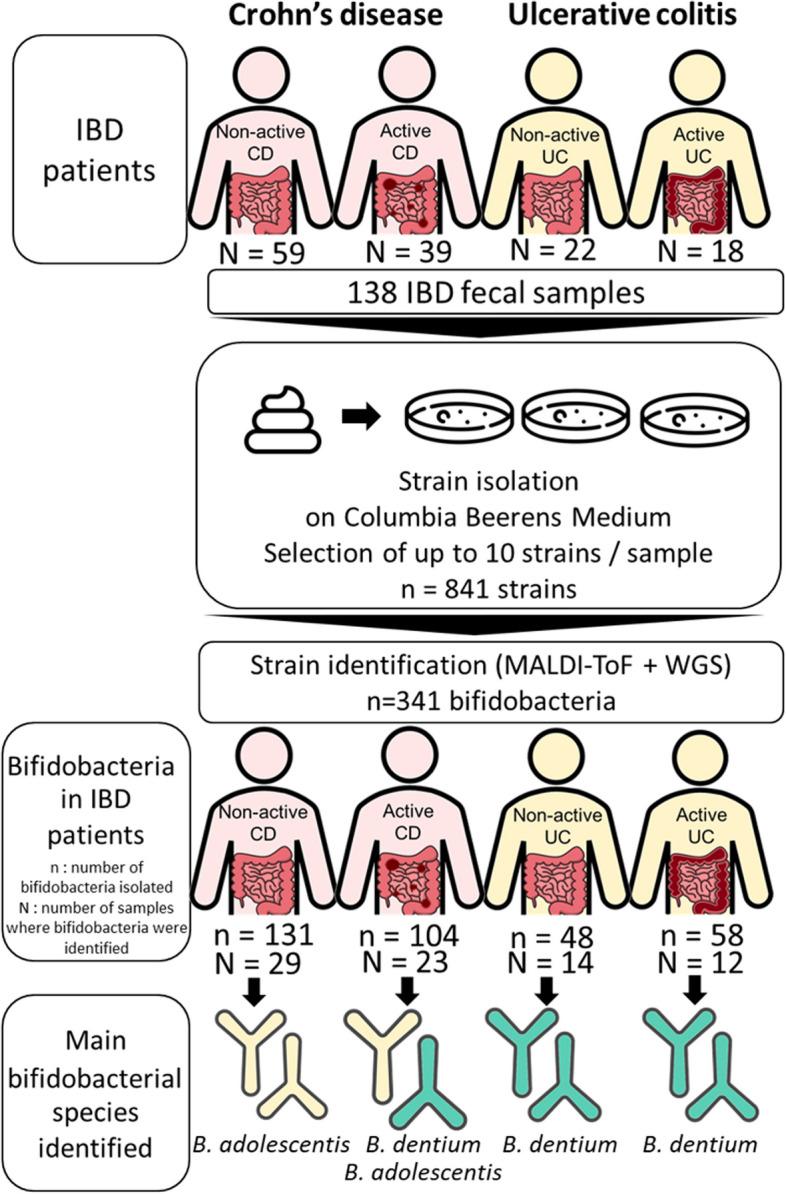
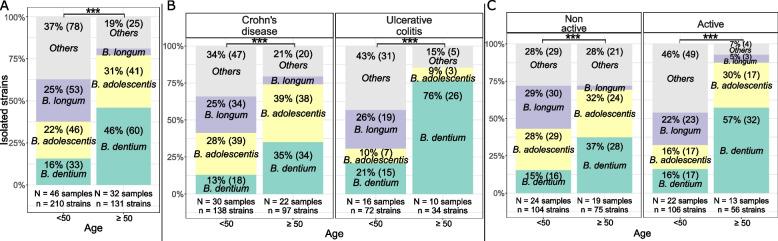
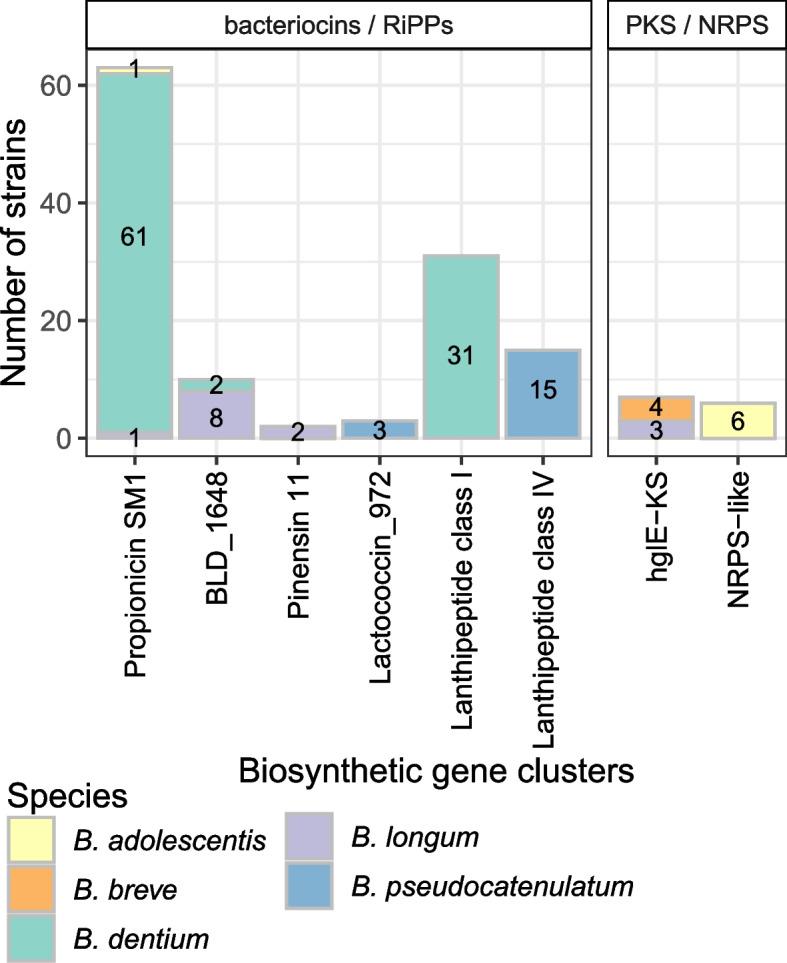
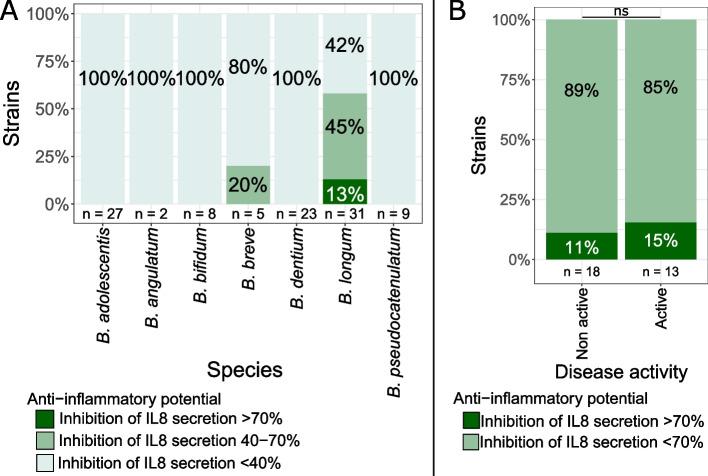
A total of 341 bifidobacteria were isolated from the intestinal microbiota of IBD patients (52 Crohn's disease and 26 ulcerative colitis patients), with a high proportion of Bifidobacterium dentium strains (28% of isolated bifidobacteria). In ulcerative colitis, the major species identified was B. dentium (39% of isolated bifidobacteria), in active and non-active ulcerative colitis. In Crohn's disease, B. adolescentis was the major species isolated from non-active patients (40%), while similar amounts of B. dentium and B. adolescentis were found in active Crohn's disease patients. The relative abundance of B. dentium was increased with age, both in Crohn's disease and ulcerative colitis and active and non-active IBD patients. Antibacterial capacities of bifidobacteria isolated from non-active ulcerative colitis against Escherichia coli LF82 and Salmonella enterica ATCC 14028 were observed more often compared to strains isolated from active ulcerative colitis. Finally, B. longum were retained as strains with the highest probiotic potential as they were the major strains presenting exopolysaccharide synthesis, antibacterial activity, and anti-inflammatory capacities. Antimicrobial activity and EPS synthesis were further correlated to the presence of antimicrobial and EPS gene clusters by in silico analysis.
CONCLUSIONS
Different bifidobacterial taxonomic profiles were identified in the microbiota of IBD patients. The most abundant species were B. dentium, mainly associated to the microbiota of ulcerative colitis patients and B. adolescentis, in the intestinal microbiota of Crohn's disease patients. Additionally, the relative abundance of B. dentium significantly increased with age. Furthermore, this study evidenced that bifidobacteria with probiotic potential (antipathogenic activity, exopolysaccharide production and anti-inflammatory activity), especially B. longum strains, can be isolated from the intestinal microbiota of both active and non-active Crohn's disease and ulcerative colitis patients.
背景
炎症性肠病(IBD)是一个主要的公共卫生问题,其病因尚不清楚。肠道微生物群落的组成和功能的变化与这些疾病有关,包括严格厌氧菌如普拉梭菌(Faecalibacterium prausnitzii)的减少。在其他厌氧菌中,双歧杆菌的减少则较少见。本研究通过培养组学方法对活动期和非活动期 IBD 患者肠道微生物群中分离的双歧杆菌的分类和功能多样性进行了表征,并评估了这些双歧杆菌是否可用作肠道健康的益生菌。
结果
从 IBD 患者(52 例克罗恩病和 26 例溃疡性结肠炎患者)的肠道微生物群中分离出 341 株双歧杆菌,其中双歧杆菌属 dentium 菌株的比例较高(分离出的双歧杆菌的 28%)。在溃疡性结肠炎中,主要鉴定的物种是 B. dentium(分离出的双歧杆菌的 39%),无论是在活动期还是非活动期溃疡性结肠炎中都是如此。在克罗恩病中,非活动期患者主要分离到 B. adolescentis(40%),而活动期克罗恩病患者则分离到等量的 B. dentium 和 B. adolescentis。双歧杆菌属 dentium 的相对丰度随着年龄的增长而增加,在克罗恩病和溃疡性结肠炎以及活动期和非活动期 IBD 患者中均如此。与从活动期溃疡性结肠炎中分离到的双歧杆菌相比,从非活动期溃疡性结肠炎中分离到的双歧杆菌对大肠杆菌 LF82 和肠炎沙门氏菌 ATCC 14028 的抗菌能力更为常见。最后,由于 B. longum 是主要的具有多糖合成、抗菌活性和抗炎能力的菌株,因此被保留为具有最高益生菌潜力的菌株。抗菌活性和 EPS 合成与通过计算机分析鉴定到的抗菌和 EPS 基因簇进一步相关。
结论
在 IBD 患者的微生物群中鉴定出了不同的双歧杆菌分类谱。最丰富的物种是 B. dentium,主要与溃疡性结肠炎患者的微生物群有关,而 B. adolescentis 则与克罗恩病患者的微生物群有关。此外,双歧杆菌属 dentium 的相对丰度随年龄显著增加。此外,本研究表明,具有益生菌潜力(抗病原活性、胞外多糖产生和抗炎活性)的双歧杆菌,特别是 B. longum 菌株,可从活动期和非活动期克罗恩病和溃疡性结肠炎患者的肠道微生物群中分离出来。




 Zotero 插件