
新冠后症状持续六个月风险的时间变化:一项基于全国人群的队列研究。
Temporal changes in the risk of six-month post-COVID symptoms: a national population-based cohort study.
作者信息
Pastorello Anne, Meyer Laurence, Coste Joël, Davisse-Paturet Camille, de Lamballerie Xavier, Melchior Maria, Novelli Sophie, Rahib Delphine, Bajos Nathalie, Vuillermoz Cécile, Franck Jeanna-Eve, Manto Carmelite, Rouquette Alexandra, Warszawski Josiane
机构信息
Paris-Saclay University, University of Versailles Saint-Quentin-en-Yvelines, National Institute of Health and Medical Research, Center for Epidemiology and Population Health, Le Kremlin-Bicêtre, France.
Epidemiology and Public Health Department, Assistance Publique-Hôpitaux de Paris Université Paris-Saclay, Le Kremlin-Bicêtre, France.
出版信息
Am J Epidemiol. 2025 Jan 8;194(1):162-171. doi: 10.1093/aje/kwae174.
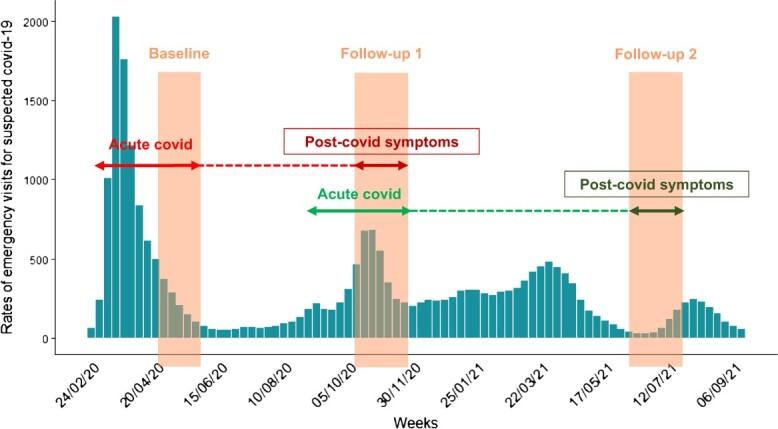
It is unclear how the risk of post-COVID symptoms evolved during the pandemic, especially before the spread of Severe Acute Respiratory Syndrome Coronavirus 2 variants and the availability of vaccines. We used modified Poisson regressions to compare the risk of six-month post-COVID symptoms and their associated risk factors according to the period of first acute COVID: during the French first (March-May 2020) or second (September-November 2020) wave. Nonresponse weights and multiple imputation were used to handle missing data. Among participants aged 15 years or older in a national population-based cohort, the risk of post-COVID symptoms was 14.6% (95% confidence interval [CI], 13.9%-15.3%) in March-May 2020, vs 7.0% (95% CI, 6.3%-7.7%) in September-November 2020 (adjusted relative risk [RR], 1.36; 95% CI, 1.20-1.55). For both periods, the risk was higher in the presence of baseline physical condition(s), and it increased with the number of acute symptoms. During the first wave, the risk was also higher for women, in the presence of baseline mental condition(s), and it varied with educational level. In France in 2020, the risk of six-month post-COVID symptoms was higher during the first than the second wave. This difference was observed before the spread of variants and the availability of vaccines.
目前尚不清楚新冠后症状的风险在疫情期间是如何演变的,尤其是在严重急性呼吸综合征冠状病毒2变体传播之前以及疫苗可用之前。我们使用修正泊松回归,根据首次急性新冠的时期,比较了新冠后六个月症状的风险及其相关危险因素:在法国第一波(2020年3月至5月)或第二波(2020年9月至11月)期间。使用无应答权重和多重插补来处理缺失数据。在一个全国性的基于人群的队列中,15岁及以上的参与者中,2020年3月至5月新冠后症状的风险为14.6%(95%置信区间[CI],13.9%-15.3%),而2020年9月至11月为7.0%(95%CI,6.3%-7.7%)(调整后相对风险[RR],1.36;95%CI,1.20-1.55)。在两个时期,存在基线身体状况时风险更高,并且随着急性症状数量的增加而增加。在第一波期间,女性、存在基线精神状况时风险也更高,并且随教育水平而变化。2020年在法国,新冠后六个月症状的风险在第一波期间高于第二波。这种差异在变体传播和疫苗可用之前就已观察到。

 Zotero 插件