
经直接谱系转换从成人鼻黏膜嗅鞘胶质细胞生成功能性神经元。
Generation of functional neurons from adult human mucosal olfactory ensheathing glia by direct lineage conversion.
机构信息
School of Experimental Sciences, Universidad Francisco de Vitoria, Pozuelo de Alarcón, Spain.
Department of Genetics and Development, Columbia University Medical Center, New York, NY, USA.
出版信息
Cell Death Dis. 2024 Jul 3;15(7):478. doi: 10.1038/s41419-024-06862-9.
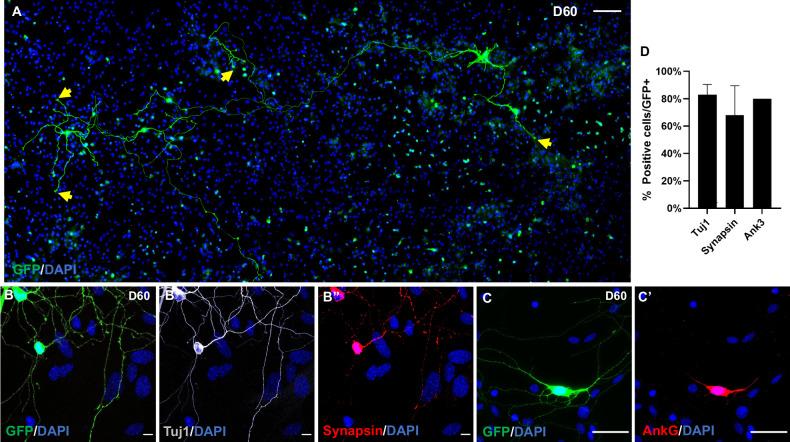
A recent approach to promote central nervous system (CNS) regeneration after injury or disease is direct conversion of somatic cells to neurons. This is achieved by transduction of viral vectors that express neurogenic transcription factors. In this work we propose adult human mucosal olfactory ensheathing glia (hmOEG) as a candidate for direct reprogramming to neurons due to its accessibility and to its well-characterized neuroregenerative capacity. After induction of hmOEG with the single neurogenic transcription factor NEUROD1, the cells under study exhibited morphological and immunolabeling neuronal features, fired action potentials and expressed glutamatergic and GABAergic markers. In addition, after engraftment of transduced hmOEG cells in the mouse hippocampus, these cells showed specific neuronal labeling. Thereby, if we add to the neuroregenerative capacity of hmOEG cultures the conversion to neurons of a fraction of their population through reprogramming techniques, the engraftment of hmOEG and hmOEG-induced neurons could be a procedure to enhance neural repair after central nervous system injury.
最近有一种促进中枢神经系统(CNS)在损伤或疾病后再生的方法,即直接将体细胞转化为神经元。这是通过转导表达神经发生转录因子的病毒载体来实现的。在这项工作中,我们提出成年人类粘膜嗅鞘细胞(hmOEG)作为直接重编程为神经元的候选物,因为它具有可及性和经过充分表征的神经再生能力。在使用单一神经发生转录因子 NEUROD1 诱导 hmOEG 后,研究中的细胞表现出形态和免疫标记神经元特征,产生动作电位,并表达谷氨酸能和 GABA 能标记物。此外,在将转导的 hmOEG 细胞移植到小鼠海马体后,这些细胞表现出特定的神经元标记。因此,如果我们将 hmOEG 培养物的神经再生能力与通过重编程技术将其部分细胞转化为神经元的能力相结合,那么 hmOEG 的移植和 hmOEG 诱导的神经元的移植可能是增强中枢神经系统损伤后神经修复的一种方法。


 Zotero 插件