
底丘脑旁核再喂养神经元集群会延迟进食开始并加速饮水。
The parasubthalamic nucleus refeeding ensemble delays feeding initiation and hastens water drinking.
作者信息
Dunning Jeffery L, Lopez Catherine, Krull Colton, Kreifeldt Max, Angelo Maggie, Shu Leeann, Ramakrishnan Charu, Deisseroth Karl, Contet Candice
机构信息
Department of Molecular Medicine, The Scripps Research Institute, La Jolla, CA, USA.
Department of Bioengineering, Stanford University, Stanford, CA, USA.
出版信息
Mol Psychiatry. 2025 Jan;30(1):37-49. doi: 10.1038/s41380-024-02653-y. Epub 2024 Jul 4.
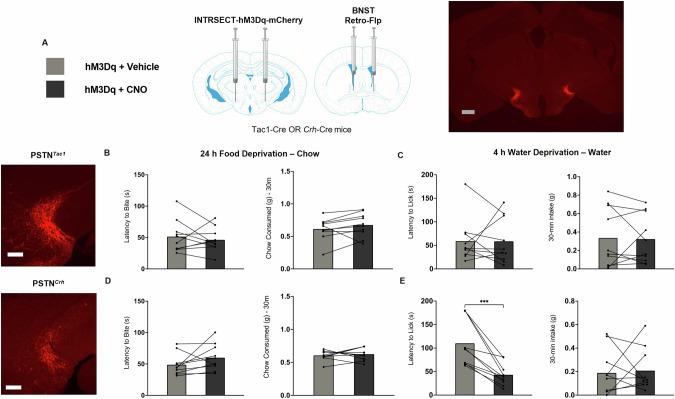
The parasubthalamic nucleus (PSTN) is activated by refeeding after food deprivation and several PSTN subpopulations have been shown to suppress feeding. However, no study to date directly addressed the role of PSTN neurons activated upon food access in the control of ensuing food consumption. Here we identify consumption latency as a sensitive behavioral indicator of PSTN activity, and show that, in hungry mice, the ensemble of refeeding-activated PSTN neurons drastically increases the latency to initiate refeeding with both familiar and a novel, familiar food, but does not control the amount of food consumed. In thirsty mice, this ensemble also delays sucrose consumption but accelerates water consumption, possibly reflecting anticipatory prandial thirst, with again no influence on the amount of fluid consumed. We next sought to identify which subpopulations of PSTN neurons might be driving these latency effects, using cell-type and pathway-specific chemogenetic manipulations. Our results suggest a prominent role of PSTN Tac1 neurons projecting to the central amygdala in the hindrance of feeding initiation. While PSTN Crh neurons also delay the latency of hungry mice to ingest familiar foods, they surprisingly promote the consumption of novel, palatable substances. Furthermore, PSTN Crh neurons projecting to the bed nucleus of the stria terminalis accelerate rehydration in thirsty mice. Our results demonstrate the key role of endogenous PSTN activity in the control of feeding and drinking initiation and delineate specific circuits mediating these effects, which may have relevance for eating disorders.
丘脑底核旁核(PSTN)在禁食后重新进食时被激活,并且已表明几个PSTN亚群会抑制进食。然而,迄今为止,尚无研究直接探讨进食时被激活的PSTN神经元在控制随后食物消耗中的作用。在这里,我们将进食潜伏期确定为PSTN活动的一个敏感行为指标,并表明,在饥饿的小鼠中,重新进食激活的PSTN神经元群体极大地增加了开始进食熟悉食物和新的熟悉食物的潜伏期,但不控制食物摄入量。在口渴的小鼠中,这个神经元群体也会延迟蔗糖消耗,但会加速水的消耗,这可能反映了预期的餐前口渴,同样对液体摄入量没有影响。接下来,我们试图通过细胞类型和通路特异性化学遗传学操作来确定哪些PSTN神经元亚群可能导致这些潜伏期效应。我们的结果表明,投射到中央杏仁核的PSTN Tac1神经元在阻碍进食启动方面发挥着重要作用。虽然PSTN Crh神经元也会延迟饥饿小鼠摄入熟悉食物的潜伏期,但令人惊讶的是,它们会促进对新的可口物质的消耗。此外,投射到终纹床核的PSTN Crh神经元会加速口渴小鼠的补液。我们的结果证明了内源性PSTN活动在控制进食和饮水启动中的关键作用,并描绘了介导这些效应的特定回路,这可能与饮食失调有关。


 Zotero 插件