
肠道微生物群在前列腺癌进展中的作用:免疫介导的孟德尔随机研究。
The role of gut microbiota in prostate cancer progression: A Mendelian randomization study of immune mediation.
机构信息
Department of Urology, Tianjin Medical University General Hospital, Tianjin, China.
Department of Urology, Huaihe Hospital of Henan University, Kaifeng, China.
出版信息
Medicine (Baltimore). 2024 Jul 5;103(27):e38825. doi: 10.1097/MD.0000000000038825.
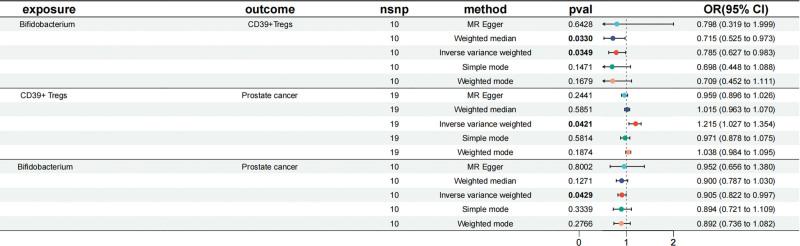
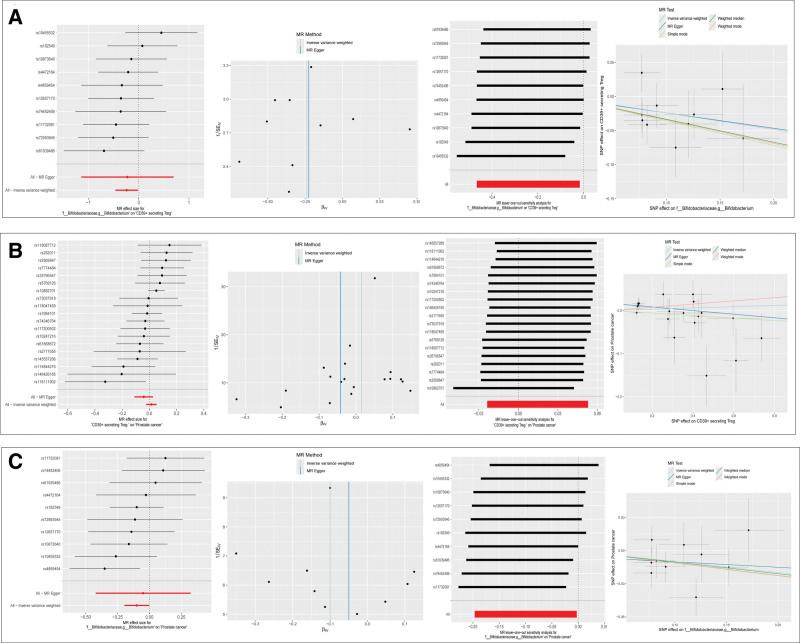
The potential relationship between the gut microbiota and prostate cancer, possibly influenced by immune cells, remains unclear. This study employed the mediation Mendelian randomization (MR) technique to investigate the causal link between the gut microbiota, immune cells, and prostate cancer. Data on immune cell activity were sourced from Valeria Orrù's research, whereas the genome-wide association study outcome dataset was obtained from the Integrative Epidemiology Unit database. The bidirectional MR analysis utilized 5 different methods: inverse variance weighted (IVW), weighted median, MR-Egger regression, weighted mode, and simple mode. In addition, the mediating effect of immune cells on the gut microbiota and prostate cancer was explored using mediation analysis. Eighty-three single nucleotide polymorphisms associated with prostate cancer were screened as instrumental variables. In a positive MR analysis with gut microbiota as the exposure factor, IVW showed an association between 8 gut microbiota and prostate cancer. Additionally, 9 types of immune cells have been found to be associated with prostate cancer using methods such as IVW. MR analysis of the gut microbiota on immune cells (beta1) revealed a negative correlation between Bifidobacterium and CD39+ T regulatory cells (Tregs; odds ratio [OR] = 0.785, 95% confidence interval [CI] = 0.627-0.983, P = .03). Furthermore, MR analysis of immune cells in prostate cancer disease (beta2) showed that CD39+Tregs are a risk factor for prostate cancer (OR = 1.215, 95% CI = 1.027-1.354, P = .04). Moreover, MR analysis of gut microbiota in prostate cancer (total effect) indicated that Bifidobacterium is a protective factor for prostate cancer (OR = 0.905, 95% CI = 0.822-0.977, P = .04). The sensitivity analysis verified the robustness of the above results. Mediation analysis demonstrated that CD39+Tregs partially mediate the causal relationship between Bifidobacterium and prostate cancer. This study demonstrates that Bifidobacterium inhibits prostate cancer progression through CD39+Tregs as mediators, providing new ideas and approaches for the treatment and prevention of prostate cancer.
肠道微生物群与前列腺癌之间的潜在关系,可能受免疫细胞的影响,目前尚不清楚。本研究采用中介孟德尔随机化(MR)技术来探讨肠道微生物群、免疫细胞与前列腺癌之间的因果关系。免疫细胞活性数据来源于 Valeria Orrù 的研究,而全基因组关联研究结果数据集则来自整合流行病学单位数据库。采用 5 种不同方法进行双向 MR 分析:逆方差加权(IVW)、加权中位数、MR-Egger 回归、加权模式和简单模式。此外,还通过中介分析探讨了免疫细胞对肠道微生物群和前列腺癌的中介作用。筛选出与前列腺癌相关的 83 个单核苷酸多态性作为工具变量。在以肠道微生物群为暴露因素的阳性 MR 分析中,IVW 显示 8 种肠道微生物群与前列腺癌之间存在关联。此外,还发现 9 种类型的免疫细胞与前列腺癌有关,方法如 IVW。肠道微生物群对免疫细胞(beta1)的 MR 分析显示双歧杆菌与 CD39+调节性 T 细胞(Tregs;比值比 [OR] = 0.785,95%置信区间 [CI] = 0.627-0.983,P = 0.03)呈负相关。此外,前列腺癌疾病中免疫细胞的 MR 分析(beta2)显示 CD39+Tregs 是前列腺癌的危险因素(OR = 1.215,95%CI = 1.027-1.354,P = 0.04)。此外,前列腺癌中肠道微生物群的 MR 分析(总效应)表明双歧杆菌是前列腺癌的保护因素(OR = 0.905,95%CI = 0.822-0.977,P = 0.04)。敏感性分析验证了上述结果的稳健性。中介分析表明,CD39+Tregs 部分介导了双歧杆菌与前列腺癌之间的因果关系。本研究表明,双歧杆菌通过 CD39+Tregs 作为中介抑制前列腺癌的进展,为前列腺癌的治疗和预防提供了新的思路和方法。


 Zotero 插件