
轻度或无症状 SARS-CoV-2 感染患者非紧急手术时机对术后恢复质量的影响:分组队列研究。
Impact of non-emergency surgical timing on postoperative recovery quality in mild or asymptomatic SARS-CoV-2 infected patients: a grouped cohort study.
机构信息
Department of Anaesthesiology, Yijishan Hospital, Wannan Medical College, Wuhu, 241000, China.
Department of Anaesthesiology, Bozhou Traditional Chinese Medicine Hospital, Bozhou, 236800, China.
出版信息
BMC Anesthesiol. 2024 Jul 6;24(1):225. doi: 10.1186/s12871-024-02600-y.
OBJECTIVE
To explore the relationship between the timing of non-emergency surgery in mild or asymptomatic SARS-CoV-2 (severe acute respiratory syndrome coronavirus 2) infected individuals and the quality of postoperative recovery from the time of confirmed infection to the day of surgery.
METHODS
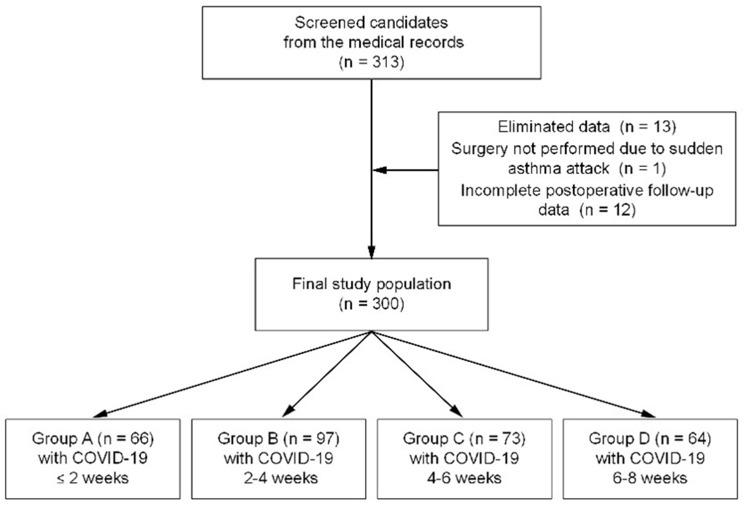
We retrospectively reviewed the medical records of 300 cases of mild or asymptomatic SARS-CoV-2 infected patients undergoing elective general anaesthesia surgery at Yijishan Hospital between January 9, 2023, and February 17, 2023. Based on the time from confirmed SARS-CoV-2 infection to the day of surgery, patients were divided into four groups: ≤2 weeks (Group A), 2-4 weeks (Group B), 4-6 weeks (Group C), and 6-8 weeks (Group D). The primary outcome measures included the Quality of Recovery-15 (QoR-15) scale scores at 3 days, 3 months, and 6 months postoperatively. Secondary outcome measures included postoperative mortality, ICU admission, pulmonary complications, postoperative length of hospital stay, extubation time, and time to leave the PACU.
RESULTS
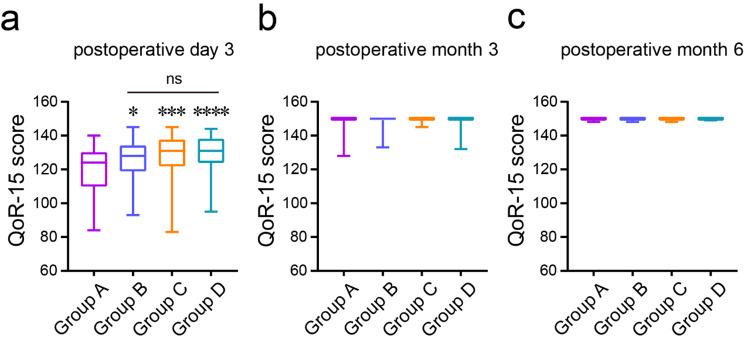
Concerning the primary outcome measures, the QoR-15 scores at 3 days postoperatively in Group A were significantly lower compared to the other three groups (P < 0.05), while there were no statistically significant differences among the other three groups (P > 0.05). The QoR-15 scores at 3 and 6 months postoperatively showed no statistically significant differences among the four groups (P > 0.05). In terms of secondary outcome measures, Group A had a significantly prolonged hospital stay compared to the other three groups (P < 0.05), while other outcome measures showed no statistically significant differences (P > 0.05).
CONCLUSION
The timing of surgery in mild or asymptomatic SARS-CoV-2 infected patients does not affect long-term recovery quality but does impact short-term recovery quality, especially for elective general anaesthesia surgeries within 2 weeks of confirmed infection. Therefore, it is recommended to wait for a surgical timing of at least greater than 2 weeks to improve short-term recovery quality and enhance patient prognosis.
目的
探讨轻度或无症状 SARS-CoV-2(严重急性呼吸综合征冠状病毒 2)感染个体非紧急手术的时机与从确诊感染到手术日之间术后恢复质量之间的关系。
方法
我们回顾性分析了 2023 年 1 月 9 日至 2 月 17 日期间在弋矶山医院接受全身麻醉择期手术的 300 例轻度或无症状 SARS-CoV-2 感染患者的病历。根据从确诊 SARS-CoV-2 感染到手术日的时间,患者被分为 4 组:≤2 周(A 组)、2-4 周(B 组)、4-6 周(C 组)和 6-8 周(D 组)。主要结局指标包括术后 3 天、3 个月和 6 个月的恢复质量-15(QoR-15)量表评分。次要结局指标包括术后死亡率、入住 ICU、肺部并发症、术后住院时间、拔管时间和离开 PACU 的时间。
结果
就主要结局指标而言,A 组患者术后 3 天的 QoR-15 评分明显低于其他 3 组(P<0.05),而其他 3 组之间无统计学差异(P>0.05)。4 组患者术后 3 个月和 6 个月的 QoR-15 评分无统计学差异(P>0.05)。就次要结局指标而言,A 组患者的住院时间明显长于其他 3 组(P<0.05),而其他结局指标无统计学差异(P>0.05)。
结论
在轻度或无症状 SARS-CoV-2 感染患者中,手术时机不会影响长期恢复质量,但会影响短期恢复质量,尤其是在确诊感染后 2 周内进行的择期全身麻醉手术。因此,建议至少等待 2 周以上的手术时机,以提高短期恢复质量,改善患者预后。
 Zotero 插件