
全球 1990 年至 2021 年房颤/房扑的负担及其归因风险因素。
Global burden of atrial fibrillation/atrial flutter and its attributable risk factors from 1990 to 2021.
机构信息
Department of Cardiology, The First Affiliated Hospital of Jinan University, No. 613, Huangpu Avenue West, Tianhe District, Guangzhou, Guangdong 510630, China.
出版信息
Europace. 2024 Jul 2;26(7). doi: 10.1093/europace/euae195.
AIMS
To devise effective preventive measures, a profound understanding of the evolving patterns and trends in atrial fibrillation (AF) and atrial flutter (AFL) burdens is pivotal. Our study was designed to quantify the burden and delineate the risk factors associated with AF and AFL across 204 countries and territories spanning 1990-2021.
METHODS AND RESULTS
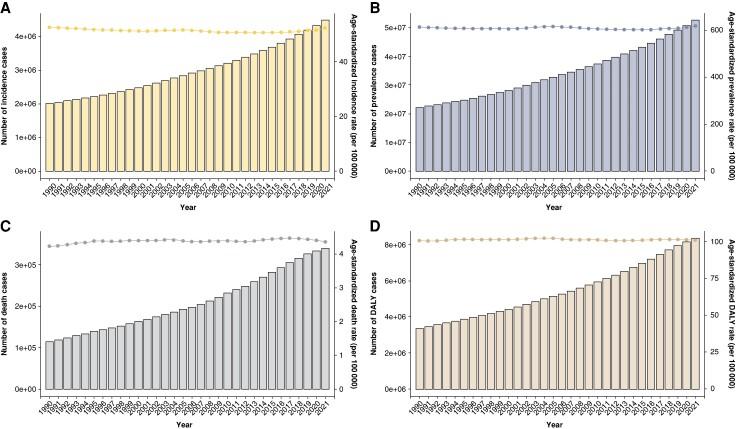
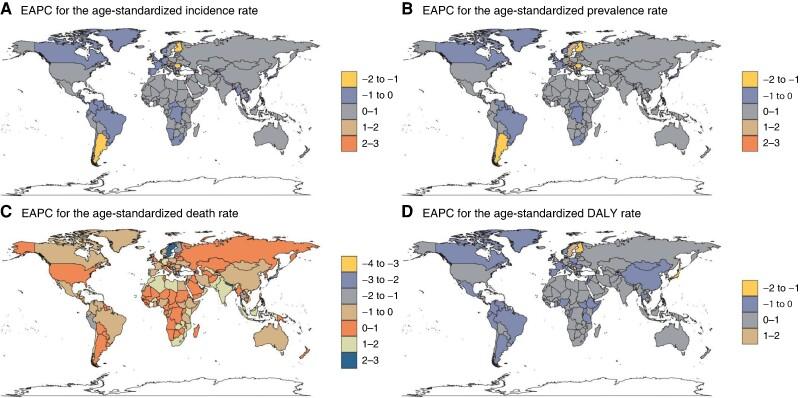
Data pertaining to AF and AFL were sourced from the Global Burden of Disease Study 2021. The burden of AF/AFL was evaluated using metrics such as incidence, disability-adjusted life years (DALYs), deaths, and their corresponding age-standardized rates (ASRs), stratified by age, sex, socio-demographic index (SDI), and human development index (HDI). The estimated annual percentage change was employed to quantify changes in ASRs. Population attributable fractions were calculated to determine the proportional contributions of major risk factors to age-standardized AF/AFL deaths. This analysis encompassed the period from 1990 to 2021. Globally, in 2021, there were 4.48 million incident cases [95% uncertainty interval (UI): 3.61-5.70], 8.36 million DALYs (95% UI: 6.97-10.13) and 0.34 million deaths (95% UI: 0.29-0.37) attributed to AF/AFL. The AF/AFL burden in 2021, as well as its trends from 1990 to 2021, displayed substantial variations based on gender, SDI quintiles, and geographical regions. High systolic blood pressure emerged as the leading contributor to age-standardized AF/AFL incidence, prevalence, death, and DALY rate globally among all potential risk factors, followed closely by high body mass index.
CONCLUSION
Our study underscores the enduring significance of AF/AFL as a prominent public health concern worldwide, marked by profound regional and national variations. Despite the substantial potential for prevention and management of AF/AFL, there is a pressing imperative to adopt more cost-effective strategies and interventions to target modifiable risk factors, particularly in areas where the burden of AF/AFL is high or escalating.
目的
为了制定有效的预防措施,深入了解心房颤动 (AF) 和心房扑动 (AFL) 负担的变化模式和趋势至关重要。我们的研究旨在量化 204 个国家和地区 1990 年至 2021 年期间 AF 和 AFL 的负担,并确定与 AF 和 AFL 相关的风险因素。
方法和结果
AF 和 AFL 数据来自 2021 年全球疾病负担研究。使用发病率、残疾调整生命年 (DALY)、死亡人数及其相应的年龄标准化率 (ASR) 等指标评估 AF/AFL 负担,按年龄、性别、社会人口指数 (SDI) 和人类发展指数 (HDI) 进行分层。使用估计的年变化百分比来量化 ASR 的变化。计算人群归因分数以确定主要风险因素对年龄标准化的 AF/AFL 死亡的比例贡献。本分析涵盖了 1990 年至 2021 年期间。全球范围内,2021 年有 448 万例新发病例[95%不确定区间 (UI):361-570]、836 万残疾调整生命年 (DALY) (95% UI:697-1013) 和 34 万例死亡[95% UI:29-37]归因于 AF/AFL。2021 年 AF/AFL 的负担以及 1990 年至 2021 年的趋势因性别、SDI 五分位数和地理区域而有很大差异。在所有潜在风险因素中,全球范围内,高收缩压是导致年龄标准化的 AF/AFL 发病率、患病率、死亡率和 DALY 率的主要因素,其次是高体重指数。
结论
我们的研究强调了 AF/AFL 作为全球范围内一个重要的公共卫生问题的持久重要性,其特点是存在深刻的区域和国家差异。尽管在预防和管理 AF/AFL 方面有很大的潜力,但迫切需要采取更具成本效益的策略和干预措施来针对可改变的风险因素,特别是在 AF/AFL 负担高或不断上升的地区。



 Zotero 插件