
食管癌根治性切除术后低风险寡转移复发的食管鳞状细胞癌患者局部根治性治疗的预后:一项回顾性队列研究
Prognosis for local radical treatment in patients with esophageal squamous cell carcinoma with low-risk oligometastatic recurrence after curative resection: a retrospective cohort study.
作者信息
Li Tingting, Ke Dongmei, Fu Xiaobin, Dai Yaqing, Lin Jules, Anker Christopher J, Bai Zhigang, Li Jiancheng
机构信息
Department of Radiation Oncology, The Second Affiliated Hospital of Fujian Medical University, Quanzhou, China.
Clinical Oncology School of Fujian Medical University, Fujian Cancer Hospital, Fuzhou, China.
出版信息
J Gastrointest Oncol. 2024 Jun 30;15(3):807-817. doi: 10.21037/jgo-24-205. Epub 2024 Jun 17.
BACKGROUND
Patients with esophageal carcinoma (EC) with recurrent disease have a poor prognosis. A limited numbers of metastases, safely treatable with curative intent, diagnosed after curative esophagectomy may be defined as oligometastatic recurrence (OLR). However, the appropriate number of metastases and metastatic organs involved remains incompletely characterized. And the role of local therapy in OLR after radical esophagectomy remains unknown. Therefore, this study aimed to more accurately define low-risk OLR in patients with esophageal squamous cell carcinoma (ESCC) treated with radical resection and investigate the role of chemotherapy combined with local treatment (CCLT) in these patients.
METHODS
A total of 83 sequential patients with ESCC who underwent radical esophagectomy, with an Eastern Cooperative Oncology Group (ECOG) performance status ≤2, with ability to tolerate chemotherapy (CT) and local treatment, and with newly diagnosed recurrence between January 2010 and May 2019 in our hospital were recruited. Overall survival (OS) curves after recurrence were analyzed using the Kaplan-Meier method, and a log-rank test was used to assess the OS differences. Cox proportional hazards regression analysis was performed to identify independent factors associated with 2-year OS. Regular follow-up examinations were assessed by thoracic and upper abdominal computed tomography (CT) scanning every 3 months in the first year, every 6 months over the next 2 years, and yearly thereafter.
RESULTS
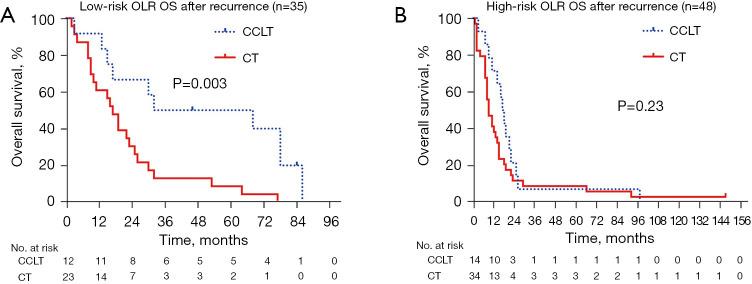
Of the 83 patients with ESCC (71 males and 12 females), the median age was 56 years (range, 37-79 years). Thirty-five patients with ESCC with ≤5 metastases safely treatable with curative intent located in a single organ had a favorable OS compared to 48 patients with metastases located in 2-3 organs with or without regional recurrence and/or regional lymph node (LN) metastases. In our study, low-risk OLR was defined as the presence of ≤5 metastases safely treatable with curative intent in a single organ and was compared to patients with 2-3 organs involved. The 2-year OS of patients with low-risk OLR with liver oligometastases was significantly worse than survival in patients with lung oligometastases (0% 61.1%, P=0.009). Patients with ESCC in the low-risk OLR group treated with CCLT had a better 2-year OS after recurrence than those who received CT alone (66.7% 30.4%, P=0.003). The multivariable Cox regression model identified treatment method [hazard ratio (HR) 3.920, P=0.02] as an independent factor affecting OS after recurrence for low-risk OLR.
CONCLUSIONS
Low-risk OLR was defined as ≤5 metastases safely treatable with curative intent in a single organ. Patients with ESCC with low-risk OLR after curative resection treated with CCLT have a favorable OS compared to those treated with CT alone. CCLT is a promising treatment option for patients with ESCC and low-risk OLR.
背景
食管癌(EC)复发患者预后较差。根治性食管切除术后诊断出的转移灶数量有限且可通过根治性意图安全治疗,可定义为寡转移复发(OLR)。然而,转移灶的合适数量及受累转移器官仍未完全明确。根治性食管切除术后局部治疗在OLR中的作用也尚不清楚。因此,本研究旨在更准确地定义接受根治性切除的食管鳞状细胞癌(ESCC)患者的低风险OLR,并探讨化疗联合局部治疗(CCLT)在这些患者中的作用。
方法
共纳入83例序贯性ESCC患者,这些患者均接受了根治性食管切除术,东部肿瘤协作组(ECOG)体能状态≤2,能够耐受化疗(CT)和局部治疗,且于2010年1月至2019年5月在我院新诊断为复发。采用Kaplan-Meier法分析复发后的总生存(OS)曲线,并使用对数秩检验评估OS差异。进行Cox比例风险回归分析以确定与2年OS相关的独立因素。在第一年每3个月通过胸部和上腹部计算机断层扫描(CT)进行定期随访检查,接下来的2年每6个月进行一次,此后每年进行一次。
结果
83例ESCC患者(71例男性和12例女性),中位年龄为56岁(范围37 - 79岁)。与48例转移灶位于2 - 3个器官且有或无区域复发和/或区域淋巴结(LN)转移的患者相比,35例具有≤5个可通过根治性意图安全治疗的转移灶且位于单一器官的ESCC患者的OS较好。在我们的研究中,低风险OLR定义为在单一器官中存在≤5个可通过根治性意图安全治疗的转移灶,并与累及2 - 3个器官的患者进行比较。肝寡转移的低风险OLR患者的2年OS明显差于肺寡转移患者(0%对61.1%,P = 0.009)。低风险OLR组接受CCLT治疗的ESCC患者复发后的2年OS优于单纯接受CT治疗的患者(66.7%对30.4%,P = 0.003)。多变量Cox回归模型确定治疗方法[风险比(HR)3.920,P = 0.02]是影响低风险OLR复发后OS的独立因素。
结论
低风险OLR定义为在单一器官中≤5个可通过根治性意图安全治疗的转移灶。根治性切除术后接受CCLT治疗的低风险OLR的ESCC患者与单纯接受CT治疗的患者相比,OS较好。CCLT是ESCC和低风险OLR患者有前景的治疗选择。

 Zotero 插件