
单细胞与空间组学:探索下丘脑的异质性
Single-cell and spatial omics: exploring hypothalamic heterogeneity.
作者信息
Junaid Muhammad, Lee Eun Jeong, Lim Su Bin
机构信息
Department of Biochemistry & Molecular Biology, Ajou University School of Medicine, Suwon, South Korea.
Department of Biomedical Sciences, Graduate School of Ajou University, Suwon, South Korea.
出版信息
Neural Regen Res. 2025 Jun 1;20(6):1525-1540. doi: 10.4103/NRR.NRR-D-24-00231. Epub 2024 Jul 10.
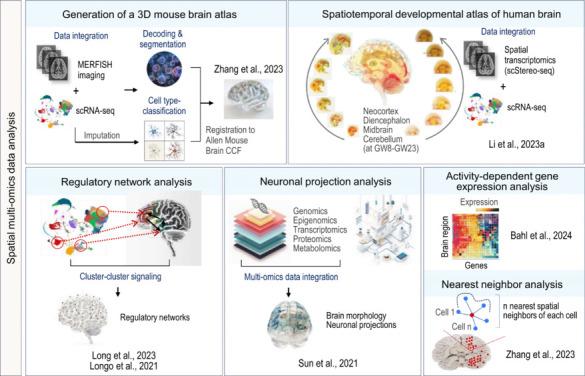
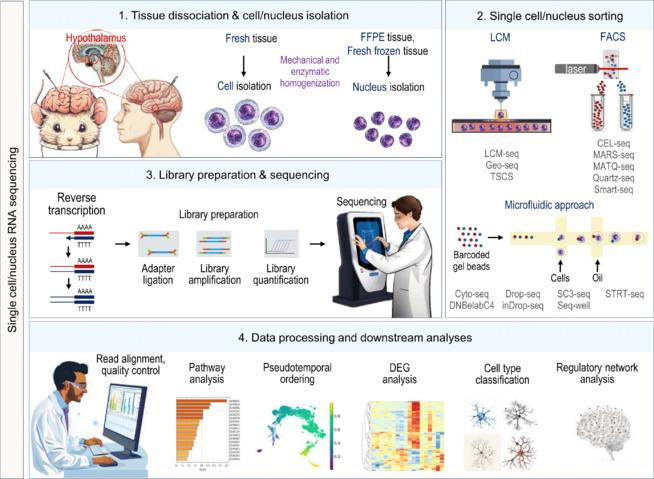
Elucidating the complex dynamic cellular organization in the hypothalamus is critical for understanding its role in coordinating fundamental body functions. Over the past decade, single-cell and spatial omics technologies have significantly evolved, overcoming initial technical challenges in capturing and analyzing individual cells. These high-throughput omics technologies now offer a remarkable opportunity to comprehend the complex spatiotemporal patterns of transcriptional diversity and cell-type characteristics across the entire hypothalamus. Current single-cell and single-nucleus RNA sequencing methods comprehensively quantify gene expression by exploring distinct phenotypes across various subregions of the hypothalamus. However, single-cell/single-nucleus RNA sequencing requires isolating the cell/nuclei from the tissue, potentially resulting in the loss of spatial information concerning neuronal networks. Spatial transcriptomics methods, by bypassing the cell dissociation, can elucidate the intricate spatial organization of neural networks through their imaging and sequencing technologies. In this review, we highlight the applicative value of single-cell and spatial transcriptomics in exploring the complex molecular-genetic diversity of hypothalamic cell types, driven by recent high-throughput achievements.
阐明下丘脑复杂的动态细胞组织对于理解其在协调基本身体功能中的作用至关重要。在过去十年中,单细胞和空间组学技术取得了显著进展,克服了在捕获和分析单个细胞方面最初的技术挑战。这些高通量组学技术现在为理解整个下丘脑转录多样性和细胞类型特征的复杂时空模式提供了一个绝佳机会。当前的单细胞和单细胞核RNA测序方法通过探索下丘脑各个亚区域的不同表型来全面量化基因表达。然而,单细胞/单细胞核RNA测序需要从组织中分离细胞/细胞核,这可能导致有关神经网络的空间信息丢失。空间转录组学方法通过绕过细胞解离,可以通过其成像和测序技术阐明神经网络的复杂空间组织。在这篇综述中,我们强调了由近期高通量成果驱动的单细胞和空间转录组学在探索下丘脑细胞类型复杂分子遗传多样性方面的应用价值。


 Zotero 插件