
印度喀拉拉邦城市患者的糖尿病健康素养、药物依从性及其相关因素
Diabetes Health Literacy, Drug Adherence and Factors Associated with Them among Urban Patients in Kerala, India.
作者信息
Arshad Mohammed Parisa Abdul, Mathews Elezebeth, Gopinathan Sandeep, Thankappan Kavumpurathu R
机构信息
Department of Public Health and Community Medicine, Central University of Kerala, Kasaragod, Kerala, India.
Department of Demography, University of Kerala, Kerala, India.
出版信息
J Postgrad Med Educ Res. 2023 Jul 26;57(3):124-130. doi: 10.5005/jp-journals-10028-1632.
AIMS
The study aimed to assess diabetes health literacy, adherence to diabetes medication, and its associated factors in Kerala, India, the most advanced Indian state in epidemiological transition with the highest literacy level in India.
MATERIALS AND METHODS
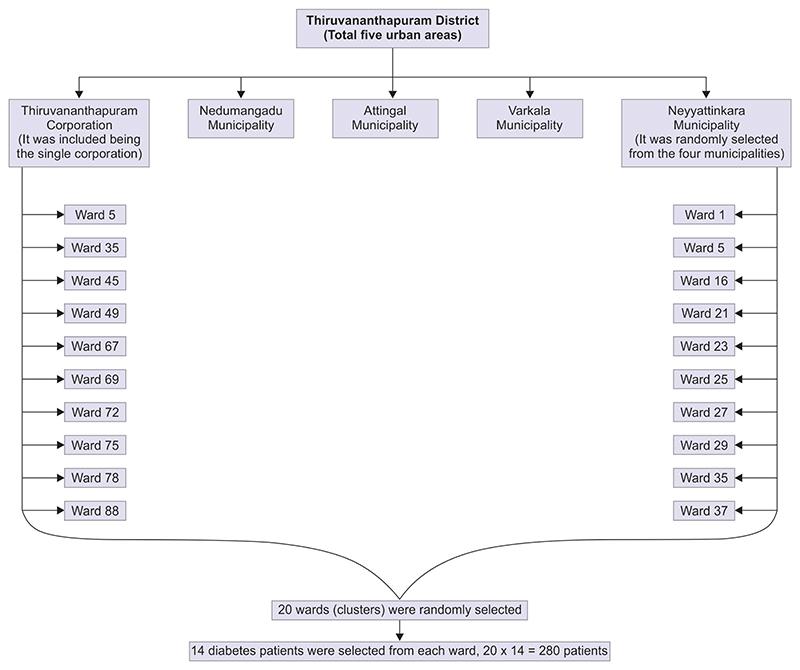
We conducted a community-based cross-sectional study among 280 diabetes patients (mean age 62 years, male 42%) selected by multistage cluster sampling. Information on sociodemographic variables was collected using a pretested structured interview schedule. Diabetes health literacy was assessed using the revised Michigan Diabetes Knowledge test. Adherence to diabetes medication was assessed using the Hill-Bone subscale. Binary logistic regression analysis was done to find out the factors associated with diabetes health literacy and medication adherence.
RESULTS
Good diabetes health literacy was reported by 35.7% [95% confidence interval (CI): 30.1-41.6] of the patients. Perfect adherence to diabetes medication was reported by 33.2% of patients (CI: 27.7-39.1). Patients who reported regular newspaper reading [adjusted odds ratio (AOR) 3.16; CI: 1.57-6.30], using the internet (AOR 2.23; CI: 1.11-4.50) and insulin use (AOR 2.60; CI: 1.35-5.00) were more likely to report good diabetes health literacy compared to their counterparts. Patients who reported reading health magazines (AOR 2.75; CI: 1.01-7.60) were more likely to report perfect medication adherence compared to those who did not.
CONCLUSION
Why diabetes health literacy and medication adherence were low among diabetes patients in the most literate state needs further investigation. Interventions to enhance diabetes health literacy and medication adherence may be undertaken among diabetes patients encouraging them to read newspapers and health magazines regularly and use the internet.
目的
本研究旨在评估印度喀拉拉邦糖尿病患者的健康素养、糖尿病药物治疗依从性及其相关因素。喀拉拉邦是印度流行病学转型最先进、识字率最高的邦。
材料与方法
我们采用多阶段整群抽样法,对280名糖尿病患者(平均年龄62岁,男性占42%)进行了一项基于社区的横断面研究。通过预先测试的结构化访谈问卷收集社会人口统计学变量信息。使用修订后的密歇根糖尿病知识测试评估糖尿病健康素养。使用希尔-博恩子量表评估糖尿病药物治疗依从性。进行二元逻辑回归分析,以找出与糖尿病健康素养和药物治疗依从性相关的因素。
结果
35.7%[95%置信区间(CI):30.1 - 41.6]的患者报告具有良好的糖尿病健康素养。33.2%的患者报告完全依从糖尿病药物治疗(CI:27.7 - 39.1)。与未定期阅读报纸的患者相比,报告定期阅读报纸的患者[调整优势比(AOR)3.16;CI:1.57 - 6.30]、使用互联网的患者(AOR 2.23;CI:1.11 - 4.50)和使用胰岛素的患者(AOR 2.60;CI:1.35 - 5.00)更有可能报告具有良好的糖尿病健康素养。与未阅读健康杂志的患者相比,报告阅读健康杂志的患者(AOR 2.75;CI:1.01 - 7.60)更有可能报告完全依从药物治疗。
结论
在这个识字率最高的邦,糖尿病患者的糖尿病健康素养和药物治疗依从性为何较低,需要进一步调查。可以对糖尿病患者采取干预措施,提高他们的糖尿病健康素养和药物治疗依从性,鼓励他们定期阅读报纸和健康杂志以及使用互联网。
 Zotero 插件