
通过聚类和模拟技术加强急诊药品和医疗用品的家庭配送:曼谷新冠肺炎居家隔离案例研究
Enhancing home delivery of emergency medicine and medical supplies through clustering and simulation techniques: A case study of COVID-19 home isolation in Bangkok.
作者信息
Kritchanchai Duangpun, Srinon Rawinkhan, Kietdumrongwong Pongtorn, Jansuwan Jirawan, Phanuphak Nittaya, Chanpuypetch Wirachchaya
机构信息
Department of Industrial Engineering, Mahidol University, Nakhon Pathom, 73170, Thailand.
The Cluster of Logistics and Rail Engineering, Mahidol University, Nakhon Pathom, 73170, Thailand.
出版信息
Heliyon. 2024 Jun 17;10(12):e33177. doi: 10.1016/j.heliyon.2024.e33177. eCollection 2024 Jun 30.
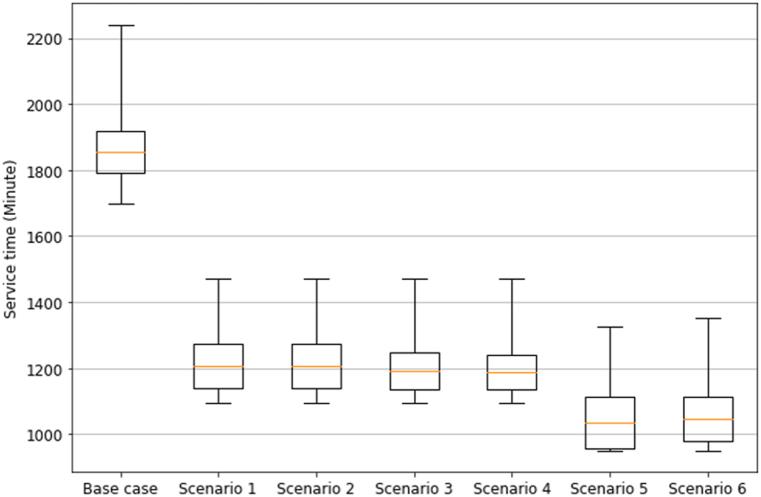
This study investigates the enhancement of the home delivery distribution network for COVID-19 Home Isolation (HI) kits during the Delta variant outbreak of the SARS-CoV-2 virus in Bangkok Metropolitan Area, Thailand. It addresses challenges related to limited resources and delays in delivering HI kits, which can exacerbate symptoms and increase mortality rates. A -means clustering approach is utilized to optimize the assignment of service areas within the COVID-19 HI program, while discrete event simulation (DES) evaluates potential changes in the home delivery logistics network. Real-world data from the peak outbreak is used to determine the optimal allocation of resources and propose a new logistics network based on proximity to patients' residences. Experimental results demonstrate a significant 44.29 % improvement in overall performance and a substantial 40.80 % decrease in maximum service time. The findings offer theoretical and managerial implications for effective HI management, supporting practitioners and policymakers in mitigating the impact of future outbreaks.
本研究调查了在泰国曼谷都会区严重急性呼吸综合征冠状病毒2(SARS-CoV-2)病毒德尔塔变种爆发期间,新冠病毒居家隔离(HI)试剂盒的家庭配送网络的强化情况。它解决了与资源有限以及HI试剂盒配送延迟相关的挑战,这些挑战可能会加重症状并提高死亡率。采用A均值聚类方法来优化新冠病毒HI项目内服务区域的分配,而离散事件模拟(DES)则评估家庭配送物流网络的潜在变化。来自疫情高峰期的实际数据用于确定资源的最优分配,并基于与患者住所的接近程度提出一个新的物流网络。实验结果表明,总体性能显著提高了44.29%,最大服务时间大幅减少了40.80%。这些发现为有效的HI管理提供了理论和管理方面的启示,有助于从业者和政策制定者减轻未来疫情爆发的影响。


 Zotero 插件