
使用加权随机森林和氧化应激生物标志物检测抑郁严重程度。
Detecting depression severity using weighted random forest and oxidative stress biomarkers.
机构信息
Department of Management Science and Engineering, Khalifa University of Science and Technology, P.O. Box 127788, Abu Dhabi, United Arab Emirates.
Department of Medical Science, Biotechnology Center, Khalifa University of Science and Technology, P.O. Box 127788, Abu Dhabi, United Arab Emirates.
出版信息
Sci Rep. 2024 Jul 15;14(1):16328. doi: 10.1038/s41598-024-67251-y.
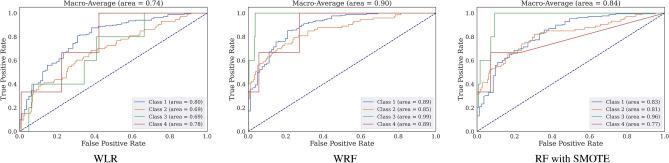
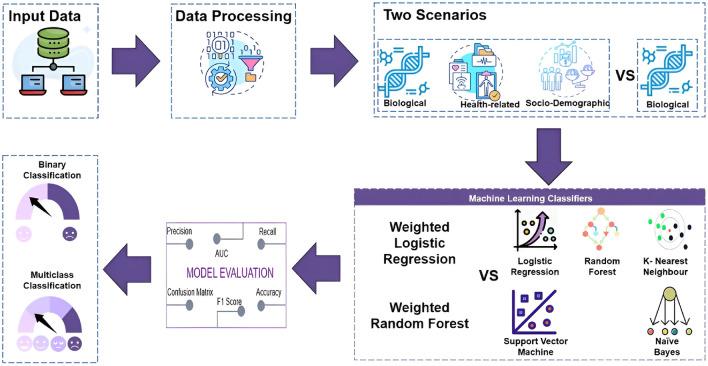
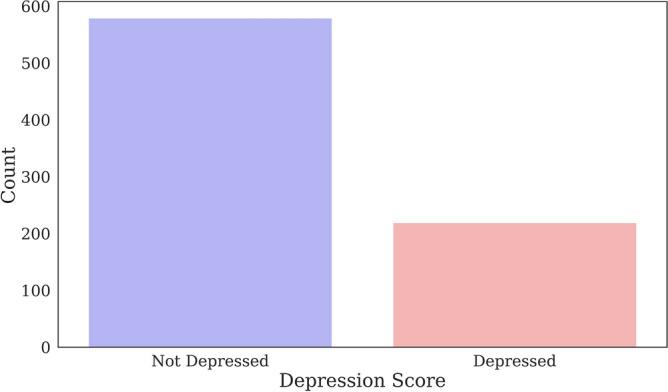
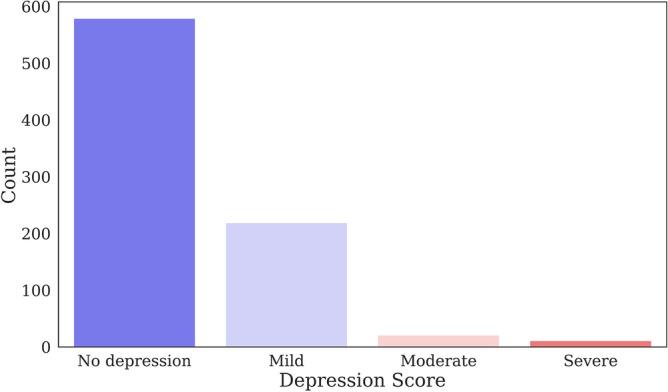
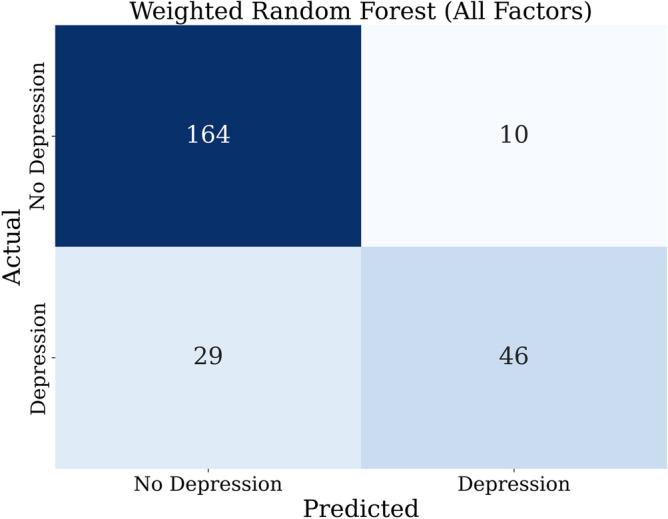
This study employs machine learning to detect the severity of major depressive disorder (MDD) through binary and multiclass classifications. We compared models that used only biomarkers of oxidative stress with those that incorporate sociodemographic and health-related factors. Data collected from 830 participants, based on the Patient Health Questionnaire (PHQ-9) score, inform our analysis. In binary classification, the Random Forest (RF) classifier achieved the highest Area Under the Curve (AUC) of 0.84 when all features were included. In multiclass classification, the AUC improved from 0.84 with only oxidative stress biomarkers to 0.88 when all characteristics were included. To address data imbalance, weighted classifiers, and Synthetic Minority Over-sampling Technique (SMOTE) approaches were applied. Weighted random forest (WRF) improved multiclass classification, achieving an AUC of 0.91. Statistical tests, including the Friedman test and the Conover post-hoc test, confirmed significant differences between model performances, with WRF using all features outperforming others. Feature importance analysis shows that oxidative stress biomarkers, particularly GSH, are top ranked among all features. Clinicians can leverage the results of this study to improve their decision-making processes by incorporating oxidative stress biomarkers in addition to the standard criteria for depression diagnosis.
本研究采用机器学习通过二分类和多分类来检测重度抑郁症(MDD)的严重程度。我们比较了仅使用氧化应激生物标志物的模型和纳入社会人口学和健康相关因素的模型。我们的分析基于从 830 名参与者那里收集的数据,这些数据基于患者健康问卷(PHQ-9)评分。在二分类中,当包含所有特征时,随机森林(RF)分类器的曲线下面积(AUC)最高,为 0.84。在多分类中,当包含所有特征时,AUC 从仅使用氧化应激生物标志物的 0.84 提高到 0.88。为了解决数据不平衡问题,应用了加权分类器和合成少数过采样技术(SMOTE)方法。加权随机森林(WRF)提高了多类分类的性能,AUC 达到 0.91。统计检验,包括 Friedman 检验和 Conover 事后检验,证实了模型性能之间存在显著差异,使用所有特征的 WRF 优于其他模型。特征重要性分析表明,氧化应激生物标志物,特别是 GSH,在所有特征中排名最高。临床医生可以利用本研究的结果,通过在抑郁症诊断的标准标准之外纳入氧化应激生物标志物来改善他们的决策过程。


 Zotero 插件