
手术后及创伤后新的持续性阿片类药物使用的发生率及危险因素:一项系统评价
Incidence and risk factors of new persistent opioid use after surgery and trauma: A systematic review.
作者信息
Gong Jiayi, Jones Peter, Chan Amy Hai Yan
机构信息
School of Pharmacy, Faculty of Medical and Health Sciences, The University of Auckland, Auckland, New Zealand.
Department of Surgery, Faculty of Medical and Health Sciences, The University of Auckland, Auckland, New Zealand.
出版信息
BMC Surg. 2024 Jul 16;24(1):210. doi: 10.1186/s12893-024-02494-0.
BACKGROUND
Persistent opioid use (POU) can occur with opioid use after surgery or trauma. Current systematic reviews include patients with previous exposure to opioids, meaning their findings may not be relevant to patients who are opioid naïve (i.e. Most recent exposure was from surgery or trauma). The aim of this review was to synthesise narratively the evidence relating to the incidence of, and risk factors for POU in opioid-naïve surgical or trauma patients.
METHOD
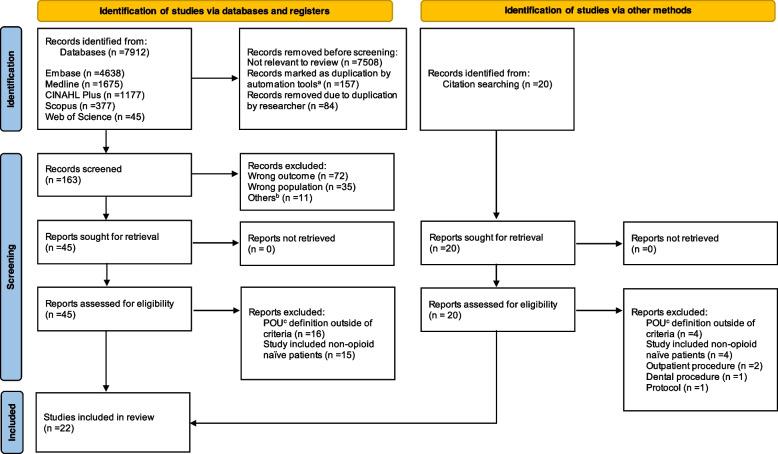
Structured searches of Embase, Medline, CINAHL, Web of Science, and Scopus were conducted, with final search performed on the 17th of July 2023. Searches were limited to human participants to identify studies that assessed POU following hospital admission due to surgery or trauma. Search terms relating to 'opioid', 'analgesics', 'surgery', 'injury', 'trauma' and 'opioid-related disorder' were combined. The Newcastle-Ottawa Scale for cohort studies was used to assess the risk of bias for studies.
RESULTS
In total, 22 studies (20 surgical and two trauma) were included in the analysis. Of these, 20 studies were conducted in the United States (US). The incidence of POU for surgical patients 18 and over ranged between 3.9% to 14.0%, and for those under 18, the incidence was 2.0%. In trauma studies, the incidence was 8.1% to 10.5% among patients 18 and over. Significant risk factors identified across surgical and trauma studies in opioid-naïve patients were: higher comorbidity burden, having pre-existing mental health or chronic pain disorders, increased length of hospital stay during the surgery/trauma event, or increased doses of opioid exposure after the surgical or trauma event. Significant heterogeneity of study design precluded meta-analysis.
CONCLUSION
The quality of the studies was generally of good quality; however, most studies were of US origin and used medico-administrative data. Several risk factors for POU were consistently and independently associated with increased odds of POU, primarily for surgical patients. Awareness of these risk factors may help prescribers recognise the risk of POU after surgery or trauma, when considering continuing opioids after hospitalisation. The review found gaps in the literature on trauma patients, which represents an opportunity for future research.
TRIAL REGISTRATION
PROSPERO registration: CRD42023397186.
背景
手术后或创伤后使用阿片类药物可能会导致持续使用阿片类药物(POU)。目前的系统评价纳入了既往有阿片类药物暴露史的患者,这意味着其研究结果可能不适用于未使用过阿片类药物的患者(即最近一次暴露是由于手术或创伤)。本综述的目的是系统总结未使用过阿片类药物的手术或创伤患者中POU的发生率及危险因素的相关证据。
方法
对Embase、Medline、CINAHL、Web of Science和Scopus进行结构化检索,最后一次检索于2023年7月17日进行。检索限于人类参与者,以识别评估因手术或创伤入院后POU情况的研究。将与“阿片类药物”“镇痛药”“手术”“损伤”“创伤”及“阿片类药物相关障碍”相关的检索词进行组合。采用队列研究的纽卡斯尔-渥太华量表评估研究的偏倚风险。
结果
分析共纳入22项研究(20项手术相关研究和2项创伤相关研究)。其中,20项研究在美国进行。18岁及以上手术患者的POU发生率在3.9%至14.0%之间,18岁以下患者的发生率为2.0%。在创伤相关研究中,18岁及以上患者的发生率为8.1%至10.5%。在未使用过阿片类药物的手术和创伤患者中确定的显著危险因素包括:较高的合并症负担、既往有心理健康或慢性疼痛障碍、手术/创伤事件期间住院时间延长,或手术或创伤事件后阿片类药物暴露剂量增加。研究设计的显著异质性妨碍了进行荟萃分析。
结论
这些研究质量总体良好;然而,大多数研究来自美国且使用的是医疗管理数据。POU的几个危险因素与POU几率增加始终且独立相关,主要针对手术患者。了解这些危险因素可能有助于开处方者在考虑住院后继续使用阿片类药物时,认识到手术或创伤后POU的风险。该综述发现关于创伤患者的文献存在空白,这为未来研究提供了机会。
试验注册
PROSPERO注册号:CRD42023397186。
 Zotero 插件