
一项前瞻性随机对照试验,调查南非开普敦一个人口密集社区的家庭中新冠病毒传播情况——拥挤环境中新冠病毒的传播(TRACE)研究。
A prospective randomised controlled trial investigating household SARS-CoV-2 transmission in a densely populated community in Cape Town, South Africa - the transmission of COVID-19 in crowded environments (TRACE) study.
作者信息
Smith Philip, Little Francesca, Hermans Sabine, Davies Mary-Ann, Wood Robin, Orrell Catherine, Pike Carey, Peters Fatima, Dube Audry, Georgeu-Pepper Daniella, Curran Robyn, Fairall Lara, Bekker Linda-Gail
机构信息
The Desmond Tutu HIV Centre, University of Cape Town, Cape Town, South Africa.
Department of Statistical Sciences, University of Cape Town, Cape Town, South Africa.
出版信息
BMC Public Health. 2024 Jul 17;24(1):1924. doi: 10.1186/s12889-024-19462-1.
BACKGROUND
South Africa's first SARS-CoV-2 case was identified 5th March 2020 and national lockdown followed March 26th. Households are an important location for secondary SARS-CoV-2 infection. Physical distancing and sanitation - infection mitigation recommended by the World Health Organization (WHO) at the time - are difficult to implement in limited-resource settings because of overcrowded living conditions.
METHODS
This study (ClinicalTrials.gov NCT05119348) was conducted from August 2020 to September 2021 in two densely populated, low socioeconomic Cape Town community sub-districts. New COVID-19 index cases (ICs) identified at public clinics were randomised to an infection mitigation intervention (STOPCOV) delivered by lay community health workers (CHWs) or standard of care group. STOPCOV mitigation measures included one initial household assessment conducted by a CHW in which face masks, sanitiser, bleach and written information on managing and preventing spread were provided. This was followed by regular telephonic follow-up from CHWs. SARS-CoV-2 PCR and IgM/IgG serology was performed at baseline, weeks 1, 2, 3 and 4 of follow-up.
RESULTS
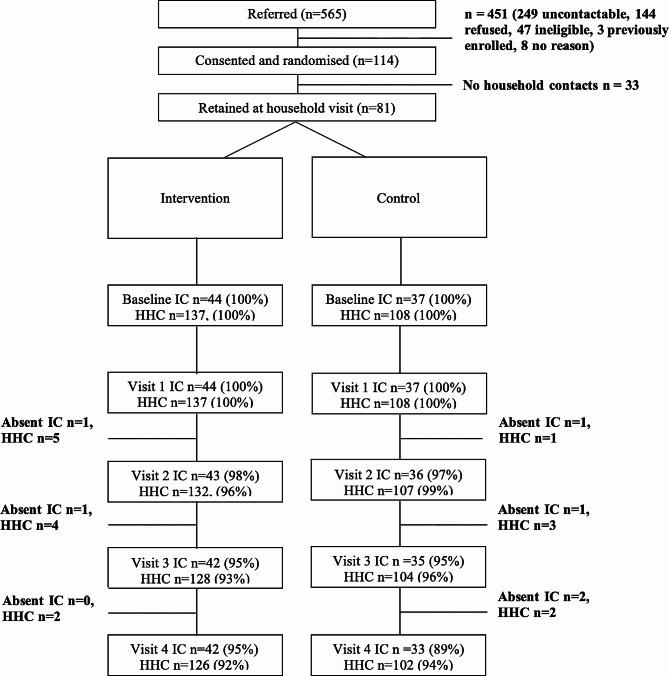
The study randomised 81 ICs with 245 HHCs. At baseline, no HHCs in the control and 7 (5%) in the intervention group had prevalent SARS-CoV-2. The secondary infection rate (SIR) based on SARS-CoV-2 PCR testing was 1.9% (n = 2) in control and 2.9% (n = 4) in intervention HHCs (p = 0.598). At baseline, SARS-CoV-2 antibodies were present in 15% (16/108) of control and 38% (52/137) of intervention participants. At study end incidence was 8.3% (9/108) and 8.03% (11/137) in the intervention and control groups respectively. Antibodies were present in 23% (25/108) of control HHCs over the course of the study vs. 46% (63/137) in the intervention arm. CHWs made twelve clinic and 47 food parcel referrals for individuals in intervention households in need.
DISCUSSION
Participants had significant exposure to SARS-CoV-2 infections prior to the study. In this setting, household transmission mitigation was ineffective. However, CHWs may have facilitated other important healthcare and social referrals.
背景
2020年3月5日南非确诊首例新冠病毒病例,3月26日开始实施全国封锁。家庭是新冠病毒二次感染的重要场所。当时世界卫生组织(WHO)建议的物理距离和卫生措施——减轻感染——在资源有限的环境中难以实施,因为生活条件拥挤。
方法
本研究(ClinicalTrials.gov NCT05119348)于2020年8月至2021年9月在开普敦两个 densely populated、社会经济地位较低的社区分区进行。在公共诊所确诊的新冠病毒新索引病例(ICs)被随机分为由社区卫生工作者(CHWs)提供的减轻感染干预措施(STOPCOV)组或标准治疗组。STOPCOV减轻措施包括由一名社区卫生工作者进行一次初始家庭评估,提供口罩、消毒剂、漂白剂以及关于管理和预防传播的书面信息。随后社区卫生工作者进行定期电话随访。在基线、随访第1、2、3和4周进行新冠病毒PCR和IgM/IgG血清学检测。
结果
该研究将81例索引病例及其245个家庭接触者(HHCs)进行了随机分组。基线时,对照组中没有家庭接触者感染新冠病毒,干预组中有7例(5%)感染。基于新冠病毒PCR检测的二次感染率(SIR)在对照组家庭接触者中为1.9%(n = 2),在干预组家庭接触者中为2.9%(n = 4)(p = 0.598)。基线时,15%(16/108)的对照组参与者和38%(52/137)的干预组参与者存在新冠病毒抗体。研究结束时,干预组和对照组的发病率分别为8.3%(9/108)和8.03%(11/137)。在研究过程中,23%(25/108)的对照组家庭接触者检测到抗体,而干预组为46%(63/137)。社区卫生工作者为干预家庭中有需要的个人进行了12次诊所转诊和47次食品包裹转诊。
讨论
参与者在研究之前有大量接触新冠病毒感染的情况。在这种情况下,减轻家庭传播的措施无效。然而,社区卫生工作者可能促进了其他重要的医疗保健和社会转诊。

 Zotero 插件