
羟基藏红花黄 A 移植人子宫内膜血管周干细胞促进大鼠子宫修复。
Transplantation of human endometrial perivascular stem cells with hydroxy saffron yellow A promotes uterine repair in rats.
机构信息
Center for Reproductive Medicine and Obstetrics and Gynecology, Nanjing Drum Tower Hospital, Clinical College of Nanjing University of Chinese Medicine, Nanjing, 210008, China.
Center for Reproductive Medicine and Obstetrics and Gynecology, Nanjing Drum Tower Hospital, Clinical College of Nanjing Medical University, Nanjing, 210008, China.
出版信息
Stem Cell Res Ther. 2024 Jul 18;15(1):217. doi: 10.1186/s13287-024-03821-1.
BACKGROUND
Intrauterine adhesions (IUAs) jeopardise uterine function in women, which is a great challenge in the clinic. Previous studies have shown that endometrial perivascular cells (En-PSCs) can improve the healing of scarred uteri and that hydroxysafflor yellow A (HSYA) promotes angiogenesis. The purpose of this study was to observe whether the combination of En-PSCs with HSYA could improve the blood supply and fertility in the rat uterus after full-thickness injury.
METHODS
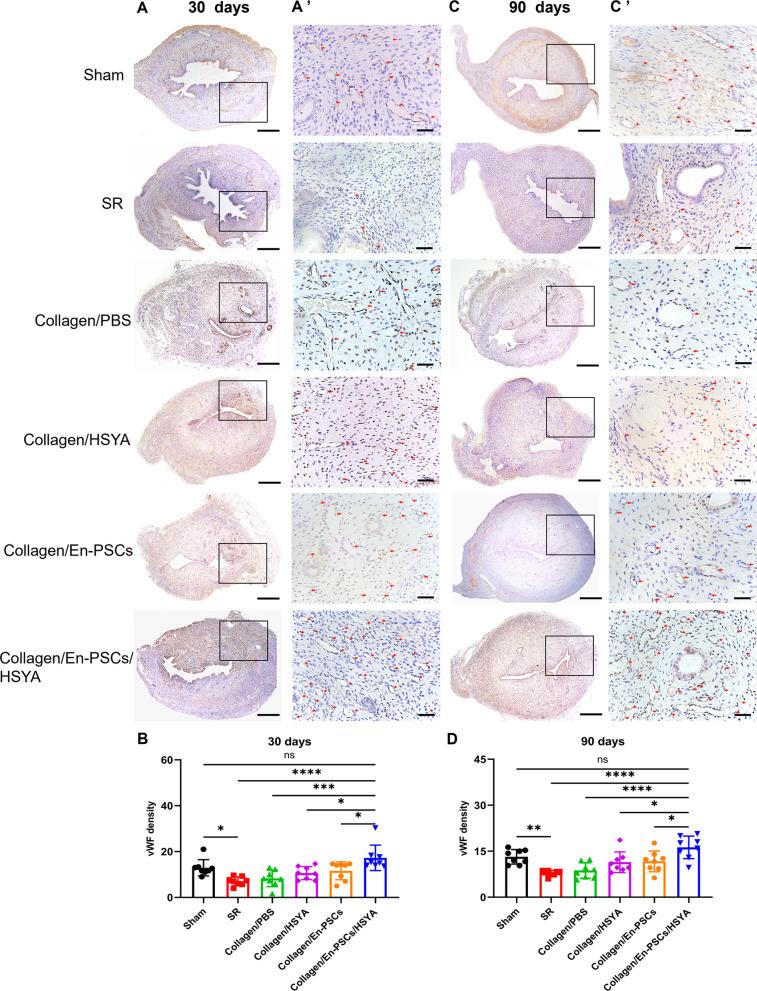
En-PSCs were sorted by flow cytometry, and the effect of HSYA on the proliferation and angiogenesis of the En-PSCs was detected using CCK-8 and tube formation assays. Based on a previously reported rat IUA model, the rat uteri were sham-operated, spontaneously regenerated, or treated with collagen-loaded PBS, collagen-loaded HSYA, collagen-loaded En-PSCs, or collagen-loaded En-PSCs with HSYA, and then collected at both 30 and 90 days postsurgery. HE staining and Masson staining were used to evaluate uterine structure and collagen fibre deposition, and immunohistochemical staining for α-SMA and vWF was used to evaluate myometrial regeneration and neovascularization in each group. A fertility assay was performed to detect the recovery of pregnancy function in each group. RNA-seq was performed to determine the potential mechanism underlying En-PSCs/HSYA treatment. Immunofluorescence, tube formation assays, and Western blot were used to validate the molecular mechanism involved.
RESULTS
The transplantation of Collagen/En-PSCs/HSYA markedly promoted uterine repair in rats with full-thickness injury by reducing fibrosis, increasing endometrial thickness, regenerating myometrium, promoting angiogenesis, and facilitated live births. RNA sequencing results suggested that En-PSCs/HSYA activated the NRG1/ErbB4 signaling pathway. In vitro tube formation experiments revealed that the addition of an ErbB inhibitor diminished the tube formation ability of cocultured En-PSCs and HUVECs. Western blot results further showed that elevated levels of NRG1 and ErbB4 proteins were detected in the Collagen/En-PSCs/HSYA group compared to the Collagen/En-PSCs group. These collective results suggested that the beneficial effects of the transplantation of Collagen/En-PSCs/HSYA might be attributed to the modulation of the NRG1/ErbB4 signaling pathway.
CONCLUSIONS
The combination of En-PSCs/HSYA facilitated morphological and functional repair in rats with full-thickness uterine injury and may promote endometrial angiogenesis by regulating the NRG1/ErbB4 signaling pathway.
背景
宫腔粘连(IUAs)会损害女性的子宫功能,这在临床上是一个巨大的挑战。先前的研究表明,子宫内膜周细胞(En-PSCs)可以改善瘢痕子宫的愈合,而羟基红花黄色素 A(HSYA)可以促进血管生成。本研究旨在观察 En-PSCs 与 HSYA 联合应用是否能改善大鼠全层损伤后的子宫血供和生育能力。
方法
通过流式细胞术分选 En-PSCs,用 CCK-8 和管形成实验检测 HSYA 对 En-PSCs 的增殖和血管生成的影响。基于先前报道的大鼠 IUA 模型,对大鼠子宫进行假手术、自发再生或用胶原负载 PBS、胶原负载 HSYA、胶原负载 En-PSCs 或胶原负载 En-PSCs 加 HSYA 处理,然后分别在术后 30 天和 90 天收集。HE 染色和 Masson 染色用于评估子宫结构和胶原纤维沉积,免疫组织化学染色用于评估各组中平滑肌再生和新生血管形成的α-SMA 和 vWF。进行生育能力检测以检测各组妊娠功能的恢复情况。进行 RNA-seq 以确定 En-PSCs/HSYA 治疗的潜在机制。免疫荧光、管形成实验和 Western blot 用于验证涉及的分子机制。
结果
全层损伤大鼠移植 Collagen/En-PSCs/HSYA 可显著减少纤维化,增加子宫内膜厚度,再生平滑肌,促进血管生成,促进活产,从而促进子宫修复。RNA 测序结果表明,En-PSCs/HSYA 激活了 NRG1/ErbB4 信号通路。体外管形成实验显示,加入 ErbB 抑制剂可削弱共培养的 En-PSCs 和 HUVECs 的管形成能力。Western blot 结果进一步表明,与 Collagen/En-PSCs 组相比,Collagen/En-PSCs/HSYA 组中 NRG1 和 ErbB4 蛋白水平升高。这些综合结果表明,Collagen/En-PSCs/HSYA 移植的有益效果可能归因于 NRG1/ErbB4 信号通路的调节。
结论
En-PSCs/HSYA 联合应用促进了大鼠全层子宫损伤的形态和功能修复,并可能通过调节 NRG1/ErbB4 信号通路促进子宫内膜血管生成。



 Zotero 插件