
更新胰十二指肠切除术后预防性腹腔引流的模式。
Updating the paradigm of prophylactic abdominal drainage following pancreatoduodenectomy.
作者信息
Li Zhenli, Zhang Yibing, Ni Yuanzhi, Li Liang, Xu Lindi, Guo Yang, Zhu Shuaishuai, Tang Yufu
机构信息
Department of Hepatobiliary Surgery, General Hospital of Northern Theater Command.
Department of General Surgery, the 963rd Hospital of the Joint Service Support Force of the PLA, Jiamusi.
出版信息
Int J Surg. 2025 Jan 1;111(1):1083-1089. doi: 10.1097/JS9.0000000000001973.
BACKGROUND
Prophylactic abdominal drainage (PAD) is considered a routine procedure after pancreatoduodenectomy (PD) to prevent and detect severe complications at an early stage. However, the drainage itself may cause adverse consequences. Thus, the optimal strategy of PAD after PD remains controversial.
METHODS
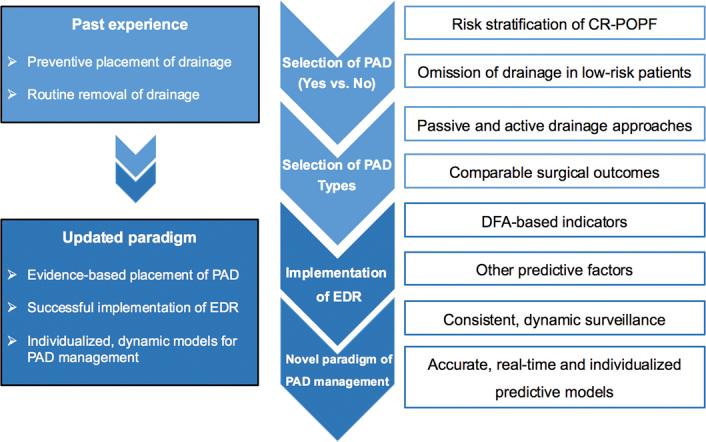
The present paper summarizes the latest research on the strategies of PAD following PD, mainly focusing on 1) the selective placement of PAD, 2) the optimal drainage types, 3) the early removal of drainage (EDR), and 4) novel strategies for PAD management.
RESULTS
Accurate stratifications based on the potential risk factors of clinically relevant-postoperative pancreatic fistula (CR-POPF) facilitates the selective placement of PAD and the implementation of EDR, with postoperative outcomes superior or similar to routine PAD placement. Both active and passive drainage methods are feasible in most patients after PD, with similar prognostic outcomes. Novel predictive models with accurate, dynamic, and individualized performance further guide the management of PAD and afford a better prognosis.
CONCLUSIONS
Evidence-based risk stratification of CR-POPF aids in the management of PAD in patients undergoing PD. Novel dynamic and individualized PAD strategies might be the next hotspot in drain-relevant explorations.
背景
预防性腹腔引流(PAD)被认为是胰十二指肠切除术(PD)后的常规操作,用于早期预防和检测严重并发症。然而,引流本身可能会导致不良后果。因此,PD术后PAD的最佳策略仍存在争议。
方法
本文总结了PD术后PAD策略的最新研究,主要集中在1)PAD的选择性放置,2)最佳引流类型,3)早期拔除引流管(EDR),以及4)PAD管理的新策略。
结果
基于临床相关术后胰瘘(CR-POPF)潜在危险因素的准确分层有助于PAD的选择性放置和EDR的实施,术后结果优于或类似于常规PAD放置。主动和被动引流方法在大多数PD术后患者中都是可行的,预后结果相似。具有准确、动态和个性化性能的新型预测模型进一步指导PAD的管理,并提供更好的预后。
结论
基于证据的CR-POPF风险分层有助于PD患者的PAD管理。新型动态和个性化的PAD策略可能是引流相关探索的下一个热点。
 Zotero 插件