
纤维化间质性肺疾病的病理机制与新型药物靶点
Pathological mechanisms and novel drug targets in fibrotic interstitial lung disease.
作者信息
Nishioka Yasuhiko, Araya Jun, Tanaka Yoshiya, Kumanogoh Atsushi
机构信息
Tokushima University, Tokushima, Japan.
The Jikei University School of Medicine, Tokyo, Japan.
出版信息
Inflamm Regen. 2024 Jul 19;44(1):34. doi: 10.1186/s41232-024-00345-2.
BACKGROUND
Interstitial lung diseases (ILDs) are a diverse group of conditions characterized by inflammation and fibrosis in the lung. In some patients with ILD, a progressive fibrotic phenotype develops, which is associated with an irreversible decline in lung function and a poor prognosis.
MAIN BODY
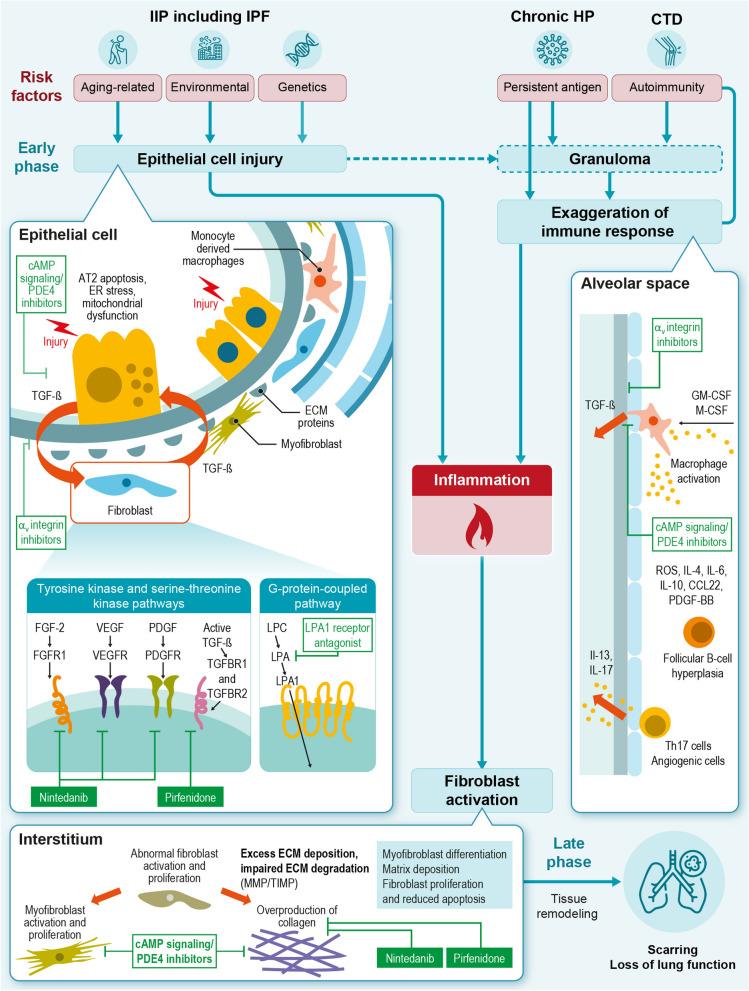
The pathological mechanisms that underlie this process culminate in fibroblast activation, proliferation, and differentiation into myofibroblasts, which deposit extracellular matrix proteins and result in fibrosis. Upstream of fibroblast activation, epithelial cell injury and immune activation are known initiators of fibrosis progression, with multiple diverse cell types involved. Recent years have seen an increase in our understanding of the complex and interrelated processes that drive fibrosis progression in ILD, in part due to the advent of single-cell RNA sequencing technology and integrative multiomics analyses. Novel pathological mechanisms have been identified, which represent new targets for drugs currently in clinical development. These include phosphodiesterase 4 inhibitors and other molecules that act on intracellular cyclic adenosine monophosphate signaling, as well as inhibitors of the autotaxin-lysophosphatidic acid axis and integrins. Here, we review current knowledge and recent developments regarding the pathological mechanisms that underlie progressive fibrotic ILD, including potential therapeutic targets.
CONCLUSION
Knowledge of the pathological mechanisms that drive progressive fibrosis in patients with ILD has expanded, with the role of alveolar endothelial cells, the immune system, and fibroblasts better elucidated. Drugs that target novel mechanisms hold promise for expanding the future therapeutic armamentarium for progressive fibrotic ILD.
背景
间质性肺疾病(ILDs)是一组多样的疾病,其特征为肺部炎症和纤维化。在一些ILD患者中,会出现进行性纤维化表型,这与肺功能不可逆下降及预后不良相关。
主体
这一过程背后的病理机制最终导致成纤维细胞活化、增殖并分化为肌成纤维细胞,后者沉积细胞外基质蛋白并导致纤维化。在成纤维细胞活化的上游,上皮细胞损伤和免疫激活是已知的纤维化进展启动因素,涉及多种不同细胞类型。近年来,我们对驱动ILD纤维化进展的复杂且相互关联的过程的理解有所增加,部分原因是单细胞RNA测序技术和综合多组学分析的出现。已确定了新的病理机制,这些机制代表了目前正在临床开发的药物的新靶点。这些包括磷酸二酯酶4抑制剂和其他作用于细胞内环磷酸腺苷信号传导的分子,以及自分泌运动因子-溶血磷脂酸轴和整合素的抑制剂。在此,我们综述了关于进行性纤维化ILD潜在病理机制的现有知识和最新进展,包括潜在治疗靶点。
结论
对驱动ILD患者进行性纤维化的病理机制的认识有所扩展,肺泡内皮细胞、免疫系统和成纤维细胞的作用得到了更好的阐明。针对新机制的药物有望为未来进行性纤维化ILD的治疗手段增添新的武器。
 Zotero 插件