
一个无抗生素平台,用于消除持续性感染而不破坏肠道微生物群。
An antibiotic-free platform for eliminating persistent infection without disrupting gut microbiota.
作者信息
Lai Yongkang, Zhang Tinglin, Yin Xiaojing, Zhu Chunping, Du Yiqi, Li Zhaoshen, Gao Jie
机构信息
Department of Gastroenterology, Shanghai Changhai Hospital, Naval Medical University, Shanghai 200433, China.
Department of Gastroenterology, Ganzhou People's Hospital Affiliated to Nanchang University, Ganzhou 341000, China.
出版信息
Acta Pharm Sin B. 2024 Jul;14(7):3184-3204. doi: 10.1016/j.apsb.2024.03.014. Epub 2024 Mar 10.
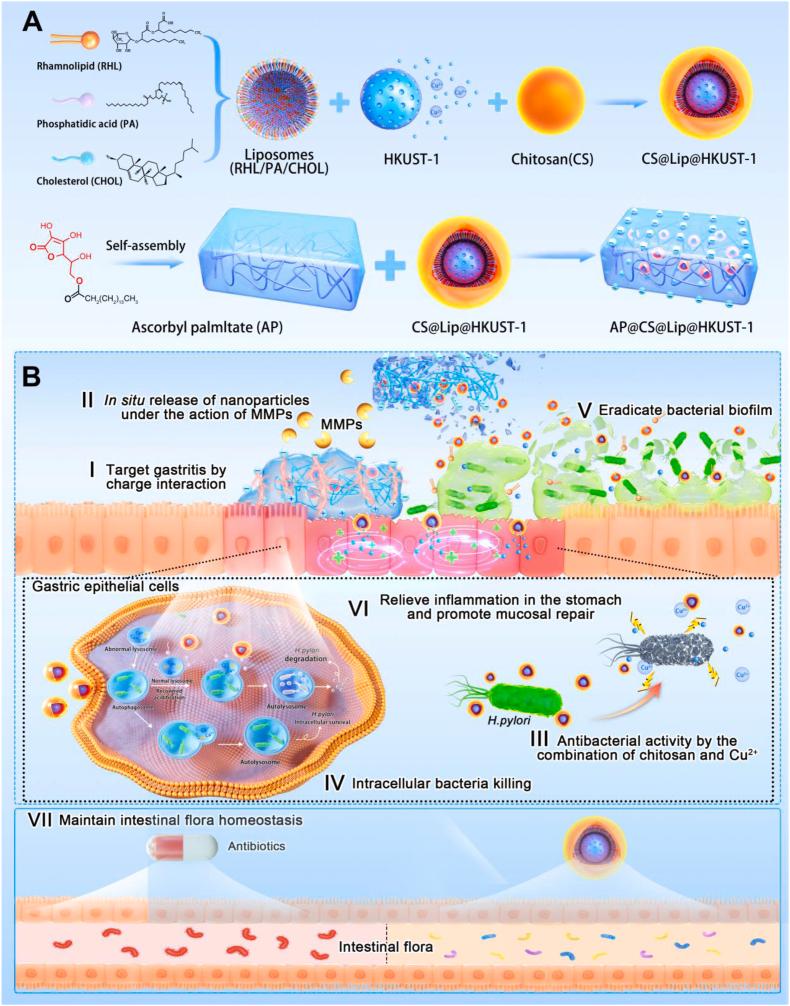
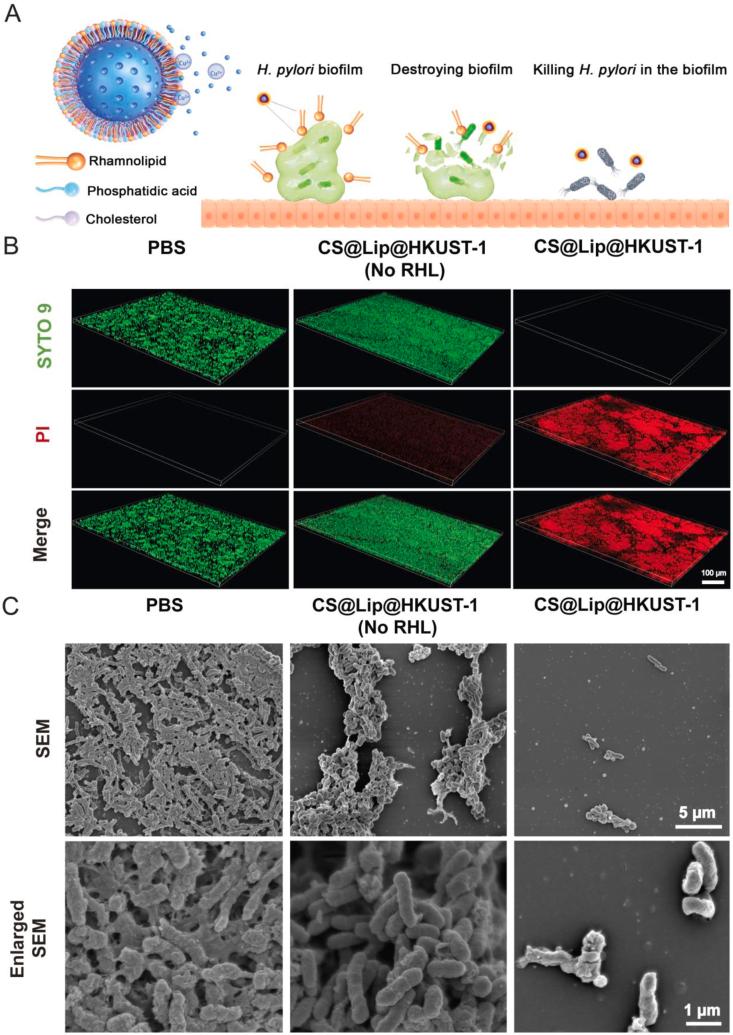
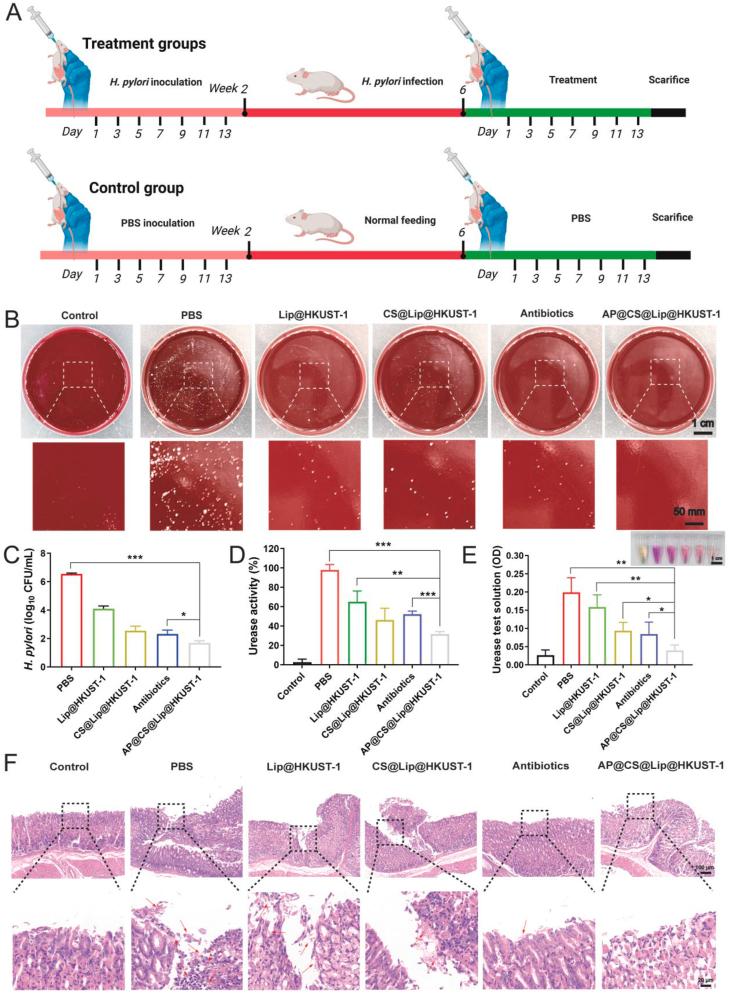
( infection remains the leading cause of gastric adenocarcinoma, and its eradication primarily relies on the prolonged and intensive use of two antibiotics. However, antibiotic resistance has become a compelling health issue, leading to eradication treatment failure worldwide. Additionally, the powerlessness of antibiotics against biofilms, as well as intracellular and the long-term damage of antibiotics to the intestinal microbiota, have also created an urgent demand for antibiotic-free approaches. Herein, we describe an antibiotic-free, multifunctional copper-organic framework (HKUST-1) platform encased in a lipid layer comprising phosphatidic acid (PA), rhamnolipid (RHL), and cholesterol (CHOL), enveloped in chitosan (CS), and loaded in an ascorbyl palmitate (AP) hydrogel: AP@CS@Lip@HKUST-1. This platform targets inflammatory sites where aggregates through electrostatic attraction. Then, hydrolysis by matrix metalloproteinases (MMPs) releases CS-encased nanoparticles, disrupting bacterial urease activity and membrane integrity. Additionally, RHL disperses biofilms, while PA promotes lysosomal acidification and activates host autophagy, enabling clearance of intracellular . Furthermore, AP@CS@Lip@HKUST-1 alleviates inflammation and enhances mucosal repair through delayed Cu release while preserving the intestinal microbiota. Collectively, this platform presents an advanced therapeutic strategy for eradicating persistent infection without inducing drug resistance.
感染仍然是胃腺癌的主要病因,其根除主要依赖于两种抗生素的长期大量使用。然而,抗生素耐药性已成为一个紧迫的健康问题,导致全球范围内根除治疗失败。此外,抗生素对生物膜无效,以及对细胞内细菌无效,且抗生素对肠道微生物群有长期损害,这也迫切需要无抗生素方法。在此,我们描述了一种无抗生素的多功能铜有机框架(HKUST-1)平台,该平台包裹在由磷脂酸(PA)、鼠李糖脂(RHL)和胆固醇(CHOL)组成的脂质层中,再被壳聚糖(CS)包裹,并负载于棕榈酸维生素C酯(AP)水凝胶中:AP@CS@Lip@HKUST-1。该平台靶向炎症部位,通过静电吸引聚集。然后,基质金属蛋白酶(MMPs)水解释放出包裹在CS中的纳米颗粒,破坏细菌脲酶活性和膜完整性。此外,RHL分散生物膜,而PA促进溶酶体酸化并激活宿主自噬,从而清除细胞内细菌。此外,AP@CS@Lip@HKUST-1通过延迟铜释放减轻炎症并增强黏膜修复,同时保护肠道微生物群。总的来说,该平台为根除持续性感染而不诱导耐药性提供了一种先进的治疗策略。






 Zotero 插件