
人类血液代谢物和代谢途径对血清尿酸和痛风的因果影响:一项孟德尔随机研究。
Causal impact of human blood metabolites and metabolic pathways on serum uric acid and gout: a mendelian randomization study.
机构信息
College of Traditional Chinese Medicine, Changchun University of Chinese Medicine, Changchun, China.
College of Integrated Chinese and Western Medicine, Tianjin University of Chinese Medicine, Tianjin, China.
出版信息
Front Endocrinol (Lausanne). 2024 Jul 4;15:1378645. doi: 10.3389/fendo.2024.1378645. eCollection 2024.
OBJECTIVE
Hyperuricaemia and gout are common metabolic disorders. However, the causal relationships between blood metabolites and serum urate levels, as well as gout, remain unclear. A systematic evaluation of the causal connections between blood metabolites, hyperuricemia, and gout could enhance early screening and prevention of hyperuricemia and gout in clinical settings, providing novel insights and approaches for clinical treatment.
METHODS
In this study, we employed a bidirectional two-sample Mendelian randomization analysis utilizing data from a genome-wide association study involving 7,286 participants, encompassing 486 blood metabolites. Serum urate and gout data were sourced from the Chronic Kidney Disease Genetics consortium, including 288,649 participants for serum urate and 9,819 African American and 753,994 European individuals for gout. Initially, LDSC methodology was applied to identify blood metabolites with a genetic relationship to serum urate and gout. Subsequently, inverse-variance weighting was employed as the primary analysis method, with a series of sensitivity and pleiotropy analyses conducted to assess the robustness of the results.
RESULTS
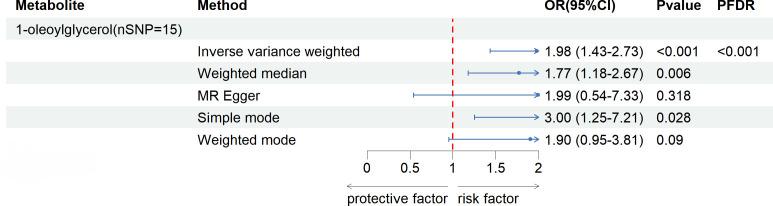
Following LDSC, 133 blood metabolites exhibited a potential genetic relationship with serum urate and gout. In the primary Mendelian randomization analysis using inverse-variance weighting, 19 blood metabolites were recognized as potentially influencing serum urate levels and gout. Subsequently, the IVW p-values of potential metabolites were corrected using the false discovery rate method. We find leucine (IVW P = 0.00004), N-acetylornithine (IVW P = 0.0295), N1-methyl-3-pyridone-4-carboxamide (IVW P = 0.0295), and succinyl carnitine (IVW P = 0.00004) were identified as significant risk factors for elevated serum urate levels. Additionally, 1-oleoylglycerol (IVW P = 0.0007) may lead to a substantial increase in the risk of gout. Succinyl carnitine exhibited acceptable weak heterogeneity, and the results for other blood metabolites remained robust after sensitivity, heterogeneity, and pleiotropy testing. We conducted an enrichment analysis on potential blood metabolites, followed by a metabolic pathway analysis revealing four pathways associated with serum urate levels.
CONCLUSION
The identified causal relationships between these metabolites and serum urate and gout offer a novel perspective, providing new mechanistic insights into serum urate levels and gout.
目的
高尿酸血症和痛风是常见的代谢紊乱疾病。然而,血液代谢物与血清尿酸水平以及痛风之间的因果关系尚不清楚。系统评估血液代谢物、高尿酸血症和痛风之间的因果关系,可以提高临床环境中高尿酸血症和痛风的早期筛查和预防水平,为临床治疗提供新的思路和方法。
方法
本研究采用双向两样本 Mendelian 随机化分析,利用涉及 7286 名参与者的全基因组关联研究数据,其中包含 486 种血液代谢物。血清尿酸和痛风数据来源于慢性肾脏病遗传学联盟,其中 288649 名参与者用于血清尿酸数据,9819 名非裔美国人和 753994 名欧洲人用于痛风数据。首先,使用 LDSC 方法识别与血清尿酸和痛风具有遗传关系的血液代谢物。然后,采用逆方差加权法作为主要分析方法,同时进行一系列敏感性和多效性分析,以评估结果的稳健性。
结果
经过 LDSC 分析,有 133 种血液代谢物与血清尿酸和痛风具有潜在的遗传关系。在使用逆方差加权法的主要 Mendelian 随机化分析中,有 19 种血液代谢物被认为可能影响血清尿酸水平和痛风。随后,使用错误发现率方法对潜在代谢物的 IVW p 值进行了校正。我们发现亮氨酸(IVW P = 0.00004)、N-乙酰鸟氨酸(IVW P = 0.0295)、N1-甲基-3-吡啶酮-4-甲酰胺(IVW P = 0.0295)和琥珀酰肉碱(IVW P = 0.00004)是血清尿酸水平升高的显著危险因素。此外,1-油酰甘油(IVW P = 0.0007)可能会显著增加痛风的发病风险。琥珀酰肉碱的异质性较小,其他血液代谢物的结果在进行敏感性、异质性和多效性测试后仍然稳健。我们对潜在的血液代谢物进行了富集分析,并进行了代谢途径分析,结果显示与血清尿酸水平相关的四条代谢途径。
结论
这些代谢物与血清尿酸和痛风之间的因果关系为我们提供了一个新的视角,为血清尿酸水平和痛风的发病机制提供了新的见解。




 Zotero 插件