
囊性纤维化患者的锌状态;一项系统评价与荟萃分析。
Zinc status in cystic fibrosis patients; a systematic review and meta-analysis.
作者信息
Malekahmadi Mahsa, Soltani Sepideh, Pahlavani Naseh, Sharifi Zahabi Elham, Kazemizadeh Hossein, Hadavi Shima, Farsani Gholamreza Mohammadi
机构信息
Imam Khomaini hospital complex, Tehran University of Medical Sciences, Tehran, Iran.
Yazd Cardiovascular Research Center, Non-communicable Diseases Research Institute, Shahid Sadoughi University of Medical Sciences, Yazd, Iran.
出版信息
Heliyon. 2024 Jun 28;10(13):e33686. doi: 10.1016/j.heliyon.2024.e33686. eCollection 2024 Jul 15.
BACKGROUND
Cystic fibrosis (CF) is an autosomal recessive hereditary disease causes concentration of secretions and this affects the lungs and digestive system. These patients are exposed to zinc (zn) deficiency. In this review, we decided to investigate the status of zn in CF patients compared to control group. Also, the clinical trials that have so far performed zinc supplementation in these patients are examined.
METHOD
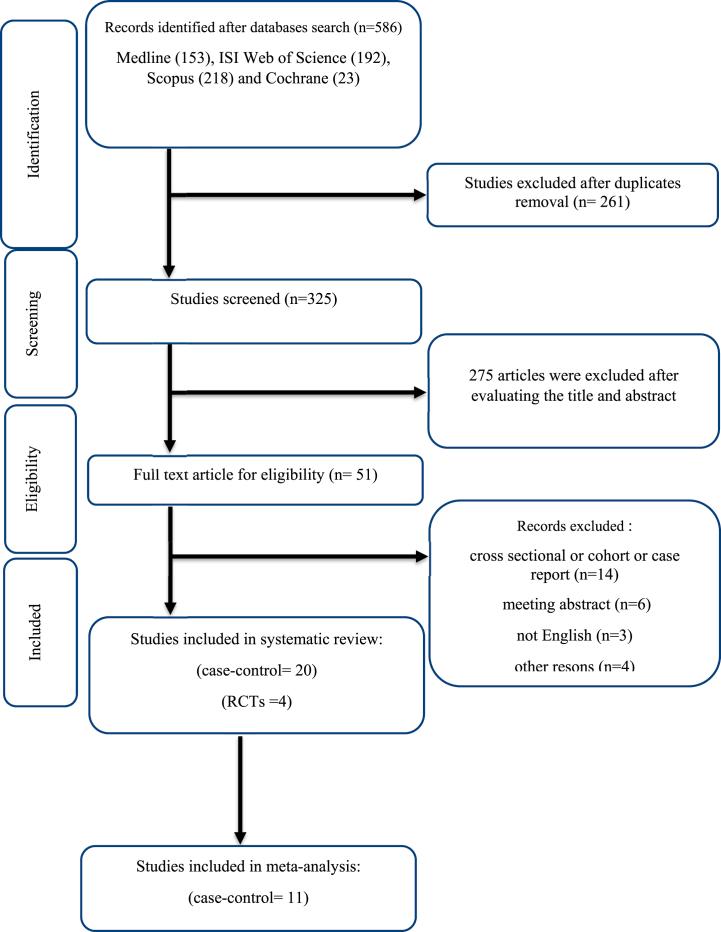
ISI Web of Science, Scopus, PubMed/Medline, and Cochrane database were searched, up to December 2023, for studies that reported the association between zn levels of CF patients compared to a healthy control group. A random-effect model was used to compute the pooled weighted mean difference (WMD) with 95 % confidence intervals (CI). Subgroup analysis was done for region, sample and method of measurement, zinc supplementation and age.
RESULT
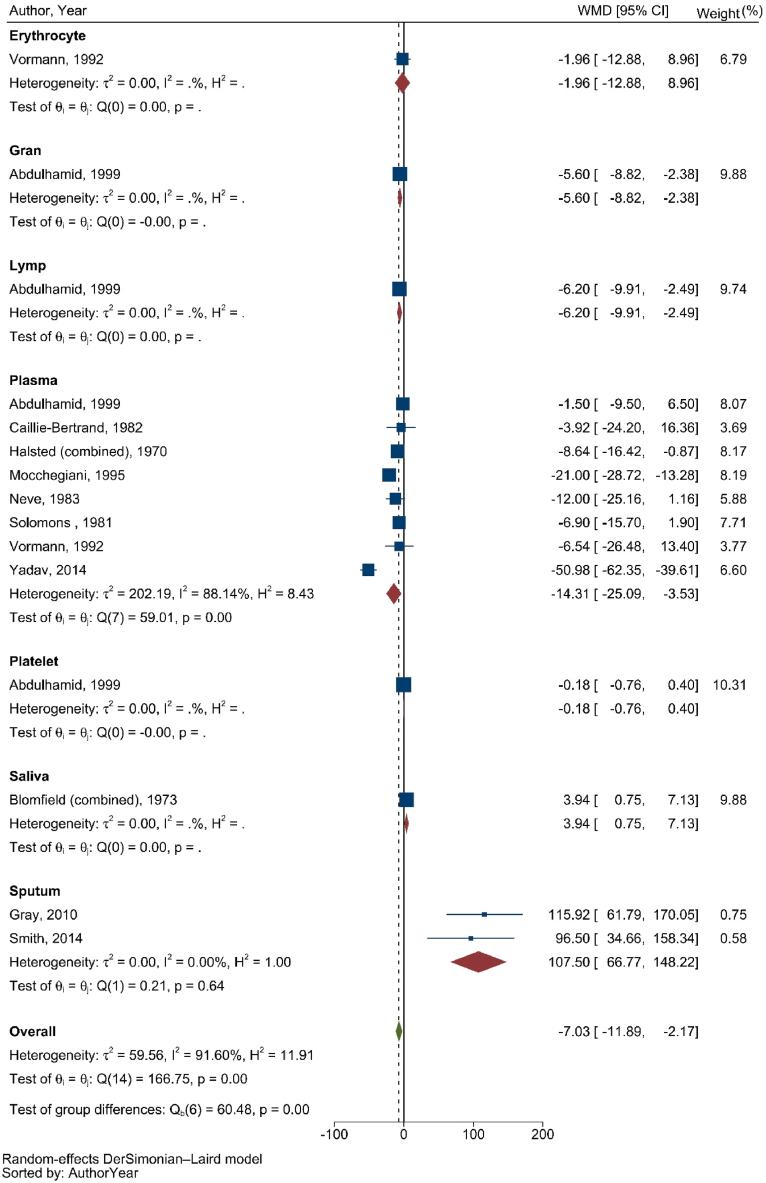
Overall, meta-analysis of 9 studies (n = 383 participants) revealed that the zn levels were significantly lower in children and adolescents with CF compared with healthy subjects (WMD = -11.97 μg/dL, 95 % CI: -22.57 to -1.37; I = 92.83 %). Meta-analysis of 8 studies (n = 320 participants) revealed that the serum and plasma level of zn was significantly lower in CF patients compared with healthy subjects (WMD = -14.31 μg/dL, 95 % CI: -25.09 to -3.53; I = 88.14 %, P-heterogeneity <0.001) While the zn level in saliva and sputum was significantly higher in CF patients.
CONCLUSION
CF patients have decreased zn levels in circulatory reservoirs. zn may effective for the diminish the respiratory and gastrointestinal symptoms in CF patients, further well-designed clinical trial studies is required to prove these effects.
背景
囊性纤维化(CF)是一种常染色体隐性遗传性疾病,可导致分泌物浓缩,影响肺部和消化系统。这些患者易出现锌(Zn)缺乏。在本综述中,我们决定研究CF患者与对照组相比的锌状态。此外,还对目前在这些患者中进行锌补充的临床试验进行了审查。
方法
截至2023年12月,在科学网(ISI Web of Science)、Scopus、PubMed/Medline和Cochrane数据库中检索报告CF患者与健康对照组锌水平之间关联的研究。采用随机效应模型计算合并加权平均差(WMD)及95%置信区间(CI)。对地区、样本和测量方法、锌补充和年龄进行亚组分析。
结果
总体而言,对9项研究(n = 383名参与者)的荟萃分析显示,与健康受试者相比,CF儿童和青少年的锌水平显著降低(WMD = -11.97μg/dL,95%CI:-22.57至-1.37;I = 92.83%)。对8项研究(n = 320名参与者)的荟萃分析显示,与健康受试者相比,CF患者的血清和血浆锌水平显著降低(WMD = -14.31μg/dL,95%CI:-25.09至-3.53;I = 88.14%,P异质性<0.001),而CF患者唾液和痰液中的锌水平显著升高。
结论
CF患者循环储库中的锌水平降低。锌可能对减轻CF患者的呼吸道和胃肠道症状有效,需要进一步设计良好的临床试验研究来证实这些效果。

 Zotero 插件