
白杨素和/或伞形酮对丙烯酰胺诱导的大鼠急性肾损伤的肾保护作用:NLRP3炎性小体和Nrf-2/HO-1信号通路的作用
Renoprotective effects of apocynin and/or umbelliferone against acrylamide-induced acute kidney injury in rats: role of the NLRP3 inflammasome and Nrf-2/HO-1 signaling pathways.
作者信息
Ageena Saad A, Bakr Adel G, Mokhlis Hamada A, Abd-Ellah Mohamed F
机构信息
Department of Pharmacology & Toxicology, Faculty of Pharmacy, Al Azhar University, Assiut Branch, Assiut, 71524, Egypt.
Department of Pharmacology & Toxicology, Faculty of Pharmacy (Boys), Al-Azhar University, Cairo, Egypt.
出版信息
Naunyn Schmiedebergs Arch Pharmacol. 2025 Jan;398(1):569-580. doi: 10.1007/s00210-024-03271-9. Epub 2024 Jul 19.
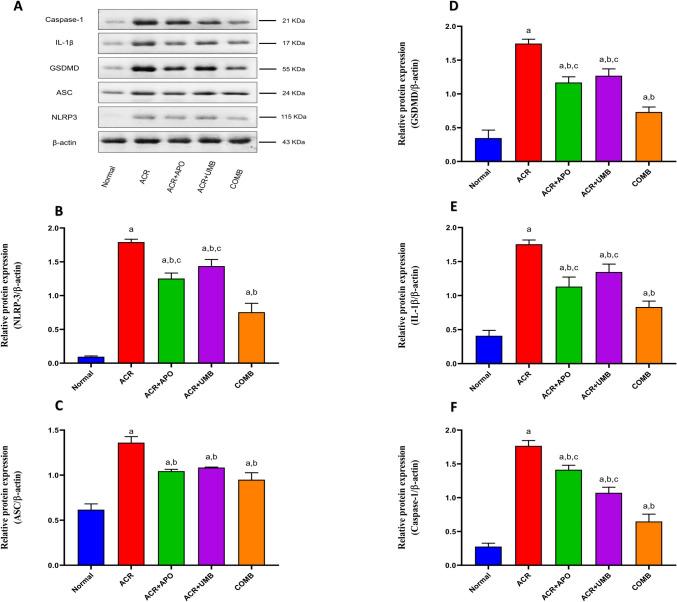
Acrylamide (ACR) is a toxic, probably carcinogenic compound commonly found in fried foods and used in the production of many industrial consumer products. ACR-induced acute kidney injury is mediated through several signals. In this research, we investigated, for the first time, the therapeutic effects of phytochemicals apocynin (APO) and/or umbelliferone (UMB) against ACR-induced nephrotoxicity in rats and emphasized the underlying molecular mechanism. To achieve this goal, five groups of rats were randomly assigned: the control group received vehicle (0.5% CMC; 1 ml/rat), ACR (40 mg/kg, i.p.), ACR + APO (100 mg/kg, P.O.), ACR + UMB (50 mg/kg, P.O.), and combination group for 10 days. In ACR-intoxicated rats, there was a significant reduction in weight gain while the levels of blood urea, uric acid, creatinine, and Kim-1 were elevated, indicating renal injury. Histopathological injury was also observed in the kidneys of ACR-intoxicated rats, confirming the biochemical data. Moreover, MDA, TNF-α, and IL-1β levels were raised; and GSH and SOD levels were decreased. In contrast, treatment with APO, UMB, and their combination significantly reduced the kidney function biomarkers, prevented tissue damage, and decreased inflammatory cytokines and MDA. Mechanistically, it suppressed the expression of NLRP-3, ASC, GSDMD, caspase-1, and IL-1β, while it upregulated Nrf-2 and HO-1 in the kidneys of ACR-intoxicated rats. In conclusion, APO, UMB, and their combination prevented ACR-induced nephrotoxicity in rats by attenuating oxidative injury and inflammation, suppressing NLRP-3 inflammasome signaling, enhancing antioxidants, and upregulating Nrf-2 and HO-1 in the kidneys of ACR-induced rats.
丙烯酰胺(ACR)是一种有毒且可能致癌的化合物,常见于油炸食品中,并用于许多工业消费品的生产。ACR诱导的急性肾损伤是通过多种信号介导的。在本研究中,我们首次研究了植物化学物质阿朴吗啡(APO)和/或伞形酮(UMB)对ACR诱导的大鼠肾毒性的治疗作用,并强调了其潜在的分子机制。为实现这一目标,将五组大鼠随机分组:对照组给予赋形剂(0.5%羧甲基纤维素;1 ml/只大鼠),ACR组(40 mg/kg,腹腔注射),ACR + APO组(100 mg/kg,口服),ACR + UMB组(50 mg/kg,口服),以及联合用药组,持续给药10天。在ACR中毒的大鼠中,体重增加显著减少,而血尿素、尿酸、肌酐和Kim-1水平升高,表明存在肾损伤。在ACR中毒大鼠的肾脏中也观察到了组织病理学损伤,证实了生化数据。此外,丙二醛(MDA)、肿瘤坏死因子-α(TNF-α)和白细胞介素-1β(IL-1β)水平升高;谷胱甘肽(GSH)和超氧化物歧化酶(SOD)水平降低。相比之下,APO、UMB及其联合用药显著降低了肾功能生物标志物水平,预防了组织损伤,并降低了炎性细胞因子和MDA水平。机制上,它抑制了NLRP-3、凋亡相关斑点样蛋白(ASC)、gasdermin D(GSDMD)、半胱天冬酶-1(caspase-1)和IL-1β的表达,同时上调了ACR中毒大鼠肾脏中核因子E2相关因子2(Nrf-2)和血红素加氧酶-1(HO-1)的表达。总之,APO、UMB及其联合用药通过减轻氧化损伤和炎症、抑制NLRP-3炎性小体信号传导、增强抗氧化剂以及上调ACR诱导大鼠肾脏中的Nrf-2和HO-1,预防了ACR诱导的大鼠肾毒性。


 Zotero 插件