
描述并分子特征鉴定了一种新的血孢子虫物种——大熊猫巴贝斯虫,该虫感染大熊猫。
Description and molecular characterisation of Babesia ailuropodae n. sp., a new piroplasmid species infecting giant pandas.
机构信息
Sichuan Agricultural University, Sichuan, China.
出版信息
Parasit Vectors. 2024 Jul 20;17(1):315. doi: 10.1186/s13071-024-06402-6.
BACKGROUND
Babesia spp. are protozoan parasites that infect the red blood cells of domesticated animals, wildlife and humans. A few cases of giant pandas (a flagship species in terms of wildlife conservation) infected with a putative novel Babesia sp. have been reported. However, comprehensive research on the morphological and molecular taxonomic classification of this novel Babesia sp. is still lacking. This study was designed to close this gap and formally describe this new Babesia sp. infecting giant pandas.
METHODS
Detailed morphological, molecular and phylogenetic analyses were conducted to characterise this Babesia sp. and to assess its systematic relationships with other Babesia spp. Blood samples from giant pandas infected with Babesia were subjected to microscopic examination. The 18S ribosomal RNA (18S rRNA), cytochrome b (cytb) and mitochondrial genome (mitogenome) of the new Babesia sp. were amplified, sequenced and assembled using DNA purified from blood samples taken from infected giant pandas. Based on the newly generated 18S rRNA, cytb and mitogenome sequences, phylogenetic trees were constructed.
RESULTS
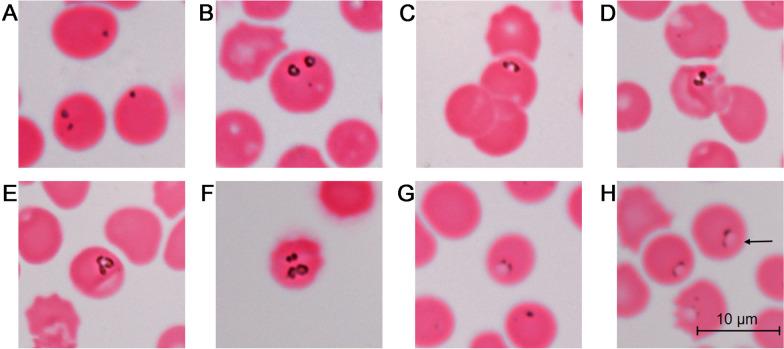
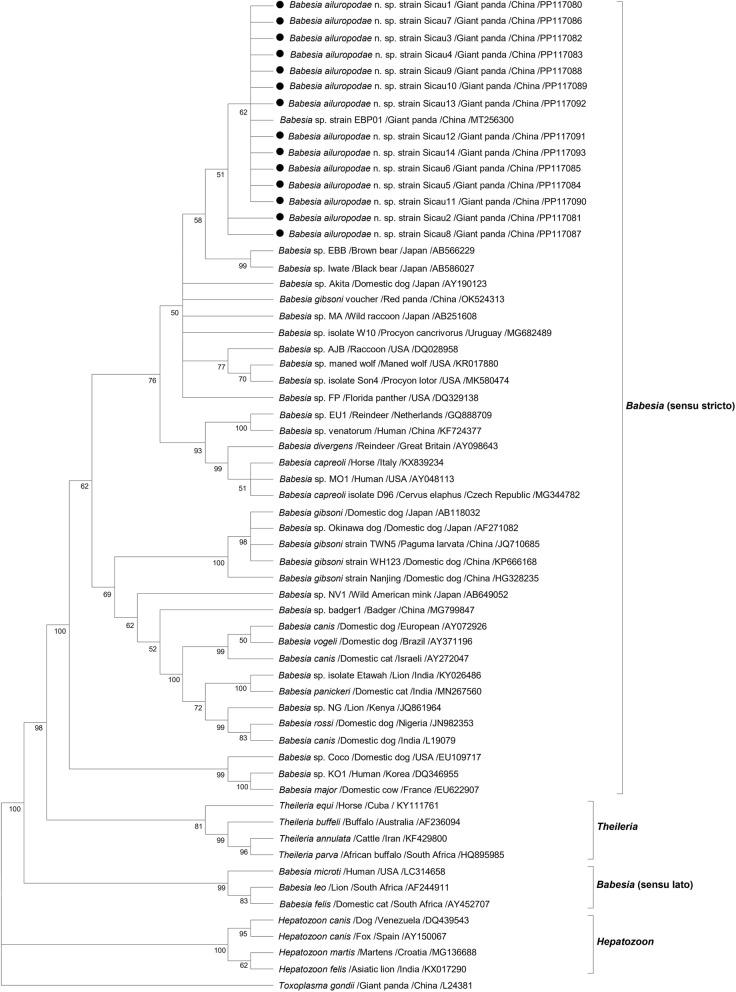
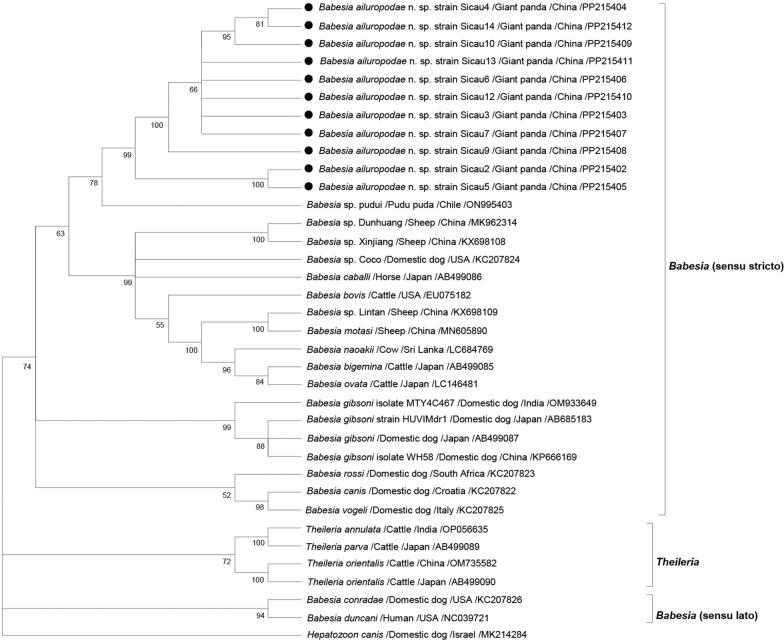
Morphologically, the Babesia sp. from giant pandas exhibited various forms, including round to oval ring-shaped morphologies, resembling those found in other small canine Babesia spp. and displaying typical tetrads. Phylogenetic analyses with the 18S rRNA, cytb and mitogenome sequences revealed that the new Babesia sp. forms a monophyletic group, with a close phylogenetic relationship with the Babesia spp. that infect bears (Ursidae), raccoons (Procyonidae) and canids (Canidae). Notably, the mitogenome structure consisted of six ribosomal large subunit-coding genes (LSU1-6) and three protein-coding genes (cytb, cox3 and cox1) arranged linearly.
CONCLUSIONS
Based on coupled morphological and genetic analyses, we describe a novel species of the genus Babesia, namely, Babesia ailuropodae n. sp., which infects giant pandas.
背景
巴贝虫属是一种原生动物寄生虫,感染家养动物、野生动物和人类的红细胞。有几例大熊猫(野生动物保护的旗舰物种)感染一种假定的新型巴贝虫的病例报告。然而,对这种新型巴贝虫的形态学和分子分类学研究仍缺乏全面的研究。本研究旨在填补这一空白,并正式描述感染大熊猫的这种新型巴贝虫。
方法
详细的形态学、分子和系统发育分析用于描述这种巴贝虫,并评估其与其他巴贝虫属的系统关系。从感染巴贝虫的大熊猫血液样本中进行显微镜检查。从感染大熊猫血液中提取的 DNA 扩增、测序和组装新的巴贝虫 18S 核糖体 RNA(18S rRNA)、细胞色素 b(cytb)和线粒体基因组(mitogenome)。基于新生成的 18S rRNA、cytb 和 mitogenome 序列构建系统发育树。
结果
形态学上,来自大熊猫的巴贝虫表现出各种形态,包括圆形到椭圆形的环状形态,类似于其他小型犬巴贝虫属和表现出典型的四联体。18S rRNA、cytb 和 mitogenome 序列的系统发育分析表明,新的巴贝虫属形成一个单系群,与感染熊(熊科)、浣熊(浣熊科)和犬科(犬科)的巴贝虫属密切相关。值得注意的是,线粒体基因组结构由六个核糖体大亚基编码基因(LSU1-6)和三个蛋白质编码基因(cytb、cox3 和 cox1)线性排列组成。
结论
基于形态学和遗传学分析,我们描述了一种新型的巴贝虫属,即大熊猫巴贝虫,感染大熊猫。


 Zotero 插件